
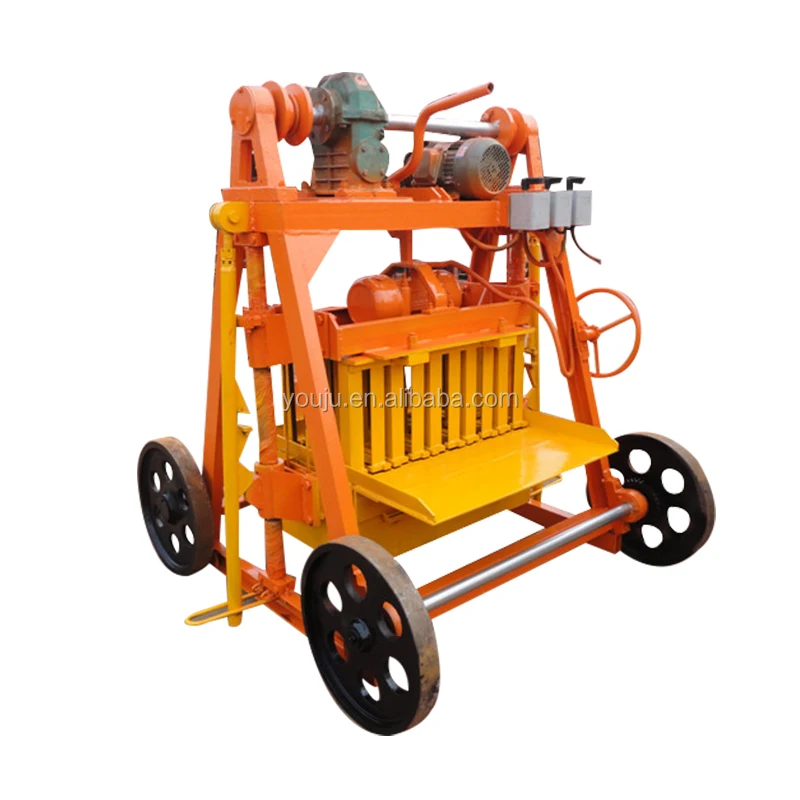
Matched System Design — The QMJ4-45 mobile egg laying block making machine is specified alongside its mixer, feeder and curing layout so cycle times align and the press never idles waiting for material.
Technical Specifications
| Parameter | Value |
|---|---|
| Model | QMJ4-45 |
| Product Type | Mobile Egg Laying Block Making Machine |
| Molding Capacity | 4 pcs/mould (basis: 400×200×200mm hollow block) |
| Molding Cycle | 40–45 s |
| Vibration Frequency | 2400 r/m |
| Vibration Method | Mold vibration |
| Productivity (Hollow Block 400×200×200mm) | 3000 pcs/day (8 hours) |
| Productivity (Hollow Block 400×150×200mm) | 3500 pcs/day (8 hours) |
| Productivity (Hollow Block 400×120×200mm) | 4500 pcs/day (8 hours) |
| Daily Productivity | 2600–4000 pcs/day (basis not stated in source — confirm block format / material / thickness) |
| Demold Method | Manual |
| Turning Method | Manual |
| Total Power | 6 kW |
| Power Source | Diesel / Petrol engine |
| Automation Level | Manual / egg-laying (no fixed plant required) |
| Pallet Requirement | None required for egg-laying operation |
Application Suitability
| Application | Material or Output |
|---|---|
| On-site hollow block production at building sites | Crushed stone, sand, cement, water |
| First block plant for entrepreneurs with limited capital | Local aggregate blends without grid power dependency |
| Housing project contractors producing locally | Hollow blocks in 400×200×200, 400×150×200 and 400×120×200mm formats |
| Remote or off-grid construction zones | Engine-powered operation on diesel or petrol |
What "Daily Capacity" Actually Means on a Job Site
A capacity figure without its block format is not a capacity figure at all.
I have watched contractors order a mobile egg laying block making machine production line based on a single headline number, only to find their real output drops sharply when they switch from a thin-wall block to the thicker format their market demands. The QMJ4-45 produces 3000 pieces per day on a 400×200×200mm hollow block in an eight-hour shift, yet that same machine reaches 4500 pieces per day on the 400×120×200mm format. The difference is not marketing — it is physics. Thinner blocks fill faster, vibrate shorter, and release sooner. When a supplier quotes one number without stating which format it assumes, the buyer is left guessing [NEED_CITE: block format impact on cycle time in egg-laying machines]. The QMJ4-45 documentation states the format behind every productivity figure so the buyer can plan against their actual product mix.
How the Line Feeds the Press
A mobile egg laying block making machine production line is only as productive as the slowest station before the press. The QMJ4-45 completes a molding cycle in 40 to 45 seconds, which means the mixer must deliver a fresh batch within that window or the machine stands empty. Raw material feeding, mixing ratios and water dosing all need to match this tempo. When the mixer undershoots, the operator waits; when it overshoots, the mix begins to set in the wheelbarrow. Matching the mixer drum capacity and discharge rate to the QMJ4-45 cycle is where line-level output is won or lost.
Engine Power and the Grid Question
Many job sites in remote development zones have no reliable three-phase supply, which is why the QMJ4-45 runs on a diesel or petrol engine rather than an electric motor alone. This removes the need for a generator large enough to handle starting surge current and eliminates the voltage-drop problems that burn out contactors on long cable runs [NEED_CITE: voltage drop effects on motor-driven construction equipment]. The 6 kW total power rating stays within the reach of a small engine, keeping fuel consumption predictable across a shift. For buyers who do have grid access, the engine can be swapped for an electric motor during configuration.
Reading the Specs That Matter
Vibration frequency at 2400 r/m acts on the mold directly rather than through the frame, concentrating compaction force where the concrete mix sits. Higher mold vibration improves particle packing in the block walls, which translates to better compressive strength after curing. The four-block-per-mold capacity on the standard 400×200×200mm hollow block sets the baseline throughput, while the 40–45 second cycle time determines how many of those four-block sets an operator can complete in a shift. Demolding and turning are both manual, which keeps the machine mechanically simple but means the operator pace directly influences daily output.
The Cost of Skipping Line-Level Planning
Buyers who treat the press as a standalone purchase often discover that curing area, block transport and raw material staging were never discussed. A mobile egg laying block making machine production line that lays blocks directly on the ground still needs a flat, cured concrete floor, adequate drainage and enough space for the blocks to remain undisturbed during initial set. When curing space is too small, blocks are moved too early and corner damage rises noticeably [NEED_CITE: early handling damage rates in mobile block production]. These hidden costs do not appear on the machine invoice but they show up in the reject pile every day.
Why Buyers Source This Line Here
Block machinery is the single focus of this workshop, so the QMJ4-45 is never shipped as a bare press with the rest of the line left to chance. The mixer, feeder and curing rack layout are specified against the buyer’s local aggregate and target block format before production begins. Molds are designed and manufactured in-house, including custom drawings when the buyer’s market sells a format outside the standard range. Automation level starts manual, so the buyer can invest in the egg-laying press now and add stationary pallet handling later. Installation support includes operator training on the actual mix the buyer will run.
Documentation & Verification
- Line layout showing raw material flow, mixer position and curing area sized to QMJ4-45 output
- Capacity calculation sheet stating the block format behind each daily productivity figure
- Mold drawing and format list confirming the hollow block dimensions supplied
- Engine or motor specification with power source confirmation before dispatch
- Factory test record run on the buyer’s confirmed block format
- Operation and maintenance manual with wear parts and mold replacement list
Installation, Commissioning & Support
- Flat concrete floor with minimum area calculated from QMJ4-45 daily output and curing time
- Diesel or petrol engine tuned on site to match local fuel grade and altitude
- Manual demold and turning mechanism demonstrated with the buyer’s own mix design
- Molding cycle timed at 40–45 seconds against the specified hollow block format
- Mixer and feeder positioned to deliver fresh mix within each QMJ4-45 cycle window
- Wear parts list supplied with first-order spares matched to mold and vibration components
Preparing Your Inquiry
To configure the QMJ4-45 as the centre of a working mobile egg laying block making machine production line, share the hollow block formats your market actually buys, the daily volume you need to sustain, and the local aggregate and cement type you plan to use. Confirm whether your site has grid power or if engine operation is required. If you already own a mixer or curing racks, provide their specifications so the line can be matched around them.
Frequently Asked Questions
Q: How is daily capacity verified and what block format does each figure assume?
A: Every QMJ4-45 productivity figure is tied to a specific hollow block size. The machine produces 3000 pieces per day on 400×200×200mm, 3500 on 400×150×200mm, and 4500 on 400×120×200mm, all based on an eight-hour shift. The capacity calculation document provided with each line states the format assumed, so buyers can plan against their actual product range rather than a single headline number.
Q: What supporting equipment is needed to keep the press running without idle time?
A: The QMJ4-45 completes a cycle every 40 to 45 seconds, so a mixer with matching drum capacity and discharge rate is essential. Raw material feeding must be positioned close enough to avoid transport delays. A flat curing area sized to hold one full day of output is also required, since egg-laying blocks remain on the ground during initial set.
Q: Can the line start with the QMJ4-45 and later expand to a stationary plant?
A: Yes. The QMJ4-45 operates as a manual egg-laying press, which keeps initial investment low. When production volume grows, the buyer can transition to a stationary configuration with pallet handling, automatic stacking and curing rack systems. The mold formats and mix design work established on the QMJ4-45 carry over, reducing the learning curve on the larger line.
Q: What raw material mix and local aggregate does the machine assume?
A: The QMJ4-45 is configured against the buyer’s actual aggregate source and cement type, not a generic catalog mix. Vibration frequency and cycle time are adjusted during commissioning to match local sand, crushed stone and water characteristics. Buyers are asked to send material samples before final configuration so the press delivers consistent block strength with locally available inputs.


