
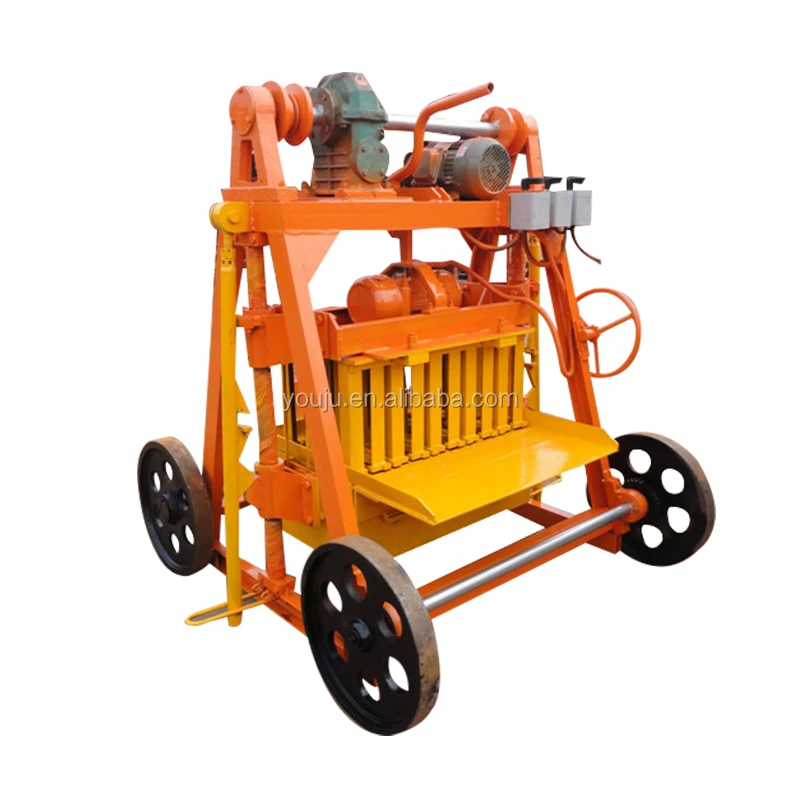
Line-Focused Sizing — every station from mixer to curing area is scaled around the 45-second press cycle so the operator never waits for the next batch.
Technical Specifications
| Parameter | Value |
|---|---|
| Model | QMJ4-45 |
| Product Type | Mobile Egg Laying Block Making Machine |
| Molding Capacity | 4 pcs/mould (400×200×200mm hollow block) |
| Molding Cycle | 45 s |
| Vibration Frequency | 2400 r/m |
| Vibration Method | Mold vibration |
| Total Power | 6 kW |
| Power Source | Diesel / Petrol engine |
| Demold Method | Manual |
| Turning Method | Manual |
| Pallet Requirement | None (egg-laying, blocks laid on ground) |
| Productivity | 3000 pcs/day on 400×200×200mm, 3500 pcs/day on 400×150×200mm, 4500 pcs/day on 400×120×200mm (8-hour shift) |
| Control System | Manual operation |
Application Suitability
| Application | Material or Output |
|---|---|
| On-site hollow block production at building projects | Crushed stone, sand, cement and water mixed locally |
| Remote housing developments without grid power | Diesel-driven operation on prepared ground surfaces |
| Small-scale block enterprises with minimal capital | Hollow blocks from 120mm to 200mm width without pallet investment |
| Contractor-run production for single-project supply | Site-sourced aggregate matched to local block standards |
Why "3000 Blocks a Day" Means Nothing Without the Mixer Spec
A mobile block machine production line is only as fast as the slowest station feeding it.
I shipped a QMJ4-45 to a contractor who expected steady output from day one. The press cycled fine at 45 seconds, but his pan mixer took three minutes per batch. The operator stood idle for two-thirds of every shift, and daily output never reached half the quoted figure. The press was never the bottleneck — the material flow was [NEED_CITE: typical mixer-to-press feed rate mismatch in small block plants]. When buyers evaluate a mobile block machine production line, they often focus on the press cycle and overlook how raw material mixing, water supply and concrete delivery to the hopper must all land within that same 45-second window.
Matching Mixer Output to the 45-Second Press Cycle
The QMJ4-45 completes a mould every 45 seconds, which means the mixer must deliver a fresh batch of concrete to the hopper at least every two cycles to avoid any pause. A single-shaft or pan mixer with a batch capacity roughly double the mould volume keeps material flowing without the operator scraping the hopper waiting for the next mix. Planning the mobile block machine production line around this rhythm ensures the engine hours translate directly into blocks on the ground.
Ground Preparation and Curing Area Layout
Blocks are laid directly on a flat, level surface in continuous rows, so the curing footprint grows with every hour of production. A site producing at the rate of 400×200×200mm blocks across an eight-hour shift will cover a substantial ground area that must remain undisturbed for at least 24 hours before blocks can be moved [NEED_CITE: standard curing time for cement hollow blocks in ambient conditions]. Grading the ground, marking row lanes and planning a watering schedule are part of the line, not an afterthought.
Reading the Specs That Actually Shape Output
The 2400 r/m vibration frequency acts on the mould itself rather than the table, compacting concrete around the core pins to produce hollow blocks with consistent wall density. Total power at 6 kW is split between vibration and the mechanical systems that raise and lower the mould box — a modest draw that a small diesel engine covers without needing a generator set. The manual demold and manual turning mean one operator controls the full cycle, keeping labour requirements low but making operator rhythm the main variable in daily throughput. Mould vibration as a method suits the egg-laying design because the block must hold its shape the moment the mould lifts away [NEED_CITE: mould vibration versus table vibration in egg-laying block machines].
When Material Flow Planning Gets Skipped
A buyer who orders the press alone and sources a mixer locally often discovers that the hopper opening, mix consistency and delivery distance were never checked against the cycle time. The result is an operator who finishes a mould, waits, then rushes to keep up — producing blocks with uneven fill and inconsistent wall thickness. The mobile block machine production line underperforms not because the press is wrong, but because the surrounding stations were never sized as a system [NEED_CITE: common causes of block density variation in manual mobile operations].
Why Sizing the Line Here Changes the Outcome
Every QMJ4-45 that leaves the factory is matched with a mixer capacity recommendation based on the buyer’s target block format and shift length, not a generic catalogue pairing. Mould options cover the three hollow block sizes listed above, with custom mould design available when the buyer’s market demands dimensions outside that range. The diesel or petrol engine choice is confirmed against the buyer’s fuel availability before production begins. Supporting equipment — mixer, water tank, ground preparation tools — is specified alongside the press so the mobile block machine production line arrives as a complete working system. Operator training covers cycle rhythm, mix consistency and curing area management, not just machine controls.
Documentation & Verification
- Line layout showing mixer-to-press feed timing for your chosen block format
- Mould drawing confirming hollow block wall thickness and core pin arrangement
- Capacity calculation stating daily output per block size at 8-hour shift
- Engine specification sheet with fuel consumption and service intervals
- Operation manual covering ground preparation, curing schedule and mould change steps
Installation, Commissioning & Support
- Flat level ground graded to tolerance before the 6 kW machine arrives on site
- Diesel or petrol engine started and run-in per manufacturer schedule on first day
- Mixer positioned within one metre of hopper to match 45-second cycle rhythm
- Operator trained on manual demold lever timing and mould turning sequence
- Mould wear parts list supplied with first reorder intervals marked by block count
- Curing area watering plan documented for local climate and aggregate type
Before You Request a Quote
Share the hollow block dimensions your market sells, the daily volume you need to hit and the raw materials you can source within hauling distance of the site. Let us know whether grid electricity is available or if the engine-driven configuration is the only option. With those details, the mixer size, ground area and curing logistics can be calculated before the quotation is issued.
Frequently Asked Questions
Q: How is daily output calculated, and which block format does it assume?
A: The 3000 pcs/day figure applies to 400×200×200mm hollow blocks across an eight-hour shift at a 45-second cycle. Switching to 400×120×200mm blocks raises that figure to 4500 pcs/day because the mould produces six pieces instead of four. Always confirm which format the quoted output assumes before comparing machines.
Q: What mixing setup keeps the press fed without interruption?
A: A pan or single-shaft mixer delivering a batch roughly every 60 to 90 seconds keeps the hopper stocked ahead of the 45-second press cycle. The mixer should sit close enough for one worker to wheel concrete to the hopper without breaking the operator’s rhythm.
Q: How much flat ground do I need for curing blocks laid by the machine?
A: At full eight-hour output on 400×200×200mm blocks, you will lay rows covering several hundred square metres that must remain undisturbed for at least 24 hours. Plan for double that area so one half cures while the other half receives fresh production each day.
Q: Can I change the mould to produce different hollow block sizes?
A: The QMJ4-45 accepts moulds for 400×200×200mm, 400×150×200mm and 400×120×200mm hollow blocks. Custom moulds can be built to buyer drawings when local market dimensions fall outside these three formats. Mould changes are manual and require basic hand tools.
Q: What else should I budget for beyond the press itself?
A: A suitable mixer, water supply with adequate pressure, ground grading and compaction for the production and curing area, plus basic hand tools for mould maintenance. Engine fuel and routine engine service items should also be factored into the operating cost.


