
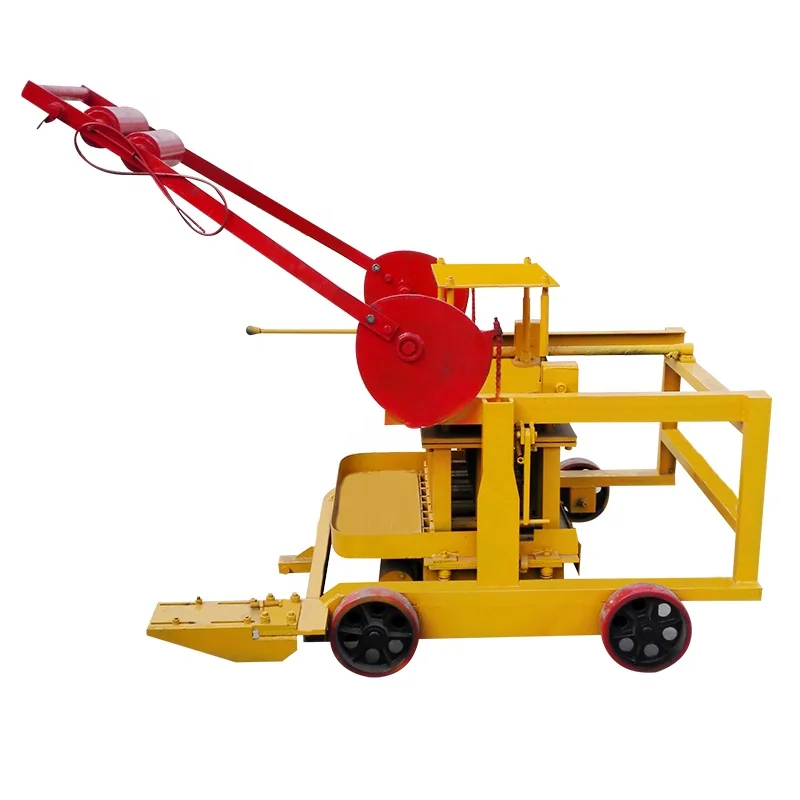
Matched Mixer-to-Press Flow — the QMR4-45 mobile block making machine line is configured with a JZC350 or JQ350 mixer and trolley so the press never waits on upstream material supply.
Technical Specifications
| Parameter | Value |
|---|---|
| Model | QMR4-45 |
| Product Type | Mobile Block Making Machine |
| Overall Dimensions (L×W×H) | 1100 x 950 x 2100 mm |
| Net Weight | 810 kgs |
| Power Source | Diesel / Petrol Engine / Electric (configurable) |
| Molding Cycle | 30–45 s |
| Output Capacity | 2560 pcs/day (basis not stated in source — confirm block format) |
| Supported Formats | Paver brick, hollow block, concrete block, solid brick, fly ash brick |
| Pallet Requirement | No pallet required (egg-laying design) |
| Included Equipment | JZC350 Diesel Concrete Mixer or JQ350 Diesel Concrete Mixer; Trolley |
| Mobility | Movable on-site without fixed plant |
| Warranty | 1 Year |
Application Suitability
| Application | Material or Output |
|---|---|
| On-site hollow block production | Crushed stone, sand, cement mixes at project locations |
| Paver brick manufacturing for small plants | Concrete and fly ash blends for interlocking and solid pavers |
| Remote rural construction projects | Diesel-powered block output where grid electricity is unavailable |
| First-plant entrepreneur setups | Solid and hollow concrete blocks with minimal curing area |
What "2560 Pieces per Day" Actually Means for Your Site
A capacity figure without a block format attached is a number, not a plan.
I once configured a mobile line for a contractor in West Africa. The press cycled fine, but the mixer batch size did not align with the press hopper volume. Every third cycle the operator stood idle waiting for the next mix. Over a ten-hour shift that gap cost roughly two thousand blocks — not because the press was slow, but because the line upstream was not matched. The QMR4-45 mobile block making machine production line addresses this by pairing the press with a JZC350 or JQ350 mixer whose batch output is sized to the 30–45 second molding cycle. [NEED_CITE: mixer-to-press cycle matching in small-scale block production]
Eliminating the Pallet Loop Entirely
The egg-laying design means blocks are placed directly onto the ground or curing surface as the machine moves forward. There is no pallet feeding station, no pallet return conveyor, and no pallet inventory to manage. For a contractor producing on a building site, this removes an entire material handling loop that fixed-plant lines require. The trade-off is that the curing area must be flat, level, and large enough to accept the day’s output in a single pass.
Power Source Flexibility for Off-Grid Sites
The QMR4-45 is available with diesel, petrol, or electric power sources, and the included mixer matches that choice. On remote housing projects where grid connection is months away, a diesel-powered line keeps production running from day one. When grid power does arrive, the same press frame can be reconfigured for electric operation without replacing the core hydraulic and vibration assembly. [NEED_CITE: power source standards for construction equipment in developing markets]
Reading the Specs That Matter on Site
The 1100 x 950 x 2100 mm footprint tells you the minimum working envelope, but the real constraint is the curing area behind the machine. Since blocks are laid without pallets, the ground must be prepared to accept continuous rows. The 810 kg net weight keeps the unit movable by hand or small loader, which matters when you need to reposition between building phases. The 30–45 second molding cycle sets the rhythm for the entire line — the mixer must deliver a fresh batch within that window, and the trolley must clear finished rows before the next pass.
The Cost of Skipping the Line-Level View
Buyers who evaluate a mobile press on cycle time alone often discover after arrival that their existing mixer is too small, their curing ground is uneven, or their trolley cannot keep pace. The result is a press that runs at a fraction of its rated rhythm. I have seen lines where the operator spent more time shoveling half-mixed material into the hopper than actually pressing blocks. Matching the mixer batch volume, the trolley speed, and the curing area layout to the press cycle is what turns a standalone machine into a functioning mobile block making machine production line. [NEED_CITE: common bottlenecks in mobile egg-laying block operations]
Why Configure the Line Here
Block machinery is the single focus of this operation, which means the press, mixer, trolley, and moulds are specified as one system rather than sourced from separate vendors. Each line configuration starts from the buyer’s actual block format, local aggregate, and site conditions — not a catalogue default. Mould design covers the formats the local market sells, including custom drawings when standard options do not match. The automation level is selectable, so a buyer can begin with manual pallet handling and add stacking automation later. Installation support includes operator training so the crew understands cycle rhythm and mixer batching from the first shift.
Documentation & Verification
- Line layout drawing showing mixer, press, and trolley positions relative to curing area
- Capacity calculation sheet stating the block format assumed for the daily output figure
- Mould drawing and supported format list with dimensional tolerances
- Voltage and power source confirmation record signed before production begins
- Factory test record demonstrating mixer-to-press cycle matching under load
- Packing photographs and customs documentation support for container loading
Installation, Commissioning & Support
- Flat, compacted curing ground required; minimum area sized to the 2560 pcs/day target format
- Diesel or electric power confirmed at order; dedicated circuit needed for electric variant
- Machine ships partially assembled; trolley and mixer arrive in the same container
- First-shift commissioning covers mixer batch timing against the 30–45 s press cycle
- Operator training on mould change procedure and daily vibration mechanism inspection
- Wear parts list and mould inventory provided with recommended reorder intervals
What to Include in Your Inquiry
To size this mobile block making machine production line correctly, share the block format and dimensions you intend to produce, your target daily output, and the raw materials available locally including aggregate type and cement grade. Confirm whether your site has grid power or requires diesel operation, and describe the curing area dimensions you can prepare. If you already own a mixer or material handling equipment, list those specifications so the line can be configured around them.
Frequently Asked Questions
Q: What block format is the 2560 pcs/day capacity based on, and how does output change for pavers versus hollow blocks?
A: The published daily figure requires confirmation against a specific block format, wall thickness, and mix design. Hollow blocks typically yield fewer pieces per cycle than solid pavers due to larger mould dimensions and longer vibration times. We provide a capacity calculation sheet that states the exact format assumed so your output expectation matches reality.
Q: Is the concrete mixer included in the line quotation, and can I use my existing mixer instead?
A: The standard quotation includes a JZC350 diesel or JQ350 electric mixer matched to the press cycle. If you prefer to use your own mixer, share its batch volume and discharge time so we can verify it delivers material within the 30–45 second molding window without creating idle gaps.
Q: How do I confirm voltage, frequency, and power source before shipment?
A: Power source selection — diesel, petrol, or electric — is confirmed during the proposal stage and recorded on a signed specification sheet. For electric variants, voltage and frequency are verified against your site supply before production begins, preventing commissioning delays after arrival.
Q: What is the minimum curing area and site preparation needed to run this mobile line?
A: The egg-laying design requires a flat, compacted ground surface large enough to accept a full day’s output in continuous rows. The 1100 x 950 mm machine footprint plus trolley travel path defines the minimum working lane width, while the curing length depends on your chosen block format and daily target.


