
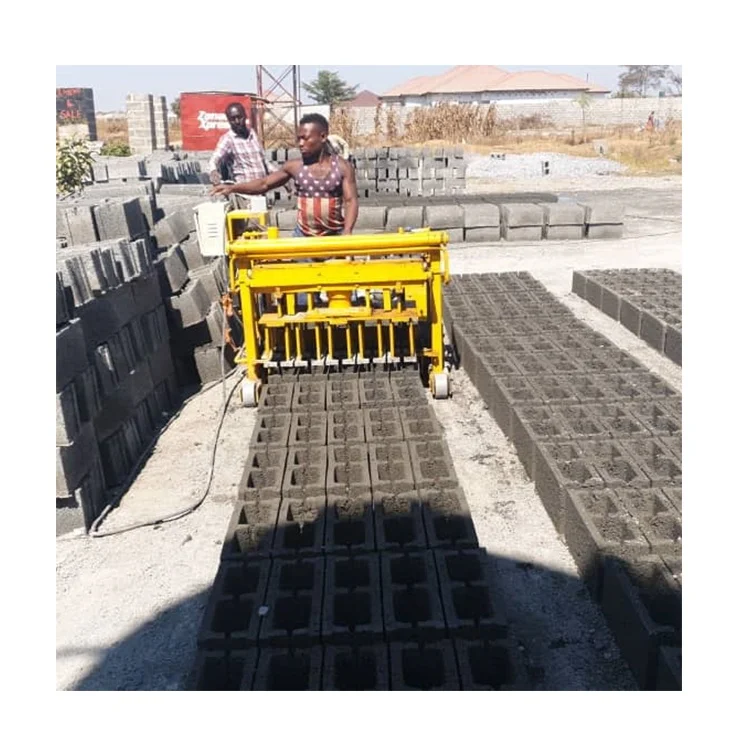
Line-first specification — Every QMY4-30 mobile block machine we ship is sized against the buyer’s curing area and mixer throughput, not quoted as a standalone press.
Technical Specifications
| Parameter | Value |
|---|---|
| Product Type | Mobile Concrete Block Making Machine |
| Model | QMY4-30 |
| Assembly State | Mobile / egg-laying type |
| Automation Level | Semi-automatic / manual pallet handling |
| Rated Power | 5 kW |
| Overall Dimensions (L×W×H) | 1200 × 1200 × 1100 mm |
| Net Weight | 950 kg |
| Cycle Time | 30 seconds |
| Mould Format | Hollow block and solid brick (moulds changeable) |
| Output Capacity | 480 pcs/h (basis: 400×200×200 mm hollow block, 4 pcs/mould) |
| Output Capacity | 600 pcs/h (basis: 400×150×200 mm hollow block, 5 pcs/mould) |
| Output Capacity | 840 pcs/h (basis: 400×100×200 mm hollow block, 7 pcs/mould) |
| Daily Output | 3,840 pcs/8h (basis: 400×200×200 mm hollow block) |
| Daily Output | 4,800 pcs/8h (basis: 400×150×200 mm hollow block) |
| Daily Output | 6,720 pcs/8h (basis: 400×100×200 mm hollow block) |
| Raw Materials | Cement, sand, crushed stones, slag |
| Pallet Size | Not applicable (egg-laying mobile type) |
| Voltage & Frequency | Configurable to site supply (verify before dispatch) |
| Control System | Semi-automatic control panel (language configurable) |
| Hydraulic Pressure | Manufacturer specification (confirm per order) |
| Vibration Force | Manufacturer specification (confirm per order) |
| Warranty | One year guarantee |
Application Suitability
| Application | Material or Output |
|---|---|
| On-site hollow block production for housing projects | Crushed stone, sand, and cement mix laid directly on the ground |
| Temporary block yard at a construction site | Solid brick and hollow block formats changed by swapping moulds |
| Start-up block plant with low initial investment | Local aggregate blended with cement, output stacked and cured on-site |
| Contractor-produced kerbs and pavers on remote sites | Slag or quarry dust mixed with cement in a portable pan mixer |
Why the Supporting Line Matters More Than the Press Itself
A mobile block machine production line is only as fast as its slowest station — and most quotations leave the mixer and curing plan out entirely.
I have watched contractors take delivery of a mobile concrete block making machine and spend the first week realizing the pan mixer they rented cannot feed the press fast enough to sustain a 30-second cycle. The QMY4-30 completes a cycle every 30 seconds, which means the mixing station must deliver a fresh batch at that same rhythm or the press sits idle. On a remote housing project in East Africa, a mismatched mixer turned what should have been a steady production day into a series of stops and starts, and the crew ended up hand-feeding the hopper [NEED_CITE: on-site block production line balancing practices]. The press was never the bottleneck — the line around it was.
Matching Mixer Throughput to a 30-Second Press Cycle
The QMY4-30 mobile concrete block making machine demands a continuous supply of blended material to maintain its rated cycle time. A small pan mixer with a batch capacity below the volume consumed per cycle forces the operator to wait, and those pauses accumulate across an eight-hour shift. We specify the mixer capacity and discharge height so material drops directly into the press hopper without a secondary transfer step. This station-to-station matching is the core of a mobile block machine production line that actually hits its daily targets.
Planning the Curing Area Before You Order the Press
An egg-laying machine drops blocks directly onto the ground, which means the curing area must be flat, level, and large enough to hold a full day’s output across whichever format the buyer plans to run. A 400×200×200 mm hollow block occupies more ground area per piece than a 400×100×200 mm unit, so the same daily output in different formats demands different yard footprints. We lay out the curing zone and walking paths before confirming the machine, because a cramped yard forces the operator to stack blocks too early and risk breakage [NEED_CITE: concrete block curing space planning guidelines].
Reading the Numbers Behind the Cycle Time
The 5 kW total power draw covers both the vibration motor and the hydraulic pump, and this matters when the site runs on a diesel generator. An undersized generator causes voltage dips that weaken the vibration force, producing blocks with inconsistent density. The 950 kg net weight keeps the machine stable during vibration without requiring a bolted-down foundation, which is the whole point of a mobile setup. The 1200 × 1200 × 1100 mm footprint means the machine can pass through a standard site gate and be repositioned as the curing yard fills up. Moulds are changeable between hollow block and solid brick formats, and each format carries its own verified output figure tied to a specific block dimension and pieces-per-mould count.
What Happens When the Line Is Specified Backwards
Contractors who pick the press first and think about mixing and curing later often find that the supporting equipment they improvise on-site creates more downtime than the press itself. A mixer that discharges at the wrong height spills material onto the ground, wasting cement and slowing the feed. A curing area without clear lane markings leads to forklift damage on freshly laid blocks. These are not machine faults — they are line design failures that no amount of press adjustment can fix [NEED_CITE: common causes of mobile block production downtime].
Why Sourcing the Line Together Matters
We treat the QMY4-30 as one station in a mobile block machine production line, not as a standalone product. Raw material feed configuration is matched to the buyer’s local aggregate and mix design, not a generic catalogue default. Line layout and capacity calculations state the exact block format assumed at each station, so there is no guesswork about daily output. Voltage, frequency, and control language are confirmed before dispatch to avoid commissioning delays. Pallet specification and curing rack handling are planned against the buyer’s existing site equipment, even though this egg-laying model does not use pallets — the surrounding material flow still needs to be mapped. Installation support includes operator training on mould change procedure and cycle timing so the crew can run independently from day one.
Documentation & Verification
- Line layout showing mixer placement, press position, and curing zone per block format
- Capacity calculation stating the exact block dimension and pieces-per-mould basis
- Machine specification sheet with voltage and frequency confirmed for your site
- Mould drawing and format list for every block type in your order
- Factory test record run on your specified raw material mix before dispatch
- Operation and maintenance manual in your chosen control language
Installation, Commissioning & Support
- Ground preparation guide for a level curing surface matched to the 1200 × 1200 mm machine footprint
- Generator sizing recommendation based on the 5 kW total draw and site voltage
- On-site assembly support covering vibration motor alignment and hydraulic line connection
- First-run commissioning with cycle time verification at your local aggregate mix
- Operator training on mould change between hollow block and solid brick formats
- Wear parts list with hydraulic seals and vibration springs identified by part number
What to Tell Us Before We Quote
Share the block formats your market actually buys and the daily volume you need per format. Provide a sample or photo of your local sand and aggregate so we can match the vibration force and hydraulic pressure to your mix. Confirm your site voltage, frequency, and whether the line will run on grid power or a generator.
Frequently Asked Questions
Q: How do I verify the real daily output across all three block formats this machine produces?
A: Each output figure we quote is tied to a specific block dimension and pieces-per-mould count. The QMY4-30 produces 3,840 pieces per eight-hour shift for 400×200×200 mm hollow blocks, 4,800 for 400×150×200 mm, and 6,720 for 400×100×200 mm. We provide a capacity calculation document that states these assumptions clearly so you can plan sales commitments against verified numbers.
Q: What mixing station capacity is needed so the QMY4-30 is never left waiting for material?
A: The 30-second cycle means the mixer must discharge a full batch within that window. We calculate the batch volume based on your block format and specify a pan mixer with a discharge height aligned to the QMY4-30 hopper, so material flows directly without manual transfer or spillage.
Q: How should I plan curing area and handling equipment around a mobile egg-laying machine?
A: The curing area must hold a full day’s output laid flat on the ground, with walking lanes wide enough for the crew. We provide a yard layout drawing that shows block spacing per format, curing duration zones, and handling paths so freshly produced units are not disturbed before they gain adequate strength.
Q: What voltage, frequency, and generator rating do I need for the complete line on a remote site?
A: The QMY4-30 draws 5 kW total, and the mixer and any conveyor add to that load. We confirm your site voltage and frequency before building the control panel, and we recommend a generator rating that covers the combined startup surge of all motors in the mobile block machine production line.
Q: Can supporting equipment be added in stages as production volume grows?
A: Yes. The QMY4-30 works as a standalone mobile concrete block making machine from day one, and you can add a dedicated mixer, raw material feeder, or additional mould sets later. We design the line layout with expansion points so new stations connect without relocating the press.


