
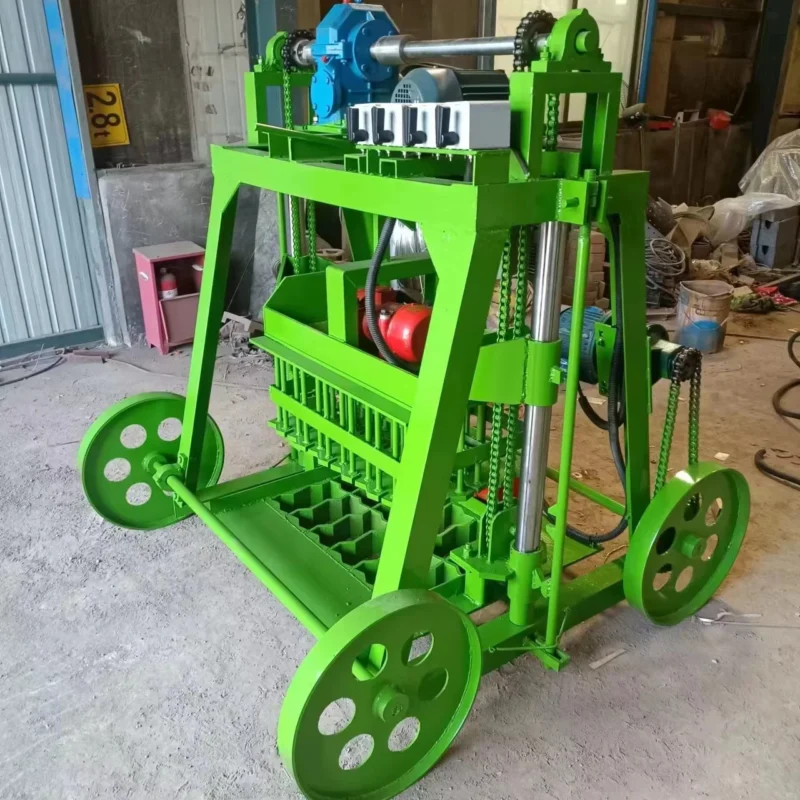
Line-Wide Synchronization — the press, mixer, and curing area must be specified as a single throughput chain so the 45-second molding cycle is never starved by upstream delays or downstream bottlenecks.
Technical Specifications
| Parameter | Value |
|---|---|
| Model | QMJ4-45 |
| Product Type | Mobile Egg Laying Block Making Machine |
| Molding Capacity | 4 pcs/mould (varies by block format) |
| Vibration Frequency | 2400 r/m |
| Vibration Method | Mold vibration (twice-vibration of molding core) |
| Molding Cycle | 45 s |
| Demold Method | Manual |
| Turning Method | Manual |
| Total Power | 6 kW |
| Power Source | Diesel / Petrol engine |
| Pallet Requirement | None (egg laying design) |
| Automation Level | Manual |
| Hollow Block Productivity (400×200×200mm) | 3000 pcs/day (4 pcs/mould, 40-45s cycle, 8-hour shift) |
| Hollow Block Productivity (400×150×200mm) | 3500 pcs/day (5 pcs/mould, 40-45s cycle, 8-hour shift) |
| Hollow Block Productivity (400×120×200mm) | 4500 pcs/day (6 pcs/mould, 40-45s cycle, 8-hour shift) |
| Certification | CE (referenced — verify certificate validity) |
Application Suitability
| Application | Material or Output |
|---|---|
| On-site construction block production | Crushed stone, sand, cement mix for hollow blocks |
| Remote project sites without grid power | Diesel-driven hollow block output at temporary locations |
| Small-scale contractor block yards | 200mm, 150mm, and 120mm wall thickness hollow blocks |
| Housing development phased builds | Local aggregate and cement blended on-site per mix design |
| First-stage block plant entry | Manual egg laying operation with expansion path to semi-automatic line |
What the Quoted Daily Output Figure Actually Requires from Your Site
A stated daily figure only holds true when mixer capacity, material staging, and curing space are sized to feed and receive the press at its verified cycle time.
Buyers frequently receive a productivity number without knowing which block format, mix design, or shift length produced it. I have walked onto sites in Latin America where a mobile block machine sat idle for hours because the hand-mixed concrete could not keep pace with the 45-second molding cycle. The operator spent more time waiting for material than pulling the lever. When the raw material feed starves the hopper, the entire production chain halts — yet the quotation only listed the press. [NEED_CITE: common causes of block machine downtime on remote project sites]
This is precisely where a mobile block machine production line must be planned beyond the press itself. The egg laying block machine with supporting equipment functions as a matched chain: the mixer must deliver batch volume at a rate matching the press consumption, and the curing ground must accommodate the day’s output without forcing blocks to be moved while still green.
Feeding the Press Without Starving the Cycle
The QMJ4-45 completes a molding cycle in 45 seconds. For the 400×200×200mm format producing 4 blocks per cycle, the hopper must receive fresh mix continuously to avoid dead time. A pan mixer delivering output at a rate matched to this consumption rhythm keeps the mobile block machine production line moving without pauses. When the mixer batch size and discharge speed lag behind the press demand, operators begin cutting corners on compaction time to catch up, which directly compromises block density.
Curing Area as Part of the Line Calculation
An egg laying block machine with supporting equipment deposits blocks directly onto the ground, eliminating pallet costs but introducing a different constraint: floor space. A single eight-hour shift producing several thousand hollow blocks requires a cured, level surface large enough to hold that day’s entire output plus the preceding day’s blocks still gaining strength. If the curing area is undersized, workers begin stacking blocks before adequate initial set, causing edge damage and wall collapse. The line layout must account for this ground footprint from the first site survey. [NEED_CITE: concrete block curing time and floor space requirements for egg laying machines]
Spec Interpretation for the Mobile Format
The twice-vibration molding core applies a two-stage compaction sequence rather than a single pass, which improves particle rearrangement within the mould cavity and produces a denser block wall. The 2400 r/m vibration frequency is tuned for standard concrete mixes using locally available sand and crushed aggregate — but when the local aggregate includes highly abrasive volcanic stone, the mould liners experience accelerated wear that standard replacement intervals will not cover. The diesel and petrol engine option removes electrical dependency entirely, which is essential for remote sites but introduces fuel logistics and engine maintenance as part of the line’s operating routine. The 6 kW total power rating covers both the vibration motor and the hydraulic demold mechanism running from a single engine-driven source. Manual demold and turning mean the operator physically controls block release and machine repositioning after each cycle, which keeps the machine cost low but sets a ceiling on how fast the egg laying block machine with supporting equipment can realistically run across a full shift.
The Hidden Cost When Line Stations Are Mismatched
When a buyer purchases only the press and sources the mixer, curing plan, and material handling separately, cycle times across stations drift apart. The mixer finishes a batch too slowly, the curing ground fills up before the shift ends, or the aggregate grading does not match what the vibration system was set for at the factory. I have seen projects where an entire mobile block machine production line was specified by catalogue defaults without anyone verifying the local sand fineness or gravel hardness against the mould design. The result was blocks that crumbled during handling, and a three-week delay while replacement liner plates were shipped from overseas. [NEED_CITE: aggregate abrasion impact on block machine mould liner lifespan]
Why Specifying the Whole Chain Matters Here
The press, mould, and handling workflow are configured as one system rather than sourced from disconnected suppliers. Each hollow block format — 200mm, 150mm, and 120mm wall thickness — has its own verified output calculation stated per cycle, so the buyer knows exactly what the 45-second rhythm produces for their chosen product. Mould design accommodates custom wall thickness and block dimensions drawn to the buyer’s local market requirements, not limited to catalogue standards. The automation level starts at manual egg laying operation and allows future expansion toward semi-automatic pallet-based systems as production volume grows. Installation support includes operator training on the specific mix design and aggregate available at the buyer’s site, ensuring the vibration force is validated against real material before the first production shift begins.
Documentation & Verification
- Line layout drawing showing mixer-to-press-to-curing workflow with station distances
- Capacity calculation sheet stating block format, cycle time, and shift length assumptions
- Mould drawing and format list for each wall thickness included in the order
- Diesel engine specification and fuel consumption record from factory test
- Hydraulic and vibration system schematic with component part numbers
- Factory test record run on buyer-specified aggregate sample before dispatch
Installation, Commissioning & Support
- Ground surface preparation guidance specifying levelness tolerance for egg laying block deposition
- Diesel engine commissioning checklist including fuel line priming and vibration motor alignment
- Mould swap procedure for switching between 200mm, 150mm, and 120mm formats within a single shift
- Operator training covering manual demold timing and twice-vibration cycle observation
- Wear parts list with replacement intervals for mould liners and vibration core bearings
- Curing area sizing calculation matched to quoted daily output for the buyer’s chosen block format
What to Share Before Requesting a Quote
To size a mobile block machine production line accurately, we need the specific hollow block formats your local market sells, including wall thickness and length. Share the aggregate type available at your project site — sand source, gravel grading, and whether volcanic or limestone rock is involved — so the vibration force and mould liner material can be matched. Indicate your daily output target in blocks and the shift hours you plan to run, along with whether existing mixing or material handling equipment will be integrated into the line.
Frequently Asked Questions
Q: Which daily output figure applies to my block size, and what was assumed?
A: The per-format table gives verified figures: 3000 pcs/day for 400×200×200mm, 3500 for 400×150×200mm, and 4500 for 400×120×200mm — all based on 4 pcs per mould (or 5/6 for thinner walls), a 40–45 second cycle, and an eight-hour shift. The general 2600–4000 range applies when format is unspecified. Your actual output depends on your chosen block size and mix consistency.
Q: How is the vibration system matched to my local aggregate?
A: The twice-vibration molding core at 2400 r/m is calibrated for standard sand-cement-aggregate mixes. When local stone is highly abrasive or unusually hard, the vibration force and mould liner specification must be adjusted. We request an aggregate sample and your typical mix ratio before finalizing the mould and vibration settings to ensure block strength meets your market standard.
Q: What mixer capacity keeps the 45-second cycle from starving?
A: The mixer must deliver a fresh batch at a rate matching the QMJ4-45 consumption per cycle. For continuous operation, a pan mixer sized to discharge enough mix for multiple cycles without delay prevents dead time. We calculate the required batch volume and discharge speed based on your block format and target output, then specify the mixer as part of the egg laying block machine with supporting equipment line.
Q: What ground preparation does the egg laying design actually need?
A: The blocks are deposited directly onto a cured, level concrete surface. That surface must be large enough to hold a full day’s output plus the previous day’s blocks still gaining strength. We provide a curing area layout showing required dimensions based on your daily production target and block format, so the site is prepared before the machine arrives.
Q: What does the first spare parts order need to include?
A: The primary wear items on the QMJ4-45 are the mould liners, vibration core bearings, and manual demold mechanism components. With abrasive aggregate, mould liners may need replacement sooner than standard intervals suggest. We provide a recommended first spare parts list with quantities and expected replacement timelines based on your specific material profile and daily production volume.


