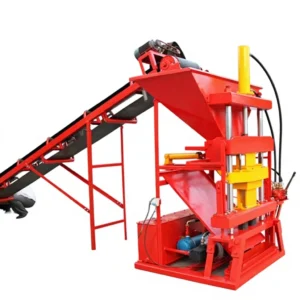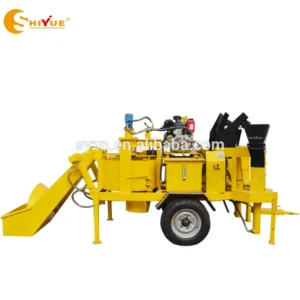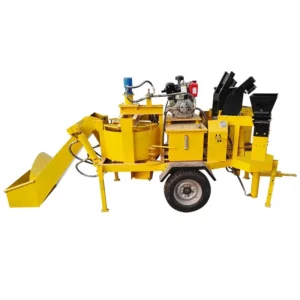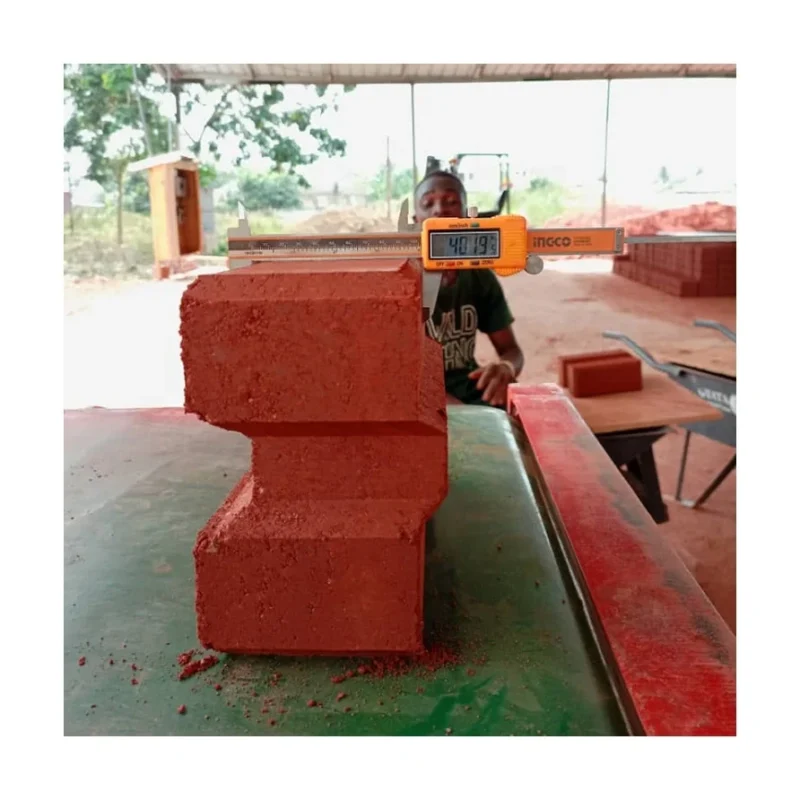
Complete Line Specification — The LY2-10 clay interlocking brick machine is never quoted as a standalone press. Raw material feeding, mixing, pallet handling, stacking and curing stations are specified against your actual block format and local clay properties so the 10-second moulding cycle is never left waiting.
Technical Specifications
| Parameter | Value |
|---|---|
| Product Type | Clay Interlocking Brick Making Machine |
| Model | LY2-10 |
| Molding Cycle | 10 s (basis to be confirmed — dependent on block format, material and thickness) |
| Output Capacity | 3000 pcs / 8 h (basis not stated in source); alternate table states 6000 pcs / 8 h for 300×150×100 mm and 250×125×75 mm formats at 2 pcs / mould |
| Rated Power | 7.5 kW |
| Hydraulic Pressure | 16 MPa |
| Raw Materials | Clay, soil, earth, mud, concrete, cement, fly ash |
| Mould Formats | Interlocking brick (sample formats 300×150×100 mm and 250×125×75 mm) |
| Automation Level | Semi-automatic (automatic material feeding, mould pressing and mould lifting) |
| Worker Requirement | 1–3 people |
| Net Weight | 1200 kg |
| Overall Dimensions (L×W×H) | 1300 × 1200 × 1900 mm |
| Voltage & Frequency | To be confirmed per target market standard |
| Control System | To be confirmed |
| Warranty | One year for the whole machine |
Application Suitability
| Application | Material or Output |
|---|---|
| On-site interlocking clay brick production | Locally sourced soil, earth, mud or clay |
| Small-plant interlocking brick manufacturing | Clay-cement or pure cement mixes |
| Floor tile production | Cement-based mixes with suitable mould change |
| Housing project block supply | Earth and soil blends stabilised with cement |
| Format diversification for existing concrete plants | Interlocking brick formats on shared pallet systems |
Why a Press-Only Quotation Fails a Complete Clay Interlocking Brick Machine Production Line
The output you paid for is only real when every station around the press keeps pace.
I once configured a compressed earth block line where the mixer and feeder were sized for a laboratory red-clay sample. On site, the actual clay had a much lower clay fraction, and the entire material flow from feeder to press fell out of sync. The buyer lost nearly two weeks of production while parameters were recalibrated across every station. When evaluating a clay interlocking brick machine production line, the bottleneck is rarely the press itself — it is the upstream feeding or downstream pallet handling that was never included in the scope [NEED_CITE: common line imbalance causes in small block plants].
Matching Every Station to the 10-Second Moulding Cycle
The LY2-10 cycles at 10 seconds per moulding stroke, which means the raw material feeder must deliver a measured charge and the mixer must discharge a homogeneous blend within that same window. If the mixer runs slower, the press sits idle; if it runs faster, material slumps before pressing. A clay interlocking brick machine production line designed around this rhythm specifies feeder gate timing and mixer discharge sequence so the press operator never waits.
Pallet Flow, Stacking and Curing as Part of the Line Scope
Interlocking bricks leave the mould on a pallet, and the rate at which pallets circulate back to the press determines whether daily capacity figures hold. On this line, pallet specification — size, material and total quantity — is calculated against the curing area available and the forklift already on site, not selected from a catalogue default. Manual stacking is the default for a 1–3 worker crew, but the line layout reserves space for an automatic stacker should the buyer upgrade later. Pallet handling gaps are where most small plants lose the output they were quoted [NEED_CITE: pallet circulation impact on small block plant throughput].
Reading the Numbers That Matter
The 16 MPa hydraulic pressure acts on the interlocking mould cavity to compress clay or earth into a dense, structurally sound brick. Pressure alone does not guarantee strength — the mix moisture, clay fraction and stabiliser content must all align with the pressure rating. The 7.5 kW motor drives both the hydraulic pump and the feeder, so line-level power planning must account for simultaneous operation of these loads alongside the mixer and any conveyor motors. The 1300 × 1200 × 1900 mm footprint is compact enough for on-site deployment, but foundation leveling and clearance for pallet return must be included in the site plan. Mould format switching between 300×150×100 mm and 250×125×75 mm changes pallet slot spacing and curing rack geometry, so the line layout must be re-verified for each active format.
The Hidden Cost of Leaving Stations Undefined
Buyers who accept a quotation covering only the press often discover that pallets, curing racks and material feeders arrive as separate purchases with incompatible dimensions. The 16 MPa pressure demands a pallet stiff enough to resist flex, yet some suppliers ship thin timber pallets that warp under repeated hydraulic load, causing uneven brick density. Voltage mismatches discovered after arrival can strand the entire line in customs while transformers are sourced, and PLC display language left unconfirmed forces the operator to run the machine from memory rather than instruction [NEED_CITE: commissioning delays caused by unconfirmed electrical specifications].
Why Source This Line Here
Every station in the clay interlocking brick machine production line is specified as a matched system rather than assembled from separate vendors, so feeder output, mixer discharge and press cycle are coordinated from the design stage. Configuration is set against your actual local clay, earth or soil properties and your target block format, not a catalogue default. Mould design covers the formats your market sells, with custom drawings available. Automation level is selectable — start semi-automatic with manual pallet transfer and add automatic stacking as volume grows. Installation, commissioning and operator training are included so the line runs correctly from the first shift.
Documentation & Verification
- Line layout and capacity calculation stating the exact block format and mix assumed
- Machine specification sheet with all hydraulic and electrical ratings confirmed
- Mould drawing and format list for each interlocking brick cavity ordered
- Pallet specification matched to curing area dimensions and forklift capacity
- Hydraulic and electrical schematic with confirmed voltage, frequency and control language
- Factory test record on buyer’s actual clay or soil sample before dispatch
Installation, Commissioning & Support
- Foundation pad leveled to 1300 × 1200 mm footprint with clearance for pallet return path
- Dedicated 7.5 kW circuit at confirmed voltage and frequency for the press and feeder
- Machine shipped dismantled per container loading plan and reassembled on site
- First-run parameter setting against buyer’s local clay, soil or earth moisture content
- Operator training covering mould pressing, mould lifting and format change procedure
- Wear parts list for hydraulic seals and mould liners with recommended reorder intervals
Request a Line Layout
Share the interlocking brick format you intend to produce, your local clay or soil source and its typical moisture content, and the daily output you need. Include your curing area dimensions, existing forklift capacity and the local voltage and frequency standard. We will respond with a complete line layout showing every station from material infeed to cured block out.
Frequently Asked Questions
Q: How is line capacity verified for my specific block format?
A: Capacity is calculated per format, stating the mould cavity count, block dimensions and mix assumed. For the LY2-10, the alternate table shows 6000 pcs / 8 h on 300×150×100 mm or 250×125×75 mm formats at 2 pcs per mould. We confirm which figure applies to your chosen format before quotation.
Q: Which supporting stations are included in the line scope?
A: The scope covers raw material feeder, mixer, pallet feeder and stacking arrangement. Each station’s cycle time is matched to the 10-second press stroke so no upstream or downstream bottleneck forms. Curing rack handling and cubing can be added as the line scales.
Q: How are pallets chosen for this production line?
A: Pallet size, material and total quantity are selected to match your curing area and the forklift you already use. A pallet too small wastes mould area; one too stiff absorbs hydraulic energy meant for the brick. We confirm pallet specs against your site before production.
Q: What electrical details must be confirmed before manufacturing?
A: Voltage, frequency and control display language are confirmed in writing before production begins. The LY2-10 requires a stable supply matching its 7.5 kW load. Supplying the correct electrical standard for your market prevents commissioning delays after the line arrives.
Q: How long does a full mould format change take on this line?
A: Format switching involves swapping the mould and adjusting pallet slot spacing on the feeder and curing rack. We provide a format change procedure in the manual. The time required depends on crew familiarity and is reduced through operator training during commissioning.