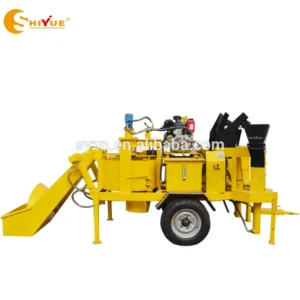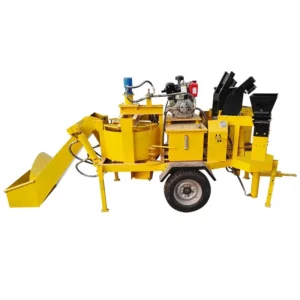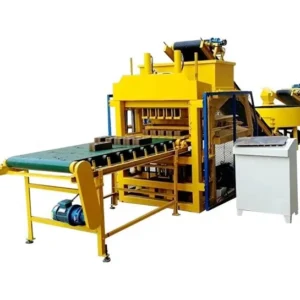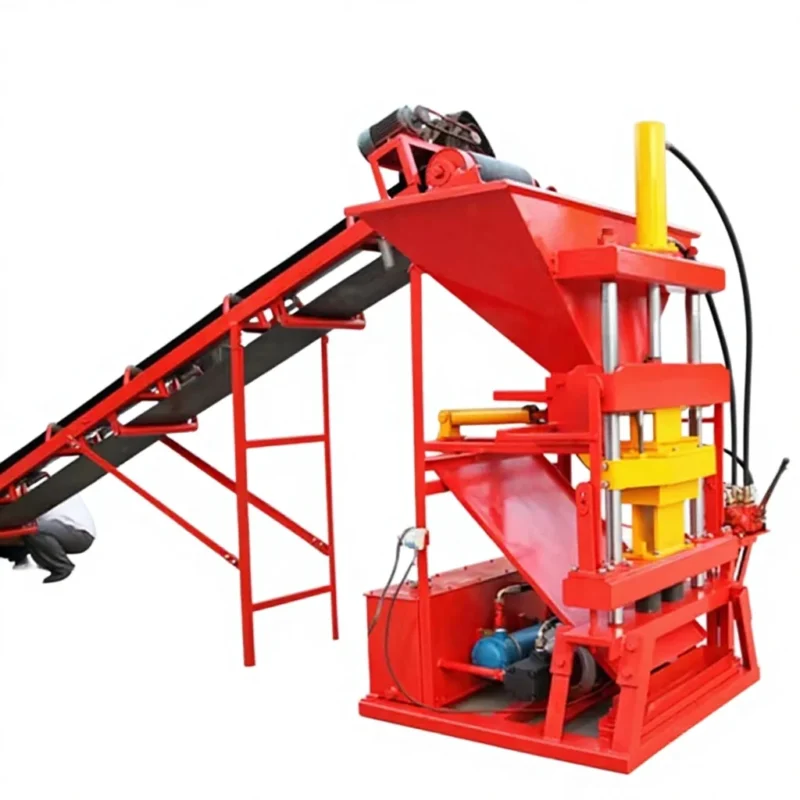
Matched System Configuration — The ECO 2700 clay interlocking brick machine is specified alongside its mixer, pallet return, and curing layout as one coordinated line, preventing the press from idling while upstream stations catch up.
Technical Specifications
| Parameter | Value |
|---|---|
| Model | ECO 2700 |
| Product Type | Clay Interlocking Brick Making Machine |
| Overall Dimensions (L×W×H) | 1600 x 1300 x 2330 mm |
| Net Weight | 1100 kgs |
| Rated Power | 7.5 kW / 12 hp diesel engine |
| Hydraulic Pressure | 16 MPa |
| Molding Cycle | 10–15 s |
| Output Capacity | 2800 pcs/day (basis not stated in source — confirm block format / material / thickness) |
| Raw Material Compatibility | Clay, Cement, Sand, Soil, Shale, Fly ash, White lime |
| Control System | Manual lever operation |
| Hydraulic Cooling | Temperature-controlled switch, automatic operation |
| Block Strength | Above 12 MPa |
| Mould Change | Manual bolt-type, upper and lower die replacement |
| Mould Gap Tolerance | 0.5 mm between upper/lower molds and cavity |
| Assembly State | Skid-mounted, single-unit machine |
Application Suitability
| Application | Material or Output |
|---|---|
| On-site housing project brick production | Cement-clay interlocking bricks for wall construction |
| Small block plant format expansion | Cement-sand interlocking bricks added to existing cement block range |
| Rural enterprise first-line setup | Cement-shale or cement-fly ash interlocking bricks for local sale |
| Mobile contractor production | Soil-cement interlocking bricks using locally excavated clay |
Why "2,800 Pieces a Day" Should Trigger a Deeper Conversation
The capacity figure only means something when tied to the exact brick format, wall thickness, and mix design you intend to run.
I once watched a clay interlocking brick machine production line in West Africa stall for forty minutes every shift because the pan mixer could not discharge fast enough to keep up with the press cycle. The quoted daily output assumed a thin paver format that the buyer never planned to produce. Once you anchor the ECO 2700 into a full line, every upstream and downstream station must match its 10–15 second molding cycle, or the press sits idle and the real output drops well below expectation. [NEED_CITE: common causes of output shortfall in small block plants]
Press Cycle and Mixer Discharge Synchronization
A 10–15 second molding cycle means the mixer must deliver a fresh batch to the hopper within that window. If the pan mixer takes twenty seconds to discharge, the press loses nearly a third of its available cycles. Specifying the mixer batch size and discharge gate against the ECO 2700 hopper volume is the first step in building a clay interlocking brick machine production line that actually runs at the pace you planned.
Pallet Return and Curing Rack Flow
Skid-mounted machines like the ECO 2700 often run on short pallet circuits or manual pallet handling. If cured bricks are not cleared from the pallets and returned to the feed station quickly enough, the operator is forced to wait. The curing rack layout must account for the ambient temperature and the cement-clay setting time so that pallets re-enter the circuit before the press runs out. [NEED_CITE: pallet return logistics in small-scale block production]
Reading the Core Specifications in Context
The 16 MPa hydraulic pressure works in tandem with the manual lever system to compress the clay-cement mix into the interlocking cavity. Higher pressure increases brick density and the stated 12 MPa block strength, but only if the mix moisture and aggregate gradation are correct for the cavity depth. The 0.5 mm mould gap tolerance keeps the interlocking profiles sharp, which matters when the bricks are laid dry-stacked without mortar. The 7.5 kW diesel engine removes dependence on grid stability, a practical choice for remote housing sites where power fluctuations would trip an electric motor offline mid-cycle. The temperature-controlled hydraulic cooling switch keeps the oil within operating range during continuous shifts in hot climates, preventing pressure drop as the afternoon temperature climbs.
The Hidden Cost of Treating the Press as a Standalone Purchase
When the mixer, pallet circuit, and curing area are sourced separately and not matched to the press cycle, the result is a line that looks complete on paper but underperforms on the floor. Operators spend time shoveling material or carrying pallets by hand, and the daily brick count falls short. In my experience across small plants in South Asia, the bottleneck is rarely the press itself — it is the station that was never timed against it. [NEED_CITE: hidden costs of unmatched equipment in block lines]
Why Source the Line as One System
Block machinery as a single focus means the ECO 2700 press, its mould, pallet, and handling equipment are specified together rather than assembled from unrelated suppliers. The configuration is set against your actual mix design and local aggregate, not a catalogue default. Mould design covers the interlocking format your market sells, with custom drawings available if your wall profile differs from standard. Automation level is selectable — a buyer can start with the manual lever press and add pallet feed or stacking later. Installation support includes line layout, operator training, and mould and wear parts supply so the first replacement does not leave you searching.
Documentation & Verification
- Line layout drawing showing mixer, ECO 2700 press, and pallet return timed to the 10–15 s cycle
- Capacity calculation stating the brick format and mix behind the 2,800 pcs/day figure
- Mould drawing with interlocking profile dimensions and 0.5 mm gap tolerance noted
- Hydraulic schematic with 16 MPa circuit and cooling switch location marked
- Voltage or diesel specification confirmed against your site conditions before dispatch
- Factory test record on your specified clay-cement mix before shipment
Installation, Commissioning & Support
- Skid-mounted ECO 2700 arrives as a single unit; level concrete pad required under the 1600 x 1300 mm footprint
- Diesel engine requires no electrical connection; confirm fuel grade for local ambient temperature
- Hydraulic oil fill and temperature-controlled cooling switch tested during on-site commissioning
- Manual lever operation trained with your crew, including mould change procedure for upper and lower dies
- Mould and hydraulic wear parts list provided for first reorder planning
What We Need to Configure Your Line
To build an accurate clay interlocking brick machine production line proposal, share your target brick format and wall thickness, the local clay or soil type you plan to use, and whether grid power or diesel is preferred on your site. If you already have a mixer or pallets in place, send the specifications so we can check cycle compatibility before quoting.
Frequently Asked Questions
Q: How is the 2,800 pcs/day capacity calculated, and which brick format does it assume?
A: The figure is published without a stated basis, so it must be confirmed against your specific interlocking brick dimensions, wall thickness, and mix design. We provide a capacity calculation in the proposal that names the exact format and cycle time assumed, so your production plan is based on your actual product, not a catalogue default.
Q: How do I match the mixer batch size and pallet return speed so the ECO 2700 press never idles?
A: The press cycles every 10–15 seconds, so the mixer must discharge a full batch within that window and pallets must return from the curing rack before the next press stroke. We time each station against the press cycle in the line layout drawing so no upstream or downstream bottleneck forms during continuous operation.
Q: What supporting stations are needed for a complete line around this press?
A: At minimum, a mixer matched to the ECO 2700 hopper volume, a pallet feed and return circuit, and a curing rack sized for the daily output and local setting time. Depending on your automation target, you can add raw material batching, automatic stacking, or cubing stations as the line grows.
Q: Can the line start semi-manual and upgrade to automatic stacking later?
A: Yes. The ECO 2700 is supplied with manual lever operation and bolt-type mould change, and the line layout can reserve space and pallet circuit capacity for a future stacker or cubing unit. Upgrading later means replacing the manual station without redesigning the entire line footprint.
Q: How does local clay and aggregate variation affect mix proportion and brick strength?
A: Clay plasticity and sand gradation change how the 16 MPa hydraulic pressure compacts the mix inside the mould cavity. We set the material proportion reference against a sample of your local aggregate and adjust the mix during commissioning to reach the target block strength above 12 MPa consistently.