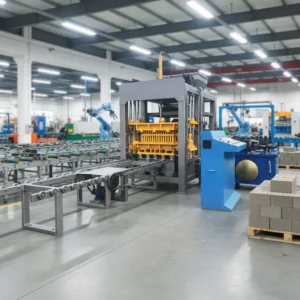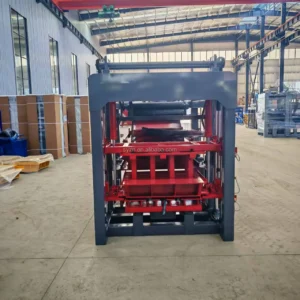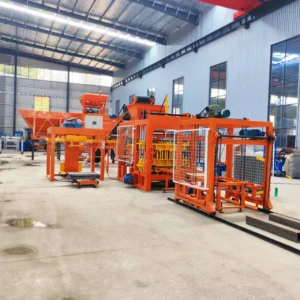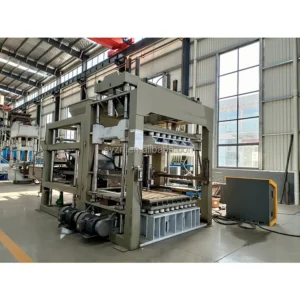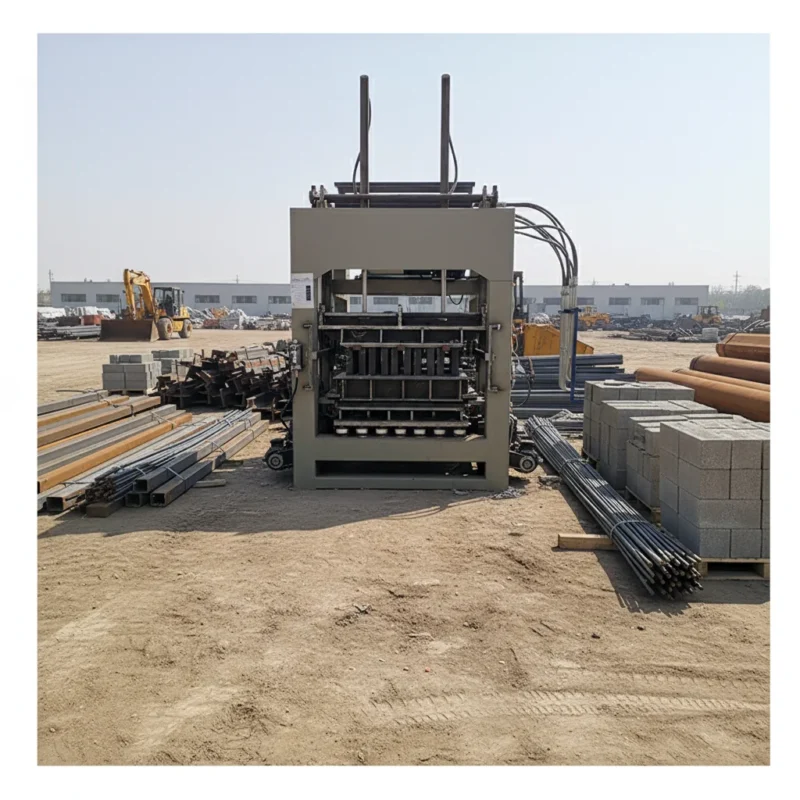
Matched Line Engineering — every station from raw material feeding to curing rack handling is timed to the press cycle so the QT8-15 never waits upstream or downstream.
Technical Specifications
| Parameter | Value |
|---|---|
| Model | QT8-15 |
| Product Type | Hydraulic Block Making Machine |
| Overall Dimensions (L×W×H) | 8300×1860×3000 mm |
| Rated Pressure | 21 MPa |
| Main Vibration Form | Platform Vibration |
| Vibration Frequency | 2800–4500 r/min |
| Vibration Force | 45 kN |
| Pallet Size | 950×900 mm |
| Molding Cycle | 15–20 s |
| Overall Power | 55.5 kW |
| Total Mass | 8 T |
| Demolding Method | Hydraulic |
| Factory Area Required | 300 m² |
| Applied Products | Concrete blocks, hollow/solid blocks, pavers, interlocking blocks, curbstone, colored pavers |
| Raw Materials | Crushed stone, sand, cement, dust, fly ash, gravel, slag |
| Loading | 1×40HQ container (basic equipment) |
| Warranty | 1 year (whole machine, excluding spare parts) |
| Output Capacity | basis not stated in source — confirm block format, material and thickness |
| Voltage & Frequency | not stated in source — confirm with supplier |
| Control System | not stated in source — confirm PLC brand and language |
Application Suitability
| Application | Material or Output |
|---|---|
| Hollow block production for building walls | Crushed stone, sand, cement, fly ash blends |
| Solid block manufacturing for load-bearing structures | Gravel, cement and slag mixes |
| Paving block and colored paver runs for roads and walkways | Fine aggregate with pigment additives |
| Interlocking brick production for landscaping | Sand, cement and stone dust combinations |
| Curbstone forming for municipal infrastructure | Coarse aggregate with high cement content |
| On-site block production for housing projects | Locally sourced sand, gravel and cement |
What a Cycle Time Figure Leaves Out About Your Daily Output
A 15–20 second molding cycle only tells part of the story — real daily output depends on whether the entire QT8-15 block machine production line keeps pace.
I have walked into plants where the press sat idle for seconds every cycle, not because the machine was slow, but because the mixer discharged too late or the pallet feeder jammed. One拉美 client installed a high-speed press with no thought to upstream batching speed. The mixer could not keep up, so the press waited for material every third cycle, and actual throughput dropped to nearly half the quoted number [NEED_CITE: block plant cycle time versus line throughput studies]. When you evaluate a turnkey block making line, the question is not just how fast the press closes — it is whether every station from raw material in to cured blocks out is matched to that same rhythm.
How Stations Connect Around the QT8-15 Press
A block line lives or dies by its weakest station. The QT8-15 block machine production line connects raw material feeding, mixing, pallet feeding, the press itself, stacking and curing rack handling into one continuous loop. Each station must hand off to the next without creating a bottleneck. When we size a turnkey block making line around this press, we calculate the mixer discharge rate against the 15–20 second molding cycle, then verify that the pallet return conveyor completes its loop before the next press stroke demands a fresh pallet.
Matching Pallet Circulation to Curing Area Reality
Pallets travel from the press to the stacking station, onto curing racks, through the curing area and back to the press. If your curing area is small or your forklift cannot handle a loaded rack, pallets pile up and the line stalls. The 950×900 mm pallet on the QT8-15 is specified with this full circuit in mind [NEED_CITE: pallet circulation planning in concrete block plants]. We confirm your curing zone dimensions, rack height and forklift capacity before the line ships, because a pallet size that does not match your facility creates a problem no amount of press speed can fix.
Reading the Specs That Actually Shape Production
The 21 MPa rated pressure and 45 kN vibration force work together to compact the mix into dense, uniform blocks. Higher pressure alone does not guarantee strength — the vibration frequency range of 2800–4500 r/min distributes force through the mould cavity, settling aggregate into voids that static pressure cannot reach. The platform vibration form means energy enters from below, which suits heavier mixes with coarse aggregate like crushed stone and gravel. The 55.5 kW overall power covers the full line, not just the press motor, so electrical planning must account for mixer, conveyor and stacking motors running simultaneously. An undersized transformer or incorrect voltage at the site will trip breakers during startup, a failure mode I have seen delay commissioning by days [NEED_CITE: voltage and frequency standards by export market].
The Hidden Cost of Treating the Press as an Island
Quoting only the press and leaving pallet handling, stacking and curing as buyer-supplied items looks cheaper on paper. What actually happens is the buyer scrambles to source pallets, welds a rack system on site and assigns workers to move blocks by hand. Output that should flow through an organized curing zone instead piles up beside the machine, chipping edges and slowing the entire operation. I have seen plants where the press was rated for a demanding cycle but operators spent half their shift moving pallets manually, erasing any speed advantage the machine offered [NEED_CITE: manual versus automated pallet handling in block plants]. A turnkey block making line that includes every station from feed to cure avoids this gap entirely.
Why Buyers Plan Full Lines Through This Supplier
Block machinery is the single focus here, which means the press, mould, pallet and handling equipment are specified as one matched system rather than assembled from unrelated vendors. Every line layout states the block format assumed in the capacity calculation, so you know exactly what daily output to expect for hollow blocks versus pavers versus kerbstones. Pallet size and material are chosen against your curing area and existing forklift, not picked from a catalogue default. Automation level is selectable — you can begin with semi-automatic pallet handling and add stacking later as volume grows. Mould design covers the formats your market actually sells, with custom drawings when standard moulds do not fit. Installation includes operator training so your team understands cycle timing and mould change procedures from the first day.
Documentation & Verification
- Line layout and capacity calculation stating the block format assumed for the QT8-15
- Machine specification sheet with hydraulic and electrical schematic
- Mould drawing and format list covering hollow, solid, paver and interlocking options
- Pallet specification matched to your curing area and forklift capacity
- Voltage, frequency and PLC display language confirmation before production
- Factory test record demonstrating cycle timing across your chosen formats
Installation, Commissioning & Support
- Foundation plan sized to the 8300×1860 mm footprint and 8 T mass of the QT8-15
- Dedicated power circuit confirmed for 55.5 kW total draw across all line stations
- Machine arrives dismantled for 40HQ container loading with reassembly guided on site
- First-run commissioning verifies molding cycle and pallet circulation timing
- Operator training covers mould change procedure, hydraulic checks and PLC navigation
- Wear parts and mould maintenance list provided with recommended replacement intervals
What We Need to Size Your Line Correctly
Tell us the block formats your market sells, the daily volume you target for each format, and the raw materials available locally. Share your site dimensions including curing area space, existing forklift capacity and the voltage and frequency at your facility. With these details we can calculate a line layout where every station matches the QT8-15 press cycle and deliver a quotation that reflects the complete system, not just the machine.
Frequently Asked Questions
Q: How is daily output calculated for this line?
A: Daily output is stated per block format and based on the molding cycle of 15–20 seconds, pallet circulation speed and curing rack capacity. We provide a capacity calculation that names the exact block size assumed, so you can compare the figure against your actual product mix rather than relying on a generic cycles-per-hour number.
Q: Are pallet feeding, stacking and curing rack handling included?
A: Yes, the line quotation covers pallet feeding from the return conveyor through to the press, stacking after demolding, and curing rack handling. Each station is specified to match the QT8-15 cycle so no single point creates a bottleneck. If you prefer to handle certain stations manually, the automation level can be adjusted.
Q: How do you match vibration and pressure to our local mix?
A: We review your aggregate type, gradation and cement ratio, then set the vibration frequency within the 2800–4500 r/min range and confirm the 21 MPa hydraulic pressure delivers sufficient compaction. This ensures block strength meets your local standard without requiring a material change that increases cost.
Q: What electrical details are confirmed before shipment?
A: Voltage, frequency and PLC display language are confirmed during the order stage. This prevents commissioning delays caused by mismatched motors or an interface the operator cannot read. We also supply the electrical schematic so your local electrician can prepare the site before the line arrives.
Q: How does the mixer connect to the press cycle?
A: The mixer discharge rate is calculated so a fresh batch reaches the press hopper before each molding cycle completes. If the mixer is too slow, the press idles and throughput drops. We size the mixer and conveyor together with the QT8-15 to keep material flowing continuously through the line.