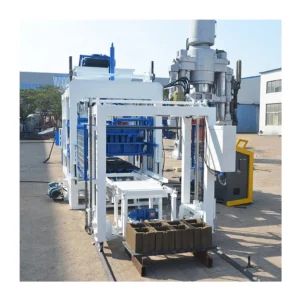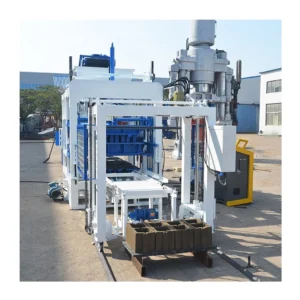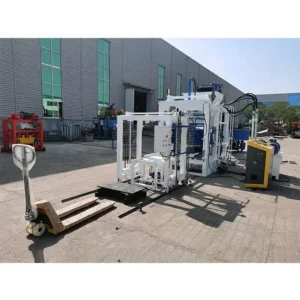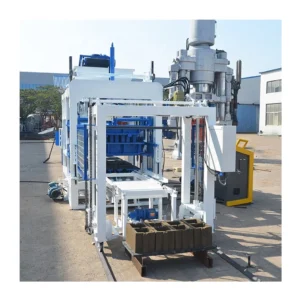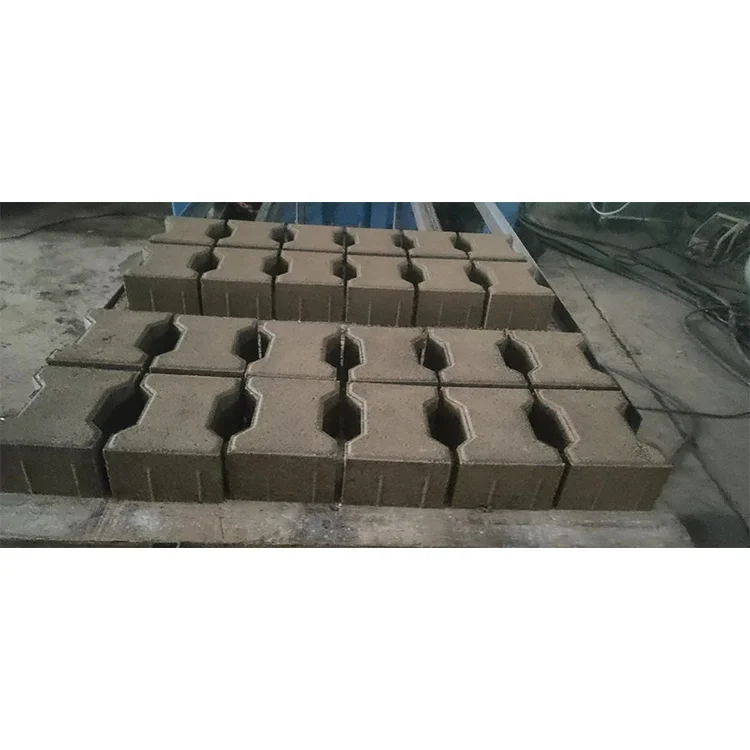
Line-Wide Pacing — Every station from raw material feeding to curing rack is matched to the QT5-15 cycle time so the press never waits on upstream or downstream equipment.
Technical Specifications
| Parameter | Value |
|---|---|
| Model | QT5-15 |
| Product Type | Hydraulic Automatic Concrete Block Making Machine |
| Overall Dimensions (L×W×H) | 7400×1950×2800 mm |
| Rated Pressure | 21 MPa |
| Main Vibration Form | Platform Vibration |
| Vibration Frequency | 2800–4500 r/min |
| Vibration Force | 40 kN |
| Pallet Size | 1100×550 mm |
| Molding Cycle | 15–20 s |
| Total Mass | 6 T |
| Demolding Method | Hydraulic |
| Factory Area | 600 m² |
| Control System | PLC intelligent control with man-machine interface, fault diagnosis system, remote control function |
| Machine Frame Material | Manganese steel (China national standard) |
| Output (Hollow brick 400×200×200mm) | 5 pcs/mold, 15–20s cycle, 7200–9600 pcs/day (basis: 8-hour shift) |
| Output (Porous brick 240×115×90mm) | 16 pcs/mold, 16–20s cycle, 23040–28800 pcs/day (basis: 8-hour shift) |
| Output (Standard brick 240×115×53mm) | 32 pcs/mold, 13–15s cycle, 61440–70892 pcs/day (basis: 8-hour shift) |
| Voltage & Frequency | Configurable to buyer’s site requirement (basis to be confirmed) |
| PLC Display Language | Configurable (basis to be confirmed) |
| Key Features | Remote control function, fault diagnosis, hydraulic demolding, platform vibration |
Application Suitability
| Application | Material or Output |
|---|---|
| Hollow block production for load-bearing walls | Crushed stone, sand, cement, fly ash |
| Standard solid brick manufacturing | Gravel, slag, dust, cement |
| Paving block and colored paver production | Fine aggregates, cement, pigment |
| Interlocking block and curbstone forming | Coarse aggregate blends, cement |
| On-site block production for housing projects | Locally sourced sand, crushed stone, cement |
| Porous brick for permeable pavement | Open-graded aggregate, cement |
Why "Press-Only" Quotes Leave Your Daily Output Half of Promised
A block machine cycle time is meaningless if the mixer takes thirty extra seconds to discharge or the pallet feeder jams on warped boards.
I spent weeks troubleshooting a site in West Africa where a QT5-15 automatic block machine production line was running at barely half its rated output. The press itself was cycling fine at 15–20 seconds per mold, but the twin-shaft mixer above it was discharging slowly because the gate actuator was undersized. Every cycle, the hopper waited. Multiply that idle gap by several hundred cycles and you lose thousands of blocks a day. The buyer had purchased a press, not a line, and every station around it was a bottleneck [NEED_CITE: line-wide cycle matching in block production].
How Surrounding Stations Must Match the QT5-15 Cycle
The QT5-15 automatic block machine production line runs a 15–20 second molding cycle, which means the mixer must discharge a full batch in under that window, the pallet feeder must advance a clean pallet in under two seconds, and the stacker must clear the wet block before the next mold opens. When any one of these stations lags, the PLC simply holds the press — and your output for that hour drops. We size the mixer discharge gate, the belt conveyor speed, and the pallet return conveyor to keep pace, not to a catalogue default.
Line Layout That Accounts for Your Site Reality
Before we ship, we draw a line layout that shows every station from raw material intake to curing rack, with cycle times annotated at each handoff point. The QT5-15 automatic block machine production line requires roughly 600 m² of factory area, but the actual footprint depends on how many pallets you want in circulation and whether your curing racks are straight-line or stacked. If your existing forklift cannot handle a loaded 1100×550 mm pallet, we adjust the pallet spec before the steel is cut — not after the container arrives at your port [NEED_CITE: pallet and forklift compatibility in block plants].
What the 21 MPa Pressure and Platform Vibration Actually Do
The 21 MPa rated hydraulic pressure compacts the mix from above while the platform vibration at 2800–4500 r/min and 40 kN force settles the aggregate from below. These two forces must be tuned to your specific mix design — a fly-ash-heavy blend needs more vibration time and less pressure than a coarse gravel mix. If the vibration force is too low for your aggregate size, the blocks come out with weak corners and inconsistent density. The PLC control on this machine lets the operator adjust frequency within the rated range, but the starting parameters should be set against a sample of your local raw materials during commissioning.
The manganese steel frame carries the repeated shock of 40 kN vibration across thousands of cycles per shift without weld fatigue, which matters when you are running hollow blocks at 7200–9600 pieces per day on an 8-hour basis with 400×200×200mm format.
The Hidden Cost of Skipping Line-Level Specification
I have seen buyers accept a quotation that lists only the press and assume everything else is standard. When the machine arrives, the pallets are the wrong size for their curing racks, the voltage does not match their transformer, and the PLC display is in a language their operators cannot read. Commissioning stalls for weeks while parts are sourced locally at inflated prices. The QT5-15 automatic block machine production line avoids this by confirming voltage, frequency, PLC language, and pallet material before production begins — not after [NEED_CITE: commissioning delays from unconfirmed electrical specifications].
Why Sourcing the Full Line From One Supplier Matters
Every station on this line — raw material feeding, mixing, pallet feeding, automatic stacking, curing rack handling — is specified as one system, so the cycle times are matched on paper before they are built in steel. The pallet size of 1100×550 mm is confirmed against your curing area and forklift, not chosen from a default list. Mould design covers the block formats your market actually sells, including custom drawings for interlocking or kerbstone profiles. The automation level is selectable, so you can start with manual pallet handling and add automatic stacking later. Installation includes operator training on the full line, not just the press.
Documentation & Verification
- Line layout with annotated cycle times at each station handoff point for your chosen block format
- Pallet specification sheet confirming material and dimensions against your existing curing infrastructure
- Voltage, frequency, and PLC display language confirmation record signed before production
- Hydraulic and electrical schematic covering press, mixer, and all conveyor drives
- Factory test record running your target block format with documented cycle times
- Wear parts and mould maintenance list with replacement intervals
Installation, Commissioning & Support
- 600 m² factory area requirement confirmed against your site dimensions before shipment
- 6 T total machine mass requires a cured concrete foundation poured to our layout drawing
- Voltage and frequency configured to your site supply with dedicated circuit for the PLC system
- On-site commissioning includes tuning vibration frequency between 2800–4500 r/min to your local aggregate
- Operator training covers PLC fault diagnosis interface and remote control function basics
- Hydraulic wear parts and mould maintenance schedule provided at handover
What We Need to Configure Your Line Correctly
To build a line that actually delivers the rated output, we need to know your target block formats and daily volume by format, the raw materials you can source locally including aggregate gradation, your available factory area and ceiling height, the voltage and frequency at your site, and the forklift capacity you already have on the floor. If you are replacing an existing press, tell us which surrounding stations you plan to keep so we can check compatibility.
Frequently Asked Questions
Q: How is the daily output verified per block format, and which format does the quoted capacity assume?
A: Every output figure we quote states the block format, pieces per mold, and cycle time it assumes. For example, 7200–9600 pieces per day is based on 400×200×200mm hollow blocks at 5 per mold with a 15–20 second cycle over an 8-hour shift. We provide a capacity calculation table for each format you plan to produce so you can verify daily throughput against your actual product mix.
Q: How are the surrounding line stations matched to the QT5-15 cycle time so the press is not left waiting?
A: We calculate the discharge time of the mixer, the travel speed of the belt conveyor, and the pallet feed rate, then size each component so every handoff completes within the 15–20 second molding cycle. The line layout we provide before production shows these timings at each station, and the factory test verifies them under actual running conditions.
Q: What pallet size and material should be chosen based on my existing curing area and forklift?
A: The standard pallet for this machine is 1100×550 mm, but we confirm this against your curing rack spacing and forklift tine width before production. If your racks are built for a different dimension, we adjust the pallet size and the corresponding pallet feeder. Bamboo, PVC, and steel pallet options are available depending on your curing method and expected pallet lifespan.
Q: Is voltage, frequency, and PLC language confirmed before production, and what happens if my site supply differs?
A: We confirm your site voltage, frequency, and preferred PLC display language before the machine enters production. If your site supply differs from what was confirmed, the motor and transformer must be replaced, which delays commissioning. We record the confirmed electrical specification as part of the production order to prevent this mismatch.
Q: What automation level is included in the line, and can it be upgraded later?
A: The QT5-15 line supports automation levels from manual pallet handling through to fully automatic stacking and cubing, depending on your selection at the order stage. The PLC control system is designed to accept additional I/O modules, so a buyer who starts with semi-automatic pallet return can add an automatic stacker and curing rack handler in a later phase without replacing the main controller.