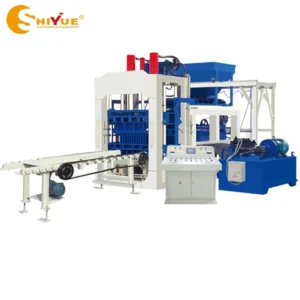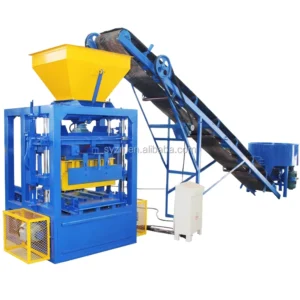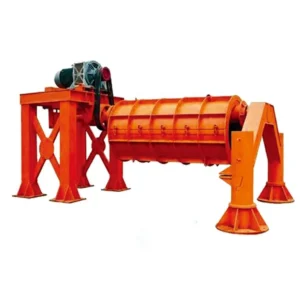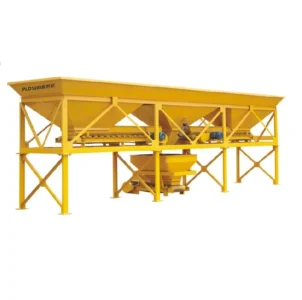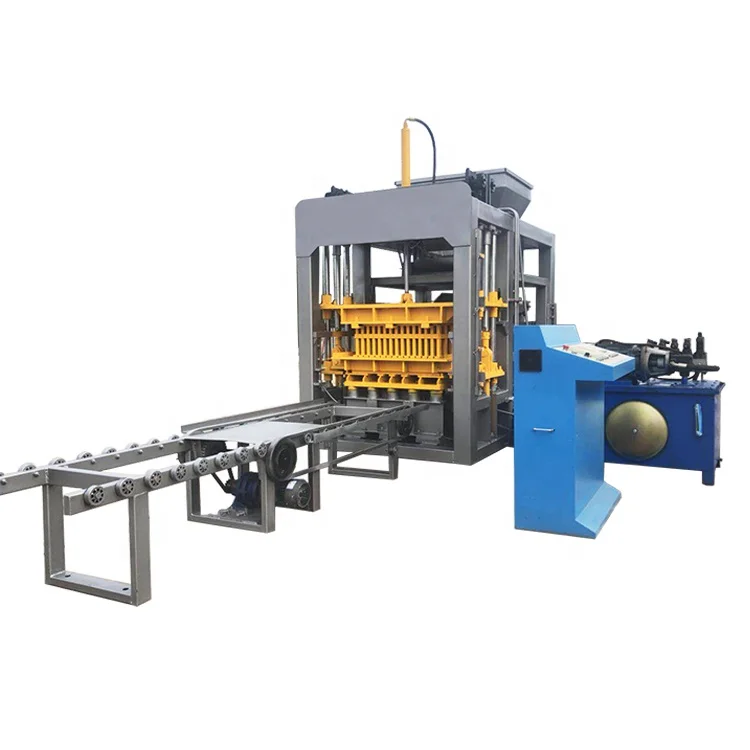
Matched System Integration — the QT5-15 automatic block machine production line is specified as a complete loop from raw material feeding to cured block cubing, so the press cycle never stalls waiting on an upstream or downstream station.
Technical Specifications
| Parameter | Value |
|---|---|
| Model | QT5-15 |
| Product Type | Automatic Hydraulic Concrete Block Making Machine |
| Rated Power | 26.5 kW |
| Voltage & Frequency | Configured to buyer’s local supply (confirmed before production) |
| Control System | PLC Controller with electric and hydraulic interlock |
| Overall Dimensions (L×W×H) | 7400 × 1950 × 2800 mm |
| Net Weight | 6000 kg |
| Hydraulic Pressure | 16–21 MPa |
| Vibration Force | 45 kN |
| Main Vibration Form | Platform vibration |
| Mould Cycle Time | 15–20 seconds |
| Pallet Size | 1100 × 550 mm |
| Output Capacity (Hollow Block 400×200×200 mm, 5 pcs/mould) | 7,200–9,600 pcs/day |
| Output Capacity (Porous Block 240×115×90 mm, 16 pcs/mould) | 23,000–28,800 pcs/day |
| Output Capacity (Standard Block 240×115×53 mm, 32 pcs/mould) | 61,440–70,400 pcs/day |
| Applied Products | Hollow/solid blocks, pavers, interlocking blocks, curbstone, colored pavers, porous blocks |
| Raw Material Compatibility | Crushed stone, sand, cement, fly ash, gravel, slag, industrial waste |
| Automation Level | Automatic (hydraulic + PLC) |
| Mould System | Mold-releasing oil cylinder; mold box locked into vibration table for synchronous vibration |
| Standards | CE declaration where applicable (confirmed per shipment) |
Application Suitability
| Application | Material or Output |
|---|---|
| Hollow block production for mid-scale building projects | Crushed stone, sand, and cement blends at 400×200×200 mm format |
| Paving stone and curbstone manufacturing | Dense aggregate mixes with pigment additives for colored pavers |
| Porous and interlocking brick lines | Fly ash, slag, and sand combinations at 240×115×90 mm |
| Standard solid block output for housing contractors | Local gravel and industrial waste aggregates at 240×115×53 mm |
Why Quoted Capacity Often Misses the Real Daily Output
A press that cycles every 15–20 seconds means nothing if the mixer or pallet feeder cannot keep up.
I once paired a QT-class press with an undersized pan mixer on a hollow block line. The press finished its cycle and then sat idle for twelve to fifteen seconds per mould waiting for the next batch. By the end of the shift, actual output had fallen noticeably short of the brochure figure. That mistake reshaped how I now lay out an automatic block machine production line — every upstream and downstream station must be calculated against the press cycle, not quoted in isolation [NEED_CITE: line balancing methodology for concrete block plants].
Synchronizing the Mixer Feed Rate with the Press Cycle
The QT5-15 completes a mould cycle in 15–20 seconds, which sets the tempo for the entire automatic block machine production line. The mixer must discharge a full batch into the hopper within that same window, or the press waits. I size the mixer volume and discharge gate to deliver slightly ahead of the press demand, building in a small buffer so raw material is always ready when the mould closes.
Pallet Circulation and Curing Rack Coordination
Every pressed block leaves the machine on a 1100 × 550 mm pallet. If pallets are not returned from the curing area fast enough, the press halts. The automatic block machine production line must therefore include a pallet return loop and curing rack handling system whose travel time matches or beats the press cycle. I calculate the pallet quantity based on total curing hours, rack capacity, and forklift turnaround so the line runs without manual pallet shuffling.
Reading the Specifications Behind the Output Figures
Hydraulic pressure in the 16–21 MPa range works together with the 45 kN platform vibration to compact the mix into a dense block. Higher pressure alone does not guarantee strength; the vibration must fluidize the aggregate so the hydraulic head can compress it uniformly. The mould box locks into the vibration table for synchronous vibration, meaning the mould walls and platform move as one unit during compaction — this reduces edge cracking and improves dimensional consistency across formats. Pallet size is not arbitrary either: 1100 × 550 mm was chosen so standard curing racks and forklifts handle the pallets without custom modifications, which keeps the downstream curing area aligned with the press output rate [NEED_CITE: hydraulic vibration compaction principles in concrete block forming].
What Happens When Line Stations Are Mismatched
When the stacking station is left out of the quotation, wet blocks pile up at the press exit and workers hand-stack them onto carts. The pallets then sit on the floor instead of entering the curing rack, which lengthens curing time and ties up pallet inventory. Over a full shift, the bottleneck migrates from the press to the curing area, and the daily output that looked solid on paper quietly drops. Buyers who treat the automatic block machine production line as a collection of separate purchases often discover these gaps only after commissioning [NEED_CITE: common block plant commissioning issues from incomplete line specifications].
Why This Line Configuration Approach Works
Block machinery is our single focus, so the QT5-15 press, its moulds, pallets, and handling equipment are specified as one matched system rather than assembled from separate suppliers. The line is configured against your actual mix design and local aggregate — not a catalogue default — so the hydraulic pressure and vibration settings align with the material you can source on site. Automation level is selectable: a buyer can start with semi-automatic pallet handling and add stacking and cubing later without replacing the press. Every configuration proposal includes a capacity calculation that states the block format assumed, so the output figure you plan against is the output figure the line delivers.
Documentation & Verification
- Line layout drawing showing station positions and pallet flow path for the QT5-15
- Capacity calculation sheet stating block format and cycle time at each station
- Hydraulic and electrical schematic for on-site line integration
- Voltage, frequency, and PLC display language confirmation form before production
- Factory test record on your target block format before dispatch
- Packing photographs and customs documentation support for shipment
Installation, Commissioning & Support
- Foundation plan referencing the 7400 × 1950 × 2800 mm footprint and load points of the QT5-15
- Electrical hookup guide for the 26.5 kW rated power with dedicated circuit requirements
- PLC parameter setup and interlock verification during first-day commissioning
- Operator training covering mould change procedure and cycle time adjustment per format
- Wear parts and mould list with reorder references for hydraulic seals and vibration components
- Scheduled maintenance intervals for the hydraulic system at 16–21 MPa operating pressure
Preparing Your Line Inquiry
To size the supporting equipment around the QT5-15, I need your target block format and daily volume, the raw materials available locally, and the curing space you have on site. Please also confirm your local voltage and frequency along with the preferred PLC display language so the control panel ships ready to run. If you already operate forklifts or curing racks, share their dimensions so pallet size and rack handling are coordinated from day one.
Frequently Asked Questions
Q: How is daily output calculated, and which block format is assumed?
A: Each output figure in the specification table states the exact block format and pieces per mould. For example, 7,200–9,600 hollow blocks per day assumes the 400×200×200 mm format at five pieces per mould with a 15–20 second cycle. When you request a quotation, we include a capacity sheet that recalculates output for your specific target format.
Q: How do upstream mixing and feeding rates match the press cycle?
A: The mixer batch volume and discharge gate are sized so a full batch reaches the press hopper within the 15–20 second mould cycle. We calculate feeder belt speed and hopper capacity to maintain a small material buffer, preventing the press from idling while waiting for the next mix.
Q: What pallet quantity is needed for continuous line operation?
A: Pallet count depends on total curing hours, rack capacity, and return-loop travel time. We calculate the required 1100 × 550 mm pallet inventory based on your curing area layout and forklift turnaround so the QT5-15 never stops for want of a pallet at the feed station.
Q: How is the line adapted to local raw materials and block strength targets?
A: We review your available aggregate — sand, crushed stone, fly ash, or slag — and adjust the hydraulic pressure within the 16–21 MPa range and vibration duration to reach the required block density. Mix proportions are confirmed before the line is finalized.
Q: Which supporting stations are included in the line quotation?
A: The quotation covers raw material feeding, mixing, pallet feeding, automatic stacking, curing rack handling, and cubing as applicable. Each station is listed with its cycle time so you can see how the automatic block machine production line connects from press to finished pallet stack.