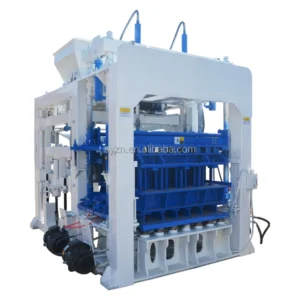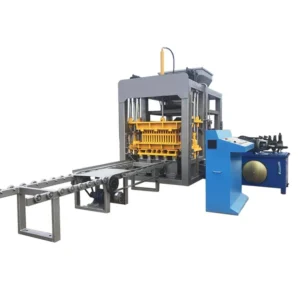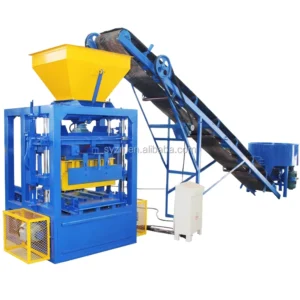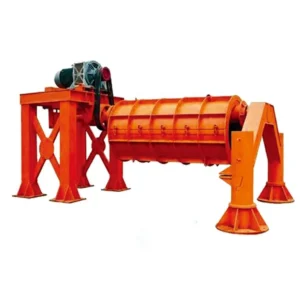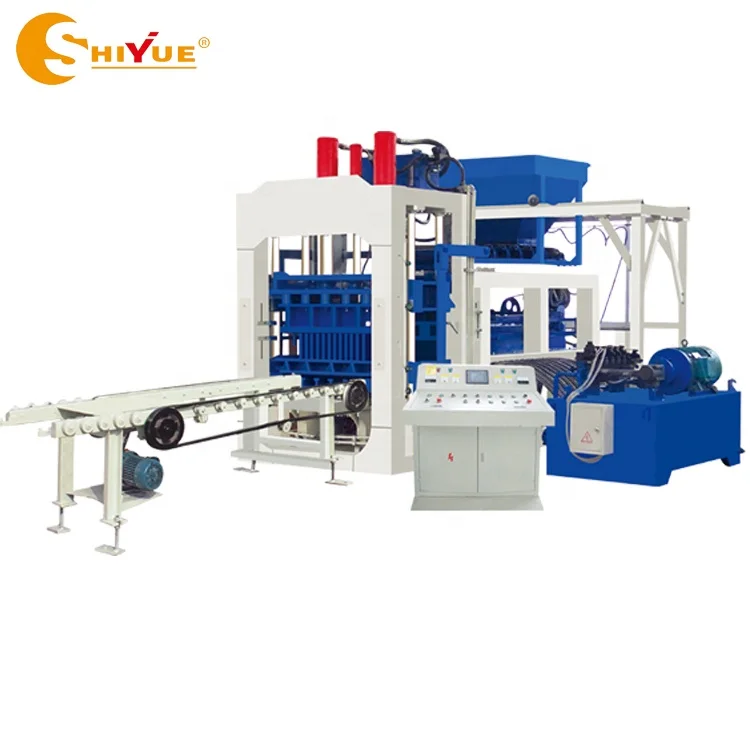
Complete Line Synchronization — Every station around the QT8-15 press is matched to its cycle time so the line produces as one system, not a collection of disconnected machines.
Technical Specifications
| Parameter | Value |
|---|---|
| Model | QT8-15 |
| Product Type | Automatic Block Making Machine |
| Overall Dimensions (L×W×H) | 8300×1860×3000 mm |
| Net Weight | 15 t (simple production line configuration) |
| Motor Power | 37 kW |
| Rated Pressure | 21 MPa |
| Vibration Force | 100 kN |
| Pallet Size | 950×900 mm |
| Control System | PLC with Siemens electronics |
| Motor Brand | Siemens |
| Remote Diagnostics | Applicable via PLC interface |
| Stacking Method | Automatic stacker lifting pallets with finished blocks |
| Color Feeder | Available for surface-pigmented paving bricks |
| Mould Manufacturing | Wire cutting and carburizing heat treatment |
| Mould Format & Productivity | Hollow block 390×190×190 mm (8 pcs/mould); Solid block 240×115×53 mm (39 pcs/mould); "S" interlock paver 225×112.5×60 mm (18 pcs/mould) |
| Cycle Time per Format | basis to be confirmed — depends on block format, material and thickness |
| Output Capacity | basis to be confirmed — depends on block format, material and thickness |
| Voltage & Frequency | to be confirmed before order |
| PLC Language Options | to be confirmed before order |
| Container Loading | 40ft HQ |
Application Suitability
| Application | Material or Output |
|---|---|
| Hollow block production for wall construction | Crushed stone, sand, cement, fly ash, and lightweight aggregates |
| Solid brick manufacturing for load-bearing structures | River sand, quarry dust, cement blends |
| Color paving brick for landscaping and municipal projects | Pigmented surface layer with standard concrete base |
| Interlocking paver for walkways and driveways | Fine aggregate, cement, mineral oxide pigments |
| Grass block and curbstone for infrastructure | Coarse aggregate, cement, reinforced mix designs |
Why the Mixer and Stacker Matter More Than the Press Alone
A block press only runs as fast as the slowest station feeding or clearing it.
Buyers often compare machines by the cycle time printed on a brochure, but a press sitting idle while the mixer finishes a batch or a worker carries a pallet away is not producing anything. I once configured a line in the Middle East where the press was sized correctly, yet the upstream batching could not keep up and the downstream handling was entirely manual. The automatic block making machine production line ended up running at half its realistic output because nobody balanced the stations. The QT8-15 needs a mixer discharge rate, a pallet return speed, and a stacker lift cycle that all converge on the same beat. When any one of those drifts, the gap shows up directly on the daily tally [NEED_CITE: line balancing principles for concrete block production].
Matching Every Station to the QT8-15 Rhythm
The QT8-15 sits at the center of an automatic block making machine production line, and every peripheral station must be specified against its vibration cycle, not a generic default. Raw material feeding, mixing, pallet circulation, stacking, and curing rack handling are configured as one matched system. The goal is that when the press completes a moulding cycle, the next charged pallet is already in position and the finished pallet is already being lifted away. This is where most quoted capacities fall apart in practice — the press is capable, but the line around it is not.
How the Color Feeder Fits Without Disrupting Flow
Adding a color feeder station for surface-pigmented pavers introduces an extra dosing and spreading step into the cycle. If the feeder is not timed to the press, it becomes the new bottleneck. The color feeder on this line is integrated into the pallet transit path so that pigmented surface material is applied during the same pallet advance that positions the block under the main hopper. This keeps the automatic block making machine production line running continuous paver output without stopping to switch processes or add a secondary color line downstream [NEED_CITE: multi-layer paving block production workflow].
Reading the Specifications That Actually Shape Your Line
Hydraulic pressure at 21 MPa and vibration force at 100 kN work together to compact the mix into the mould cavity. Higher pressure alone does not guarantee a stronger block if the vibration is insufficient to settle fine particles into voids, and vice versa. The 950×900 mm pallet size determines how many blocks form per cycle, but it also dictates the curing rack dimensions and forklift capacity you need on the other end. A mismatch here means buying new racking or replacing pallets that do not fit your existing yard. The 37 kW motor power must be matched to your site’s electrical supply — voltage, frequency, and phase all need written confirmation before the cabinet is wired. The PLC with Siemens electronics and remote diagnostics capability means an off-site technician can review fault logs without flying to your plant, which matters during the first weeks of commissioning.
What Happens When the Line Is Not Balanced
When upstream and downstream stations are chosen independently, the consequences compound. A mixer that discharges slower than the press cycles means the vibration table waits. Manual pallet removal after pressing introduces a variable delay that widens with each shift as workers fatigue. Pallets sized without regard to your curing area force you to reconfigure the yard or handle blocks twice. Voltage mismatches discovered after the machine arrives can delay commissioning by weeks while transformers are sourced locally. These are not theoretical — they are the most common reasons a new block plant runs below its nameplate capacity in the first six months [NEED_CITE: common commissioning delays in block plant startup].
Why Configure the Line Here Rather Than Assemble It Yourself
Block machinery is the single focus, so the press, moulds, pallets, and handling equipment are specified as one matched system rather than assembled from separate vendors. The QT8-15 configuration is set against your actual mix design, local aggregate, and target block format instead of a catalogue default. Mould design covers the formats your market sells, with custom drawings available when standard formats do not match. Automation level is selectable — you can start with semi-automatic pallet handling and add the stacker and cubing system later without replacing the press. Installation support includes operator training on your specific line configuration, not a generic manual handed over at the container door.
Documentation & Verification
- Line layout showing station spacing and pallet flow path for the QT8-15
- Capacity calculation stating the exact block format assumed for each output figure
- Mould drawing and format list with wire cutting and carburizing specifications
- Hydraulic and electrical schematic matching the as-built 37 kW configuration
- Voltage, frequency, and PLC display language confirmed in writing before production
- Factory test record on your specified block format and mix before container loading
Installation, Commissioning & Support
- Foundation pad leveled to support 15 t net weight across the 8300 mm machine length
- Dedicated electrical circuit sized for 37 kW motor draw at your confirmed voltage and frequency
- Machine dismantled for 40ft HQ loading with reassembly supervised on site
- PLC language and Siemens electronics interface configured to operator preference before first run
- Pallet size 950×900 mm verified against your curing rack spacing and forklift fork width
- Wear parts list and mould replacement schedule provided at handover
What to Prepare Before Requesting a Line Quote
To configure the automatic block making machine production line around your actual conditions, we need your target block formats with dimensions, the daily output you plan to run per format, and the raw materials available locally including aggregate gradation. Your site voltage and frequency, preferred PLC display language, and existing curing area dimensions with forklift capacity determine the pallet and electrical specification. If you already operate upstream or downstream equipment, share the model and cycle rates so the QT8-15 can be matched to them rather than the other way around.
Frequently Asked Questions
Q: How is daily output calculated across the full line, and which block format is assumed?
A: Daily output is stated per block format, not as a single number. The QT8-15 moulds produce 8 hollow blocks, 39 solid bricks, or 18 interlock pavers per cycle, but the actual hourly rate depends on your mix, material moisture, and how the mixer and stacker are timed to the press. Every capacity figure in the proposal names the format it assumes.
Q: How do upstream and downstream stations match the QT8-15 cycle time?
A: The mixer discharge rate, pallet feed speed, and stacker lift cycle are each specified against the press vibration and moulding cycle. If any station runs slower, the press waits. The line layout document shows the timing relationship between every station so the bottleneck is visible before equipment is built.
Q: What pallet size and material does the line require, and can it match my existing curing infrastructure?
A: The QT8-15 uses 950×900 mm pallets. Before order, we verify this against your curing rack slot width, rack spacing, and forklift capacity. If your existing infrastructure uses a different dimension, the pallet and mould configuration can be adjusted to match rather than forcing you to rebuild the yard.
Q: Can the line start semi-automatic and upgrade to full stacking later?
A: Yes. The QT8-15 automation level is selectable. You can begin with manual pallet handling and add the automatic stacker and cubing system as a later phase without replacing the press or changing the PLC platform. The Siemens electronics architecture supports this upgrade path.
Q: What documentation is provided for commissioning the line?
A: You receive hydraulic and electrical schematics matching the as-built configuration, a factory test record on your block format, the PLC language confirmation, mould drawings, a wear parts list, and packing photographs. CE declaration documentation is available where applicable for customs and regulatory compliance.