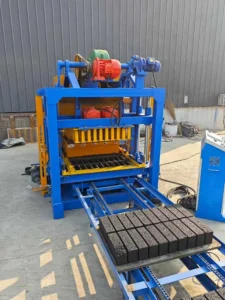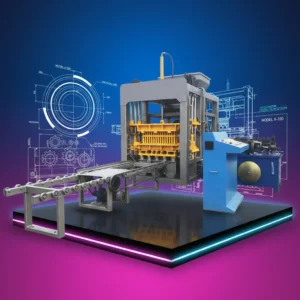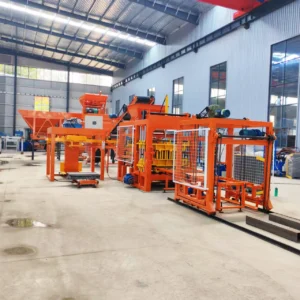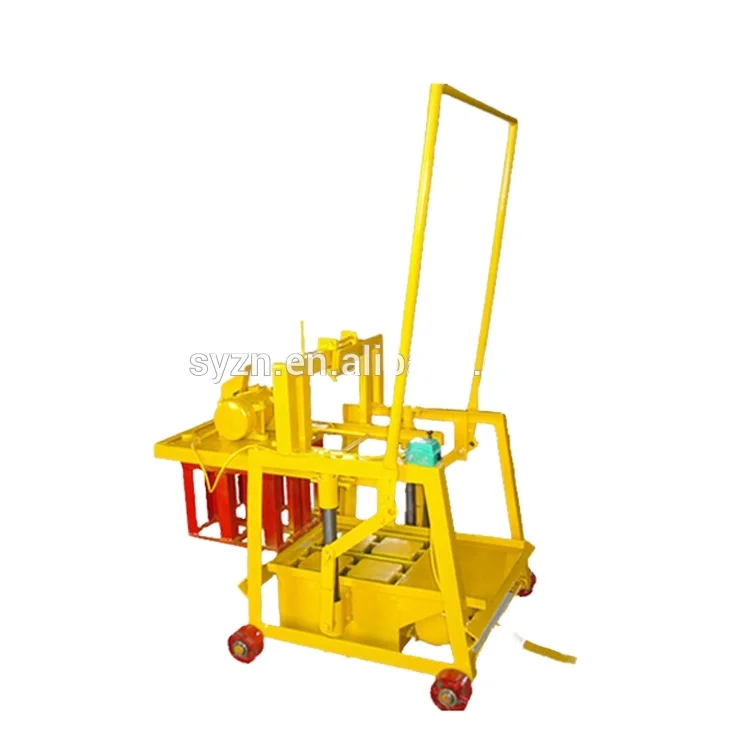
Matched System Supply — The QMY2-45 mobile egg-laying block machine ships with its JQ350 mixer, mould and manual handling logic specified as one connected line rather than three separate purchases.
Technical Specifications
| Parameter | Value |
|---|---|
| Model | QMY2-45 |
| Product Type | Mobile Egg-Laying Block Making Machine |
| Rated Power | 1.5 kW |
| Voltage & Frequency | Customized to local supply (basis to be confirmed before order) |
| Control System | Manual operation |
| Overall Dimensions (L × W × H) | 1000 × 800 × 1300 mm |
| Net Weight | 215 kg |
| Mould Format | 400 × 200 × 200 mm hollow block, 2 cavities per mould |
| Vibration Type | Mold box vibration |
| Cycle Time | 45 s per cycle (basis not stated in source) |
| Output Capacity | 1000 pcs/day (basis not stated in source — confirm block format and working hours) |
| Basic Equipment Included | JQ350 Mixer |
| Automation Level | Manual / mobile egg-laying |
| Assembly State | Fully assembled, nude packing |
| Warranty | 1 year (excluding wearing parts) |
Application Suitability
| Application | Material or Output |
|---|---|
| On-site hollow block production for housing projects | Crushed stone, river sand, cement |
| Startup block plants with limited capital | Local aggregate blends with standard cement ratios |
| Supplemental production beside a fixed line | Same raw mix as the main plant for format flexibility |
| Remote construction sites without grid power access | Low-voltage diesel-generator-compatible setups |
What a "Mobile Block Machine Production Line" Actually Requires on the Ground
A mobile press alone does not make blocks — the mixer, curing area, and manual transport path must be planned before the first cycle runs.
Many first-time buyers assume the machine quotation covers everything needed to produce saleable hollow blocks. In practice, the QMY2-45 sits at the centre of a minimal line: the JQ350 mixer feeds wet concrete into the mould box, the press vibrates and releases the block onto the ground, and workers must move, stack, and cure the output by hand. When any of these surrounding stations is missing or undersized, the press spends most of the shift waiting. [NEED_CITE: common causes of idle time in small-scale block plants]
How the Mixer and Press Connect as One Line
The JQ350 mixer is bundled as basic equipment with this mobile block machine production line, which removes one sourcing decision from the buyer. A 350-litre drum capacity means each batch must be timed so the mixer empties before the next cycle of the QMY2-45 demands fresh concrete. When the batch size and the mould volume are mismatched, either the mixer runs half-empty or the press operator waits for the next mix.
Where Curing and Transport Fit into the Footprint
Because the QMY2-45 is an egg-laying type, it deposits blocks directly on the ground or a prepared floor surface. This eliminates pallet costs but shifts the burden to curing logistics: the area around the press must be flat, shaded, and large enough to hold a full day’s output without blocking the machine’s next travel path. At roughly 1000 × 800 mm in footprint, the press itself is compact, but the surrounding curing zone will occupy several times that area. [NEED_CITE: floor space planning for ground-cured block production]
Reading the Specs That Matter for Daily Output
The 1.5 kW rated power keeps utility demand low enough for sites running on portable generators, which is a genuine advantage for remote project locations. The 215 kg net weight means two workers can reposition the machine without a forklift, supporting the on-site mobility that defines this equipment class. Mold box vibration is tuned to the 400 × 200 × 200 mm two-cavity hollow block format — switching to a solid block or paver mould would change the vibration response and must be evaluated separately. The 45-second cycle time and 1000 pcs/day figures are quoted without a stated block format or shift length, so any capacity planning should confirm these assumptions with the supplier before committing.
The Hidden Cost of Skipping the Line Layout
Buyers who order the press without mapping the supporting stations often discover that their curing area is too small, their mixer batch cycle is too slow, or their local aggregate requires a different water-to-cement ratio than the default setting assumes. The result is a machine that technically runs but produces blocks with inconsistent density and strength. In my years configuring block lines in Shandong, I have watched entire first production runs get rejected because the mix design was never tested against the buyer’s actual sand source. [NEED_CITE: aggregate variability effects on block compressive strength]
Why Sourcing the Line Together Matters
The QMY2-45 and its JQ350 mixer are specified as a matched pair, so the batch volume and cycle rhythm are aligned from the start. Block machinery is our single focus, which means the mould, machine, and handling logic are evaluated against the buyer’s target block format rather than pulled from a generic catalogue. Voltage and frequency are confirmed before production so the motor arrives matched to the site’s electrical supply. A factory test record is generated on the buyer’s stated block format before dispatch. The automation level is selectable — a buyer starting with this manual egg-laying unit can plan a future move to semi-automatic or fully automatic operation without replacing the entire line concept.
Documentation & Verification
- Line layout drawing showing mixer, press, and curing zone positions for the QMY2-45 footprint
- Factory test record run on the buyer’s specified 400 × 200 × 200 mm hollow block format
- Voltage and frequency confirmation sheet signed before production begins
- Operation and maintenance manual covering both the QMY2-45 press and JQ350 mixer
- Wear parts and mould list with part numbers for first replacement planning
Installation, Commissioning & Support
- Level concrete floor required; the 1000 × 800 × 1300 mm footprint needs no bolted foundation
- Dedicated 1.5 kW circuit at the confirmed local voltage and frequency for the press motor
- Fully assembled nude packing — no reassembly needed beyond mixer drum mounting
- First-run cycle timing adjusted on site to match the buyer’s actual mix and aggregate
- Operator training covers mould box vibration settings and JQ350 batch sequencing
- Wear parts list provided so mould and vibration components can be reordered before stockout
Before You Send the Inquiry
To size this mobile block machine production line correctly, share your target block format, the local aggregate type you plan to use, and the available curing area dimensions. Confirm your site’s voltage and frequency so the motor can be wound to match. If you already own a mixer or other handling equipment, let us know so the line configuration accounts for what you have rather than duplicating it.
Frequently Asked Questions
Q: How is the 1000 pcs/day output calculated and for which block format?
A: The 1000 pcs/day figure is quoted in the source without a stated block format, shift length, or cycle assumption. For the 400 × 200 × 200 mm two-cavity hollow block, realistic daily output depends on mixer batch speed, worker count, and curing area capacity. Confirm these variables before treating any single number as a guaranteed target.
Q: What supporting stations are needed around the QMY2-45 to form a complete line?
A: Beyond the included JQ350 mixer, you need a flat curing area large enough for a full day’s output, manual transport tools such as wheelbarrows, a water source for mix preparation and block curing, and shaded storage for finished blocks. The press itself is mobile, but the curing zone must remain fixed and accessible.
Q: Can the motor voltage and frequency be matched to my site’s electrical supply?
A: Yes. Voltage and frequency are customized to the buyer’s local supply, but this must be confirmed before production starts. Providing your site’s exact voltage, phase, and frequency in the inquiry avoids commissioning delays caused by a motor wound for the wrong standard.
Q: What is included in basic equipment and what must be sourced locally?
A: The QMY2-45 press and JQ350 mixer are included. Buyers typically source cement, aggregate, water supply, curing covers, and manual transport equipment locally. Pallets are not required for egg-laying operation, but a prepared flat floor surface is essential.