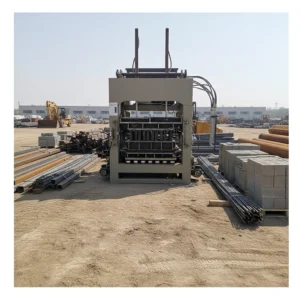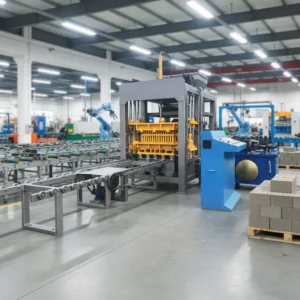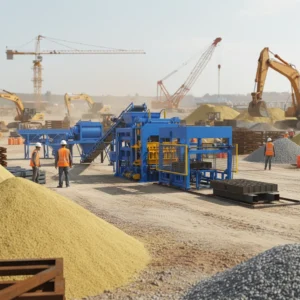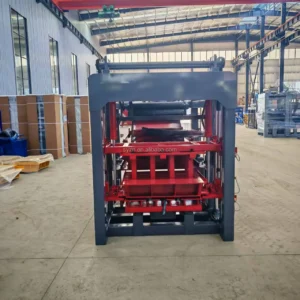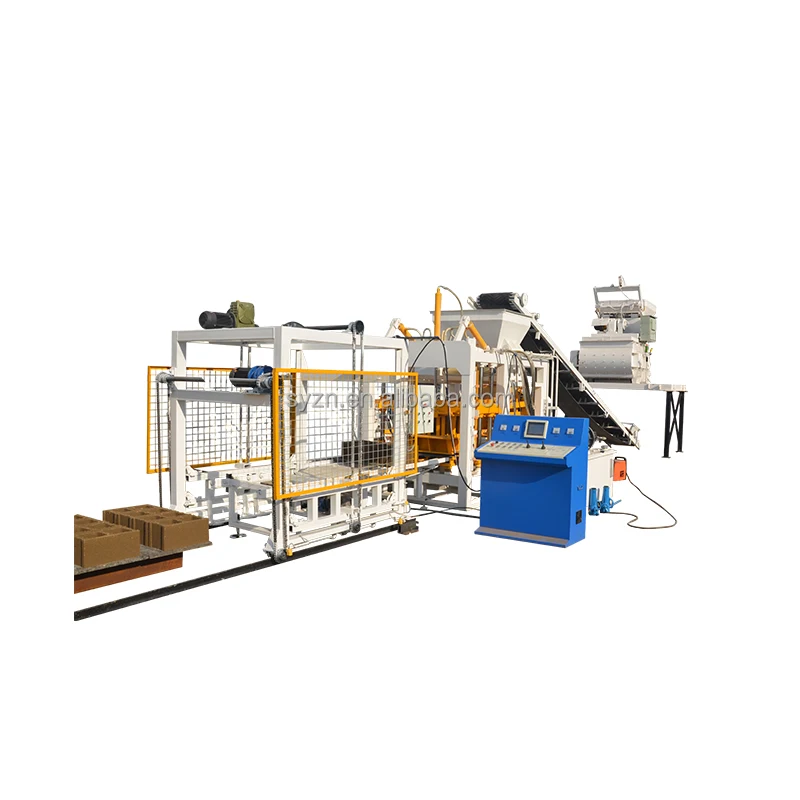
Matched Line Configuration — Every station from the mixer to the sweeper is timed to the QT4-15A press cycle so no equipment sits idle between moulding strokes.
Technical Specifications
| Parameter | Value |
|---|---|
| Model | QT4-15A |
| Product Type | Automatic Concrete Block Making Machine |
| Overall Dimensions (L×W×H) | 7100×1600×2610 mm |
| Molding Cycle | 15–25 s |
| Vibration Frequency | 4600 r/min |
| Vibration Force (Exciting Power) | 40–50 kN |
| Total Power | 18.45 kW |
| Mixer Model | JQ350 |
| Pallet Size | 850×550×25 mm |
| Net Weight | 3 T |
| Applied Products | paver, solid block, hollow block, curbstone |
| Raw Materials | crushed stone, sand, cement, dust, fly ash |
| Control System | PLC control system |
| Included Line Equipment | block making machine, hydraulic station, PLC control system, pallet feeder, brick conveyor, block sweeper |
| Output Capacity (Hollow Block) | 408 pcs/h (basis: 400×200×200 mm, 4 pcs/mould) |
| Output Capacity (Hollow Block) | 510 pcs/h (basis: 400×150×200 mm, 5 pcs/mould) |
| Output Capacity (Solid Brick) | 2100 pcs/h (basis: 240×115×53 mm, 18 pcs/mould) |
Application Suitability
| Application | Material or Output |
|---|---|
| Hollow block production for building walls | Crushed stone, sand, cement, fly ash |
| Solid brick manufacturing for load-bearing structures | Sand, cement, dust, stone powder |
| Paver and curbstone production for infrastructure | Crushed stone, cement, pigment (if applicable) |
| On-site block production for housing projects | Locally sourced aggregate and cement |
Why Synchronization Beats Raw Cycle Speed in an automatic block making machine production line
A 15-second moulding cycle means nothing if the pallet feeder takes 20 seconds to deliver the next board.
Many quotations list an impressive cycles-per-hour figure without showing what happens upstream and downstream of the press. I have stood on sites where operators were hand-feeding pallets while the hydraulic station sat idle, cutting real daily output to a fraction of the brochure number. [NEED_CITE: Impact of line synchronization on effective block plant throughput] When you evaluate an automatic block making machine production line, the question is not how fast the press can cycle in isolation, but whether the pallet feeder, conveyor and sweeper can all match that rhythm without forcing the press to wait.
Pallet Feeding and Downstream Handling as Standard Stations
The QT4-15A line ships with a pallet feeder matched to the 850×550×25 mm pallet format. This is not an optional add-on quoted later; it arrives as part of the automatic block making machine production line package. The feeder places a board into the press exactly as the previous cycle finishes, keeping the 15–25 second moulding rhythm intact. Downstream, the brick conveyor carries loaded pallets away while the block sweeper cleans the mould face, preparing the press for the next charge without manual intervention.
Mixer Throughput and Press Demand Across Formats
When the line produces 400×200×200 mm hollow blocks at 408 pieces per hour (4 pcs/mould), the JQ350 mixer must deliver a continuous supply of prepared mix to the hopper. Switch the mould to 240×115×53 mm solid bricks and the press now demands 2100 pieces per hour (18 pcs/mould) of dense material. [NEED_CITE: Raw material consumption rates across different block formats] The mixer position, batch size and discharge timing must accommodate this swing. A line that only specifies the press leaves this calculation to the buyer, often resulting in a mixer that starves the hopper during solid brick runs.
Reading the Specifications Beyond the Press Footprint
The vibration frequency of 4600 r/min and exciting power of 40–50 kN determine how densely the mix is compacted inside the mould box, directly affecting block strength. But density also depends on hydraulic pressure working in tandem with vibration. If pressure is set too low for a particular aggregate, the blocks will crumble at the edges when the sweeper brushes the mould. The PLC control system coordinates vibration duration, pressure application and mould release in a single sequence, so adjusting for a different raw material means changing parameters on the screen rather than rewriting relay logic. [NEED_CITE: Relationship between hydraulic pressure and vibration force in block compaction]
The Cost of Treating the Press as a Standalone Purchase
When the pallet feeder, conveyor and sweeper are sourced separately after the press arrives, the buyer faces integration problems that delay commissioning. A conveyor running too fast drops fresh blocks off the pallet; one running too slow creates a queue that backs up to the press discharge. I have seen plants where the sweeper motor was rated for a different voltage than the PLC output, requiring a transformer that nobody had ordered. These are not engineering failures — they are specification failures, and they happen because the surrounding line was never quoted as a single system. [NEED_CITE: Common commissioning delays caused by mismatched line equipment]
What We Configure Before the Machine Ships
Block machinery is our single focus, so the press, pallet feeder, conveyor, sweeper and mixer are specified together against your target block format and local aggregate. Line layout drawings show each station’s cycle time, confirming synchronization to the 15–25 second moulding window. Capacity calculations state the exact block format assumed, so your daily output expectation is grounded in reality, not a catalogue default. Mould design covers the formats your market actually sells, with changeover procedures documented. Voltage, frequency and PLC display language are confirmed in writing before production begins, preventing the arrival-day surprises that halt commissioning.
Documentation & Verification
- Line layout drawing showing station sequence and cycle time for each format
- Capacity calculation sheet stating the specific block dimensions assumed
- Pallet specification confirming size, material and load rating match your curing area
- Hydraulic and electrical schematic with voltage and frequency confirmed per your site
- Factory test record running your target block format before container loading
- Operation manual covering mould change procedures and PLC parameter adjustment
Installation, Commissioning & Support
- Foundation plan sized to the 7100×1600 mm press footprint and 3 T operating weight
- Power supply spec confirming 18.45 kW total draw and dedicated circuit for the hydraulic station
- Pre-assembly verification of pallet feeder alignment to the 850×550 mm pallet path
- Commissioning sequence testing all three block formats through the full line cycle
- Operator training covering PLC parameter changes for different raw material mixes
- Wear parts list including mould liners, hydraulic seals and sweeper brush elements
What to Include in Your Inquiry
Send us your target block formats with dimensions, your daily output requirement per format, and a sample or description of the local aggregate you will use. We also need your site voltage and frequency, preferred PLC display language, and whether your existing forklift and curing area are already set up for a specific pallet size. With that information, we can configure the automatic block making machine production line and return a line layout that shows exactly how each station connects.
Frequently Asked Questions
Q: How is the line capacity calculated, and which block format does each output figure assume?
A: Every capacity figure states the exact block dimensions and pieces per mould it assumes. For example, 408 pieces per hour is based on 400×200×200 mm hollow blocks at 4 pieces per mould, while 2100 pieces per hour assumes 240×115×53 mm solid bricks at 18 pieces per mould. We provide a calculation sheet so you can see the cycle time and format behind each number.
Q: What happens if the pallet feeder or conveyor cycle does not match the press?
A: The PLC control system coordinates all stations to the 15–25 second moulding cycle. The pallet feeder is timed to deliver a board as the press completes its stroke, and the conveyor speed is set to clear loaded pallets before the next discharge. Factory testing verifies this synchronization before shipment.
Q: Can the line be expanded later with automatic stacking or curing rack handling?
A: The standard configuration includes pallet feeding, conveying and sweeping. If you plan to add automatic stacking or curing rack handling later, tell us during the quotation stage so the line layout reserves space and the PLC program includes expansion points for those future stations.
Q: How do I confirm voltage, frequency and PLC language before production?
A: We send a written confirmation form listing your required voltage, frequency and PLC display language for your signature before production begins. This prevents the common problem where a machine arrives with a control panel the operators cannot read or a motor that does not match the local grid.