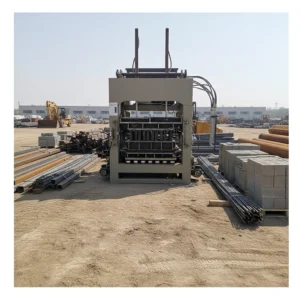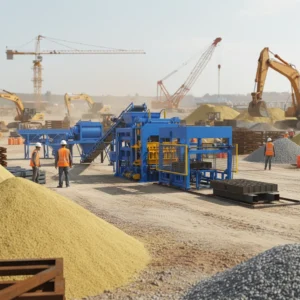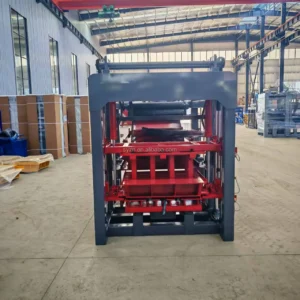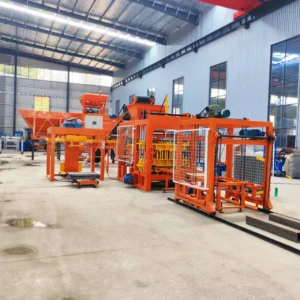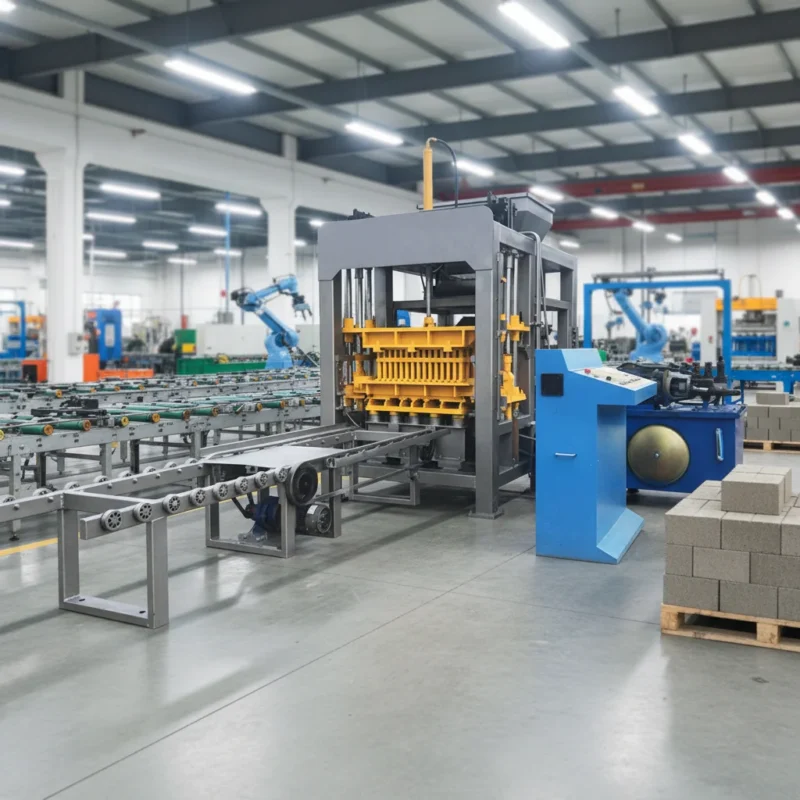
Matched Line Integration — every station from raw material feeding through to stacking is specified against the QT10-15 press cycle so no unit waits on another.
Technical Specifications
| Parameter | Value |
|---|---|
| Model | QT10-15 |
| Product Type | Automatic Cement Block Making Machine |
| Control System | PLC control cabinet |
| Hydraulic System | Independent integrated hydraulic station |
| Vibration Mode | Vertical station mode resonance with automatic FM-AM |
| Mould Change | Simple replacement for multi-format production |
| Core Components | Pallet feed machine, block making machine, storage hopper, conveyor, hydraulic unit, PLC control cabinet |
| Output Capacity (400×200×200mm hollow block) | 1800–2400 pcs/hour, 14400–19200 pcs/8hr (based on 10 pcs/mould, 15–20s cycle) |
| Output Capacity (400×150×200mm hollow block) | 2160–2880 pcs/hour, 17280–23040 pcs/8hr (based on 12 pcs/mould, 15–20s cycle) |
| Output Capacity (240×115×53mm solid brick) | 8928–11160 pcs/hour, 71424–89280 pcs/8hr (based on 62 pcs/mould, 15–20s cycle) |
| Output Capacity (200×100×60mm paving block) | 5184–6480 pcs/hour, 41472–51840 pcs/8hr (based on 27 pcs/mould, 20–25s cycle) |
| Output Capacity (225×112.5×60mm interlocking brick) | 4032–5040 pcs/hour, 32256–40320 pcs/8hr (based on 24 pcs/mould, 20–25s cycle) |
| Cycle Time | 15–20s for hollow blocks and solid bricks; 20–25s for paving and interlocking bricks |
| Mould Formats | Hollow block, multicellular brick, paving brick, standard brick |
| Automation Level | Automatic (pallet feed, hydraulic press, PLC-controlled) |
| Warranty | 1 year for whole machine (excluding spare parts) |
| Rated Power (kW) | (basis to be confirmed) |
| Voltage & Frequency | (basis to be confirmed) |
| Overall Dimensions (L×W×H) | (basis to be confirmed) |
| Pallet Size | (basis to be confirmed) |
| Hydraulic Pressure (MPa) | (basis to be confirmed) |
| Vibration Force (kN) | (basis to be confirmed) |
Application Suitability
| Application | Material or Output |
|---|---|
| Hollow block production for building walls | Crushed stone, sand, cement, fly ash aggregate mixes |
| Solid brick manufacturing for masonry | Fine aggregate and cement blends |
| Paving block production for roads and walkways | High-density concrete with coarse aggregate |
| Interlocking brick forming for landscape and retaining walls | Cement-stabilised soil or aggregate mixes |
| On-site block production for housing projects | Locally sourced sand, gravel and cement |
What "Cycles per Hour" Hides About Your automatic block making machine production line
A press running 15-second cycles is useless if the mixer delivers batch every four minutes or the stacker jams every twentieth pallet.
I watched a QT10-15 class press sit idle in an Indonesian block plant because the buyer ordered the press alone and sourced the mixer and stacker locally. The upstream mixer could not keep up with the press appetite, and the downstream stacker misaligned every few cycles. The entire line stalled at two different stations while the press waited. That automatic block making machine production line took half a month to resequence before it ran continuously [NEED_CITE: line synchronisation failures in block plants].
How the Stations Connect Around the Press
The QT10-15 press sits at the centre of a sequence that starts with raw material feeding into the storage hopper, moves through the conveyor delivering measured batches, presses on a pallet fed automatically, then releases the loaded pallet for stacking and curing rack transfer. Each station must complete its task within the press cycle window — 15 to 20 seconds for hollow and solid formats, 20 to 25 seconds for paving and interlocking bricks. When the automatic block making machine production line is configured as one system, the PLC coordinates every station against that window rather than leaving each unit to run at its own speed.
Why Line Balancing Matters More Than Press Speed
A press with a faster cycle time does not raise daily output if the pallet feed station cannot deliver pallets in time or the stacking unit backs up loaded pallets at the exit. In the Indonesian project, the real bottleneck was not the press but the gap between stations — the conveyor dropped material too slowly and the stacker gripper timing drifted after extended runs. Matching every station to the QT10-15 cycle eliminates those gaps and keeps the line running at its designed rhythm across a full shift [NEED_CITE: PLC-synchronised block line throughput].
Reading the Specifications That Actually Shape Output
Hydraulic pressure and vibration force together determine the density and compressive strength of every block leaving the mould. The independent integrated hydraulic station on the QT10-15 is isolated from host vibration, which keeps pressure stable across consecutive cycles rather than letting it fluctuate as dust and shock load the valves. The vertical station mode resonance with automatic FM-AM tuning adjusts vibration frequency and amplitude to suit different mix designs — a fine sand mix needs different vibration energy than a coarse aggregate mix, and this adjustment happens without manual dial changes. Pallet size directly affects how many blocks fit per cycle and must align with the curing rack dimensions and the forklift capacity already on site. Mould change is designed as a simple replacement so that switching from hollow block to paving block format does not consume an entire shift.
The Cost of Treating the Press as a Standalone Purchase
When a buyer orders the press without specifying upstream and downstream stations as part of the same line, the gaps show up at commissioning. The mixer runs at its own batch rhythm, the pallet feeder uses a different brand sensor that the PLC cannot read, and the stacker was never told the pallet dimensions. The result is a line that technically works but never reaches continuous output. Fixing those mismatches after installation means replacing components, rewriting PLC logic, and losing production weeks [NEED_CITE: post-installation line integration costs in block production].
Why a Line-First Approach Changes the Outcome
The QT10-15 is specified here as the core of a matched system rather than a catalogue item sold alone. Every station — raw material feeding, mixing, pallet feeding, stacking, curing rack handling — is selected so its cycle time fits within the press window. The line layout states the block format assumed for each output figure, so the daily planning number you see is tied to a specific mould, cavity count and cycle time. Configuration is set against the buyer’s local aggregate and target block format, not a default catalogue setting. Automation level is selectable, meaning a plant can start with semi-automatic pallet handling and add stacking and cubing later without replacing the press. Installation support covers the full line, not only the press, with operator training on PLC operation and station coordination.
Documentation & Verification
- Line layout and capacity calculation stating the block format and mould cavity count assumed for each output figure
- Machine specification sheet with cycle time listed per format, not a single aggregate number
- Hydraulic and electrical schematic confirming voltage, frequency and PLC display language before shipment
- Pallet specification matched to the buyer’s curing rack spacing and forklift capacity
- Factory test record run on the buyer’s target block format before dispatch
Installation, Commissioning & Support
- Foundation plan sized to the QT10-15 overall dimensions and vibration load distribution
- Dedicated power circuit matching the confirmed voltage and frequency before the press arrives on site
- PLC language and display set to the operator’s working language during factory configuration
- First-run commissioning covering full line coordination from hopper feed through to stacking station
- Operator training on mould change procedure and FM-AM vibration adjustment for local aggregate
- Wear parts and mould list provided with recommended replacement intervals per component
Before You Request a Quote
Share your target block formats, required daily output per format, and the local aggregate and cement type you plan to use. Confirm your site voltage, frequency, and preferred PLC display language. Let us know your existing curing area dimensions and forklift capacity so the pallet size and stacking station are matched from the start.
Frequently Asked Questions
Q: How is line capacity calculated when the press cycle must match upstream mixing and downstream stacking speed?
A: Each output figure for the QT10-15 is tied to a specific block format, mould cavity count and cycle time. The upstream mixer batch size and the downstream stacker cycle are both set against that press window so no station waits. The line layout document states the format assumed for every capacity number.
Q: What pallet size and material does the QT10-15 require, and how does it align with my curing area?
A: Pallet size is confirmed during line configuration based on your mould selection, curing rack spacing and forklift capacity. The pallet material is chosen to withstand the vibration force and hydraulic pressure of each cycle without warping across repeated curing heat exposure.
Q: Which block formats share the same pallet, and which require a pallet change that affects throughput?
A: Hollow blocks and solid bricks of similar footprint typically share one pallet size, while paving and interlocking bricks may need a different pallet dimension. A pallet change adds handling time, so the line quotation states which formats run on the same pallet and which require a separate set.
Q: How are raw material feeding and storage hopper capacity sized so the press is never starved?
A: The storage hopper volume and conveyor feed rate are calculated against the QT10-15 cycle time and mould cavity count. The mixer batch output is matched so that a fresh batch arrives before the hopper level drops below the minimum feed threshold during continuous pressing.
Q: What is included in the line quotation versus what is left for the buyer to source separately?
A: The quotation covers the press, pallet feeder, storage hopper, conveyor, hydraulic unit and PLC cabinet. Stacking, curing racks and cubing stations are included when selected. Items left for the buyer are stated explicitly in the line layout so there are no surprise gaps at installation.