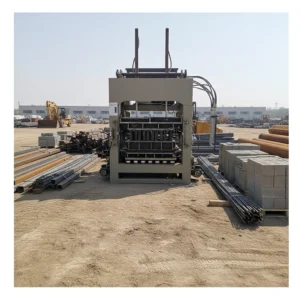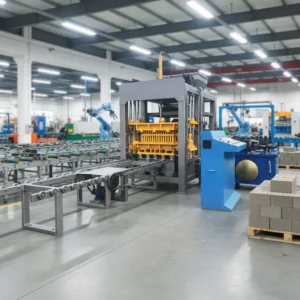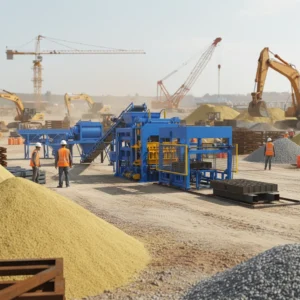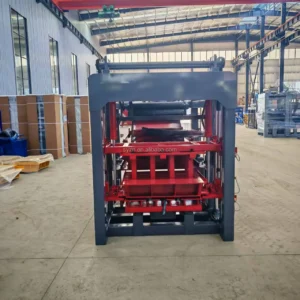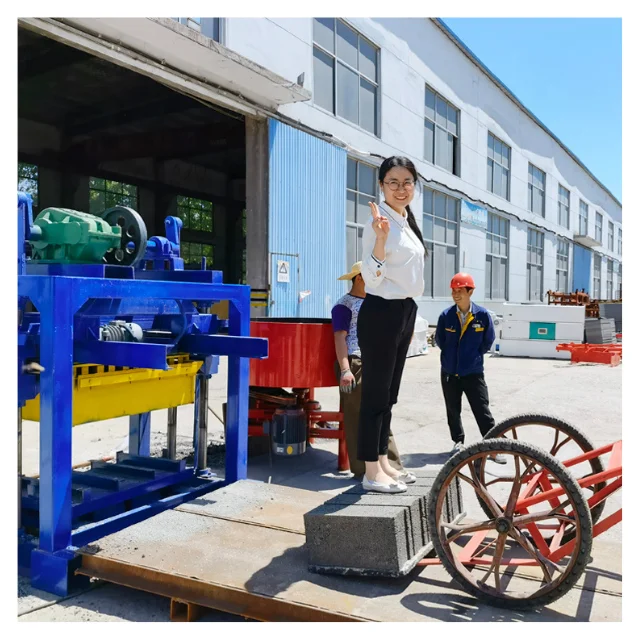
Matched Line Layout — the QTJ4-40 press is specified alongside its mixer, pallet return and stacking stations so cycle pace is never bottlenecked by upstream or downstream gaps.
Technical Specifications
| Parameter | Value |
|---|---|
| Model | QTJ4-40 |
| Product Type | Semi-Automatic Concrete Block Making Machine |
| Rated Power | 9.5 kW |
| Molding Cycle | 40 s |
| Theoretical Output (400×200×200 mm hollow block) | 4 pcs/mould, 360 pcs/h, 2800 pcs/day |
| Theoretical Output (400×150×200 mm hollow block) | 5 pcs/mould, 450 pcs/h, 3600 pcs/day |
| Theoretical Output (225×112.5×60 mm solid brick) | 9 pcs/mould, 800 pcs/h, 6400 pcs/day |
| Overall Dimensions (L×W×H) | 1350 × 1460 × 1800 mm |
| Machine Weight | 1 T |
| Pallet Size | 850 × 450 mm |
| Vibration System | Bed mould vertical vibration + upper mould compression vibration |
| Mould Operation | Top die push-and-pull with automatic scraper |
| Automation Level | Semi-automatic |
| Voltage | Configured to local supply (confirmed before production) |
| Raw Materials | Concrete, sand, cement, fly ash, lime, gypsum |
Application Suitability
| Application | Material or Output |
|---|---|
| Small to medium-scale block plants | Hollow blocks, solid bricks, paving blocks from concrete and fly ash mixes |
| On-site production for housing projects | Hollow and solid formats using locally available sand and cement |
| Entrepreneurs launching a first block plant | Lower-investment semi-automatic line with manual pallet handling |
| Existing manufacturers adding formats | Interchanging moulds for hollow, solid and paving profiles on one press |
Why "Pieces per Hour" Means Nothing Without the Block Format
A capacity headline only becomes useful once the assumed block size, mix design and pallet cycle are stated alongside it.
I once watched a buyer in Southeast Asia take a quoted hourly figure at face value, install the line, and then discover the volcanic ash aggregate in his region extended the molding cycle well beyond the brochure number. His daily output dropped to roughly half of what he had planned for, and the small-block supply for his housing project nearly ran dry. A semi-automatic block making machine production line must be evaluated format by format, with the local material behaviour factored into every timing calculation [NEED_CITE: effect of local aggregate on concrete block molding cycle time].
How Each Station Keeps the Press Fed
A semi-automatic block making machine production line is only as fast as its slowest station. The QTJ4-40 completes a cycle every 40 seconds, which means the mixer must deliver a fresh batch to the hopper within that window and the pallet feeder must present a clean, cured pallet before the mould drops. If either station lags, the press sits idle and the quoted output becomes theoretical. Line planning therefore starts with the press cycle and works outward, matching mixer batch size, conveyor speed and pallet return travel time to that 40-second rhythm.
Where the Pallet Size Decision Ripples Through the Plant
The 850 × 450 mm pallet specified for this press is not an isolated choice. It dictates the curing rack spacing, the forklift tine width and the floor area needed for a full day’s stock. A buyer who already owns curing racks built for a different pallet dimension will face either a rack rebuild or a pallet change before the line can run [NEED_CITE: pallet and curing rack compatibility in block plants]. Confirming pallet material — timber, bamboo or composite — against local humidity and curing temperature is equally important, because warped pallets produce uneven blocks and force unscheduled mould stops.
Reading the Specs That Actually Shape Output
The dual vibration system — vertical vibration on the bed mould combined with compression vibration on the upper mould — is what compacts the concrete uniformly across the block cross-section. Without both forces tuned to the mix density, hollow blocks can show weak webs while solid bricks develop surface cracks. The top die push-and-pull mechanism with an automatic scraper keeps the squeeze head aligned with the mould box, so block geometry stays repeatable over thousands of cycles. A 9.5 kW rated power envelope means the press can run on a standard three-phase industrial supply, yet the total connected load of the full line — mixer, feeder, conveyor — must be calculated separately to avoid tripping breakers during start-up. Pallet size and machine footprint together define the minimum bay width; the 1350 × 1460 mm body leaves room for operator passage, but the pallet return path needs clear floor space on both sides.
The Cost of Skipping the Line-Level View
When a buyer treats the press as a standalone purchase and sources the mixer, pallets and stacking table from separate vendors, timing mismatches are almost guaranteed. A mixer that delivers too slowly forces the press into a wait state, cutting real output. Pallets that are too thick for the return conveyor jam at the transfer point, and each jam risks damaging the mould face. These issues are not warranty claims — they are integration gaps that fall on the buyer to resolve [NEED_CITE: integration risks in multi-vendor block production lines]. The result is weeks of lost production while the plant owner re-engineers connections that should have been specified from the start.
What Makes This Supply Point Different
Block machinery is the single focus here, so the QTJ4-40 is never quoted as a bare press. Every line proposal pairs the machine with a mixer sized to the 40-second cycle, pallets matched to the buyer’s curing racks, and a handling layout that accounts for the available floor space. Configuration is set against the buyer’s actual mix design and local aggregate, not a catalogue default. Moulds are designed for the block formats the buyer’s market actually sells, including custom profiles drawn to buyer specifications. Automation level is selectable — a plant can begin with manual pallet handling and add automatic stacking later without replacing the press. Installation support includes operator training on-site, so the crew knows mould change procedure and daily maintenance before the first production shift.
Documentation & Verification
- Line layout drawing with capacity stated per block format, not a single headline number
- Pallet specification sheet matched to buyer’s existing curing rack dimensions
- Voltage and control language confirmation signed off before production starts
- Factory test record showing cycle time on buyer’s target format and mix
- Hydraulic and electrical schematic for local maintenance team reference
- Operation manual with mould change steps and wear part replacement intervals
Installation, Commissioning & Support
- Foundation pad poured to 1350 × 1460 mm footprint with anchor bolt template provided
- Dedicated 9.5 kW circuit plus separate breaker for mixer and conveyor motors
- Press shipped partially assembled; vibration table and hopper bolted on site
- First-run cycle time verified against 40-second target with buyer’s mix present
- Operator training covers mould swap, scraper adjustment and pallet loading sequence
- Wear parts list supplied with part numbers for hydraulic seals and vibration springs
What We Need to Size Your Line
Send the block formats you plan to produce, the daily volume you need for each, and a sample of your local sand or aggregate. Include the voltage and frequency at your site, the language your operators read on a control panel, and the dimensions of any curing area or forklift already in place. If you have an existing mixer or conveyor, share the model so we can confirm it keeps pace with the press cycle.
Frequently Asked Questions
Q: How is daily output calculated for the QTJ4-40, and which format does it assume?
A: Output is derived from the 40-second molding cycle multiplied by the number of cavities per mould and the operating hours per shift. Each block format — hollow, solid or paving — produces a different piece count per cycle, so the daily total must be stated per format, not as a single figure.
Q: Which supporting stations are included in a typical line quotation?
A: A standard line quotation covers the press, a pan mixer sized to the cycle time, a pallet feeder and a manual or semi-automatic stacking table. Automatic stacking and cubing can be added as an option if the buyer wants to reduce manual handling.
Q: How does pallet size influence the curing area and forklift choice?
A: The 850 × 450 mm pallet sets the rack spacing, the stacking height and the forklift tine width required to move loaded racks. Confirming these dimensions before order prevents a mismatch that would force rack modification or pallet replacement after the line arrives.
Q: How are voltage and control language locked in before shipment?
A: The buyer’s site voltage, frequency and preferred panel language are confirmed in writing during the proposal stage. A signed confirmation sheet is attached to the production order so the electrical cabinet and PLC labels are built to the correct standard before the press leaves the factory.