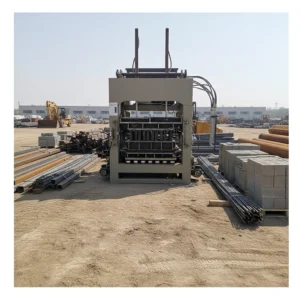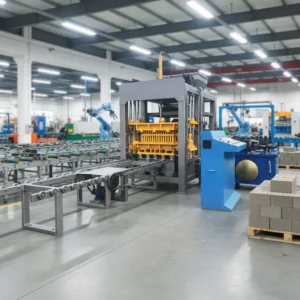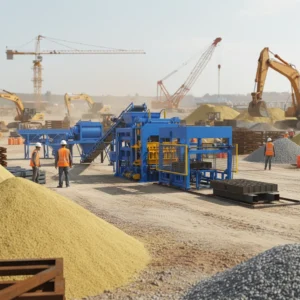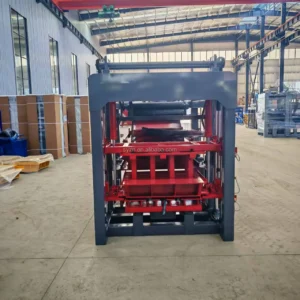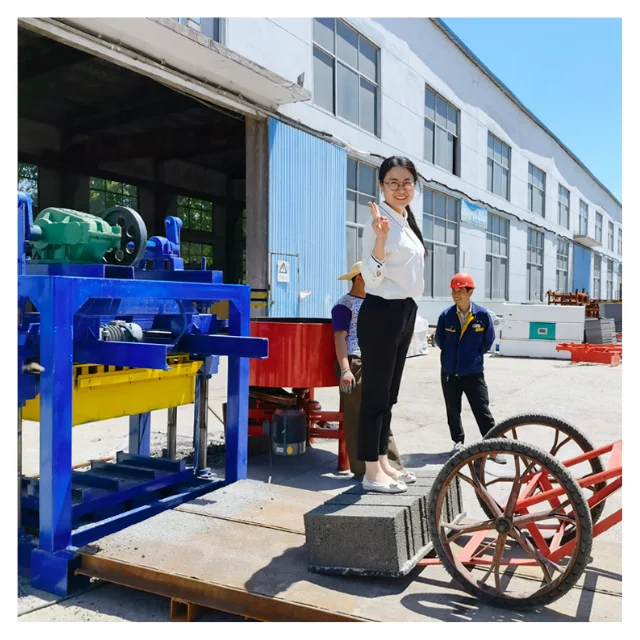
Matched Line Pacing — every station from mixer to stacking is timed to the QTJ4-40’s 40-second moulding cycle so the press never sits idle waiting for upstream feed or downstream pallet removal.
Technical Specifications
| Parameter | Value |
|---|---|
| Model | QTJ4-40 |
| Product Type | Semi-Automatic Concrete Block Making Machine |
| Machine Power | 10.4 kW |
| Moulding Cycle | 40 s |
| Theoretical Productivity (400×200×200 mm hollow block, 4 pcs/mould) | 360 pcs/h, 2800 pcs/day |
| Theoretical Productivity (400×150×200 mm hollow block, 5 pcs/mould) | 450 pcs/h, 3600 pcs/day |
| Theoretical Productivity (225×112.5×60 mm solid brick, 9 pcs/mould) | 800 pcs/h, 6400 pcs/day |
| Vibration System | Bed mould vertical vibration + upper mould compression vibration |
| Mould Actuation | Top die push-pull with automatic scraper |
| Pallet Size | 850 × 450 mm |
| Machine Weight | 1 T |
| Overall Dimensions (L×W×H) | 1350 × 1460 × 1800 mm |
| Automation Level | Semi-automatic |
| Raw Materials | Concrete, sand, cement, fly ash, lime, gypsum |
| Voltage | Configured to local voltage and frequency |
Application Suitability
| Application | Material or Output |
|---|---|
| Hollow block production for masonry walls | Crushed stone, sand, cement, fly ash blends |
| Solid brick manufacturing for load-bearing structures | Cement, sand, and lime mixes |
| On-site block production for housing projects | Locally sourced aggregate and cement |
| Small plant adding paver and brick formats | Concrete mixes with varying coarse aggregate ratios |
Why the Press Alone Is Not a Production Line
A semi-automatic block machine production line only performs as well as its slowest station. The QTJ4-40 completes a moulding cycle every 40 seconds — if your mixer cannot deliver a fresh batch within that window, or if an operator cannot clear the pallet before the next press stroke, the entire line stalls around the press.
Many buyers focus on the press specification and treat everything upstream and downstream as an afterthought. The result is a machine rated for a certain output that never reaches it because raw material arrives in surges, pallets pile up on the floor, or the curing rack is too far away for one person to manage. Line integration is where real capacity lives or dies [NEED_CITE: common causes of block line underperformance in small plants].
How the 40-Second Cycle Sets the Line Rhythm
The moulding cycle of the QTJ4-40 dictates how fast every other station must operate. A pan mixer positioned upstream needs to discharge a complete batch within roughly 35 seconds to keep the hopper charged without overflow. The pallet feeder must slide a fresh 850 × 450 mm pallet into position within the same window. When any one of these intervals drifts, the semi-automatic block machine production line loses cycles that cannot be recovered later in the shift.
Pallet Size as a Downstream Constraint
The 850 × 450 mm pallet is not just a press consumable — it determines rack slot spacing in the curing area, forklift tine width, and the maximum stacking height before blocks shift during transport. Buyers who select pallet size without checking their existing curing racks often discover after arrival that loaded pallets do not fit, forcing a full rack rebuild or a different pallet order [NEED_CITE: pallet and curing rack compatibility in block production]. Aligning pallet dimensions before shipment avoids weeks of lost production.
Vibration, Pressure, and Block Density
The dual vibration system — vertical vibration at the bed mould combined with compression vibration from the upper mould — works with the hydraulic push-pull actuation to compact concrete evenly across the cavity. Consistent density matters because block strength must meet local building codes, and inconsistent compaction leads to reject batches. The vibration force is fixed on this model, which means the mix design and aggregate gradation must be matched to the machine rather than expecting the machine to adapt to any mix.
What Happens When Line Stations Are Mismatched
I once helped a plant owner in Shandong who had purchased a QTJ4-40 separately from the rest of his equipment. The mixer he already owned discharged every 90 seconds — more than twice the press cycle — so the QTJ4-40 sat idle for half of every minute. Pallets were moved by hand from the press to a curing yard 40 metres away, and output backed up on the floor before the operator could clear it. The press was never the bottleneck; the missing line logic was. After recalculating each station’s timing and adding a simple roller conveyor, the same press ran at its expected rhythm without a single hardware change [NEED_CITE: impact of line pacing on semi-automatic block output].
Why Sourcing the Line Together Matters
Block machinery as a single focus means the QTJ4-40 is specified alongside its mixer, pallet feeder, and handling stations as one system rather than assembled from separate vendors who each guarantee only their own station. Configuration is set against your actual mix design and local aggregate, not a catalogue default. Pallet specification is confirmed against your curing area and forklift before production starts. Voltage, frequency, and control panel language are locked in during the order stage, not discovered at commissioning. Factory test records cover the full line cycle, not just the press in isolation.
Documentation & Verification
- Line layout drawing showing every station with cycle time at each point
- Capacity calculation stating the block format assumed for the output figure
- Pallet specification matched to your curing rack dimensions and forklift
- Voltage, frequency, and control language confirmation before shipment
- Factory test record covering full line operation, not press alone
- Operation and maintenance manual with wear parts and mould list
Installation, Commissioning & Support
- Foundation plan sized to the QTJ4-40 footprint of 1350 × 1460 mm and 1 T operating weight
- Dedicated electrical circuit matching the 10.4 kW total load at your local voltage and frequency
- Machine arrives assembled; pallet feeder and mixer positioned and wired on site
- First-run commissioning includes cycle timing verification across every line station
- Operator training covers mould change procedure, vibration adjustment, and daily greasing points
- Wear parts list identifies high-wear items and recommended replacement intervals
Preparing Your Line Inquiry
To move from a standalone press quote to a full semi-automatic block machine production line proposal, share the block formats your market demands, the daily volume you need to sustain, and the raw materials available within your region. Include your existing curing area dimensions and any forklifts already on site so pallet and rack compatibility can be checked upfront.
Frequently Asked Questions
Q: How is daily capacity calculated, and which block format is assumed?
A: Each output figure is tied to a specific block format and mould cavity count. For example, 2800 pieces per day assumes 400×200×200 mm hollow blocks at 4 pieces per mould running an 8-hour shift. Changing the format changes the number. We provide a capacity table listing every format you plan to produce so you can plan around realistic figures.
Q: What upstream equipment must match the 40-second cycle?
A: The mixer must discharge a full batch within roughly 35 seconds, and the pallet feeder must deliver a fresh pallet in the same window. If either station is slower, the press waits and daily output drops. We time every station during the line design phase to prevent this mismatch.
Q: Is pallet handling and stacking included in the quotation?
A: On a semi-automatic configuration, pallet transfer from the press to the curing rack and block stacking are manual operator tasks. We specify the labour count and pallet trolley requirements so you know exactly what is covered and what your crew needs to handle.
Q: What voltage and frequency does the line require?
A: The QTJ4-40 and all line motors are built to your local voltage and frequency, confirmed during the order stage. The control panel display language is also set before shipment so your operators can read alarms and settings from day one of commissioning.
Q: Can one station be upgraded to automatic later without replacing the whole line?
A: The semi-automatic block machine production line is designed with upgrade paths in mind. An automatic stacker or pallet return system can be added later as long as the physical spacing and electrical capacity were accounted for in the original layout. We note upgrade readiness on the initial line drawing.