
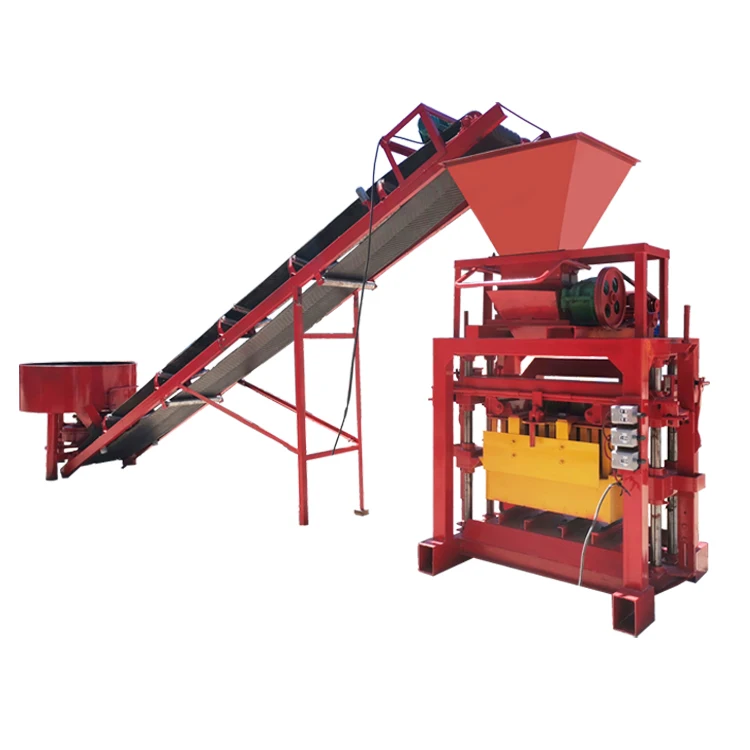
System-Matched Configuration — The QTJ4-35 is positioned as the central press within a block making machine production line, where mixer throughput, pallet feeder speed, and stacking cadence are all timed to its 35–50 second molding cycle so the press is never left waiting and daily throughput matches expectation.
Technical Specifications
| Parameter | Value |
|---|---|
| Model | QTJ4-35 |
| Product Type | Mechanical Manual Block Making Machine |
| Overall Dimensions (L×W×H) | 2050 x 1660 x 1900 mm |
| Main Vibration Form | Motor Vibration |
| Vibration Force | 35 KN |
| Pallet Size | 850 x 450 x 20 mm |
| Molding Cycle | 35–40s (basis: 400x200x200mm & 400x150x200mm hollow blocks); 40–50s (basis: 240x115x53mm solid bricks, 200x100x60mm pavers, 225×112.5x60mm interlocking bricks) |
| Overall Power | 9.8 kW |
| Output Capacity | 2,880–3,264 pcs/8hr (based on 400x200x200mm hollow blocks, 4 pcs/mould); 2,880–4,080 pcs/8hr (based on 400x150x200mm hollow blocks, 5 pcs/mould); 12,096–15,120 pcs/8hr (based on 240x115x53mm solid bricks, 21 pcs/mould); 8,064–10,080 pcs/8hr (based on 200x100x60mm pavers, 14 pcs/mould); 5,184–6,480 pcs/8hr (based on 225×112.5x60mm interlocking bricks, 9 pcs/mould) |
| Automation Level | Mechanical manual (semi-automatic with manual pallet handling) |
| Voltage & Frequency | (basis to be confirmed before ordering) |
| Control System | (basis to be confirmed before ordering) |
| Mould Change Time | (basis to be confirmed with supplier) |
| Net Weight | (basis to be confirmed with supplier) |
| Stacking Method | Manual pallet handling |
| Standards | CE declaration where applicable |
Application Suitability
| Application | Material or Output |
|---|---|
| Hollow block production for wall construction | Crushed stone, sand, cement producing 400x200x200mm and 400x150x200mm blocks |
| Solid clay-format brick production | Local aggregate and cement yielding 240x115x53mm bricks |
| Paving block for walkways and yards | Aggregate-cement mix forming 200x100x60mm pavers |
| Interlocking brick for retaining walls and landscaping | Crusher dust and cement shaping 225×112.5x60mm units |
| On-site contractor production | Mobile setup using locally available aggregates for project-specific output |
| First plant for entrepreneurs | Small-scale block plant using regional raw materials |
Why Quoted Cycles per Hour Rarely Match What Leaves the Yard
A press rate means nothing when the upstream mixer and downstream pallet handling cannot keep pace with the QTJ4-35.
I once spent a week on a site in Southeast Asia where the block making machine production line had a perfectly spec’d press, yet finished blocks were stacking up on the conveyor because the pallet return loop was bottlenecked by a single operator moving pallets by hand. The line was designed around a press that could cycle every 35 to 50 seconds depending on the block format, but the pallet feeder could only supply a fresh pallet every 70 seconds. The owner had purchased a press rated for thousands of pieces per shift, only to find real daily output falling short because the rest of the turnkey block plant equipment was never specified as a matched system. [NEED_CITE: production line synchronization standards for concrete block plants]
Upstream and Downstream Stations That Must Keep Cadence with the Press
Every station in a block making machine production line either feeds the press or receives its output, so each one must match the QTJ4-35’s cycle timing. The raw material mixer must deliver a fresh batch of concrete to the hopper before the current charge is exhausted. If the mixer takes two minutes to blend a batch but the press consumes material every 35 seconds, the press sits idle and the quoted capacity becomes theoretical. The same logic applies downstream: once a pallet of wet blocks exits the press, it must be cleared from the delivery table quickly enough for the next pallet to arrive.
How Pallet Return Speed Governs the Entire Line Output
The QTJ4-35 uses manual pallet handling, which means an operator physically removes each finished pallet and slides a fresh one into position. During hollow block production, the 35–40 second molding cycle leaves a narrow window for that swap. If the curing racks are far from the press, the operator spends more time walking than feeding, and the press waits. Planning the curing area within a short reach of the outfeed side — and ensuring pallet quantity covers a full shift without requiring mid-shift retrieval from the curing racks — keeps the turnkey block plant equipment running at its intended rhythm. [NEED_CITE: pallet circulation logistics in small-scale block production]
Specifying Pallet Dimensions Against Your Curing Area and Forklift
The QTJ4-35 requires an 850 x 450 x 20 mm pallet, but that number alone does not tell you whether your existing curing racks or forklift will accept it. The pallet width must fit between the rack uprights with enough clearance for easy placement, and the forklift tines must support the pallet length without overhang that risks tipping a load of wet blocks. Specifying pallet material — timber, bamboo, or composite — also affects lifespan and weight, which in turn affects how many pallets one operator can move during a shift. A mismatch here forces a costly pallet reorder or, worse, a curing area rebuild after the block making machine production line arrives.
Vibration Force, Motor Power, and What They Mean for Block Density
The 35 KN vibration force generated by the QTJ4-35’s motor vibration system is what compacts the concrete mix inside the mould cavity. For hollow blocks with thin walls, adequate vibration ensures the aggregate particles settle tightly, reducing voids and producing a denser block face. The 9.8 kW overall power must cover the vibration motor, the feed mechanism, and any auxiliary conveyors in the turnkey block plant equipment package. If the local power supply fluctuates, voltage dips can reduce the vibration motor’s effective force, leading to inconsistent block density across a single shift. Confirming voltage and frequency before the machine ships prevents this class of problem from appearing during commissioning.
The Hidden Cost of a Line That Was Never Balanced
I have seen plant owners purchase a press with impressive cycle times and then spend months trying to figure out why the daily block count never reaches the quoted figure. The root cause is almost always a station mismatch: the mixer is too small, the pallet quantity is insufficient, or the stacking area is positioned too far from the press outfeed. Each of these gaps silently erodes output without triggering an alarm. [NEED_CITE: common capacity shortfalls in concrete block production plants] With the QTJ4-35, where manual pallet handling already limits the practical cycle speed, any additional delay compounds quickly across an eight-hour shift. A balanced block making machine production line accounts for every second between stations, not just the seconds the press spends vibrating.
Why Buyers Source the Full Line from One Supplier
Specifying the QTJ4-35 together with its mixer, pallet feeder, and curing rack handling as one matched system eliminates the guesswork of cross-referencing cycle times from separate equipment vendors. Capacity calculations are provided per block format, so the line throughput document states exactly how many 400x200x200mm hollow blocks or 200x100x60mm pavers the complete line produces, not just what the press alone can achieve. Mould design covers the formats your local market actually sells, with drawings supplied before production begins. Voltage, frequency, and control language are confirmed for every station in the turnkey block plant equipment package before shipment, so commissioning proceeds without electrical surprises. The configuration is set against your actual mix design and local aggregate, not a catalogue default.
Documentation & Verification
- Line layout drawing showing QTJ4-35 position with upstream mixer and downstream pallet flow
- Capacity calculation sheet stating output per block format with mould quantity assumed
- Pallet specification covering 850 x 450 x 20 mm size, material grade, and shift quantity
- Electrical schematic for the 9.8 kW power draw across all line stations
- Voltage and control language confirmation document signed before production starts
- Factory test record running your target block format before dispatch
Installation, Commissioning & Support
- Foundation pad sized for the QTJ4-35 footprint of 2050 x 1660 mm with leveling anchors
- Dedicated electrical circuit rated for 9.8 kW total load including mixer and conveyors
- Machine arrives partially assembled; press frame, vibration table, and hopper are bolted on site
- First-run commissioning covers mould alignment, vibration timing, and pallet feed positioning
- Operator training on pallet swap technique to maintain the 35–50 second cycle window
- Wear parts list covering vibration motor brushes, mould liners, and pallet guide rollers
What to Prepare Before Requesting a Line Proposal
Send us your target block format and the daily output you need, along with the local aggregate type and cement brand you plan to use. Provide your workshop dimensions so the line layout can position the QTJ4-35, mixer, and curing racks without congestion. Confirm your site voltage, frequency, and the language your operators read so that every control panel in the block making machine production line matches from day one. If you already own pallets or a forklift, share their specifications so the pallet system is designed around what you have.
Frequently Asked Questions
Q: How do I verify that each station in the line matches the QTJ4-35 press cycle time?
A: Request a line layout that states the throughput of every station — mixer, pallet feeder, stacking area — against the press cycle of 35–50 seconds depending on block format. Each station’s rate must equal or exceed the press rate. If one station is slower, that station governs the daily output of the entire block making machine production line.
Q: What pallet size and material should I specify for my existing curing area?
A: The QTJ4-35 uses 850 x 450 x 20 mm pallets. Measure the clear width between your curing rack uprights and confirm your forklift tine length supports 850 mm without overhang. Material choice — timber, bamboo, or composite — affects pallet weight and lifespan, which influences how many pallets your operator can move during a shift.
Q: Which supporting equipment is included in the quotation and which is optional?
A: The core quotation covers the QTJ4-35 press, mould, and pallets. Supporting stations such as the raw material mixer, conveyor belts, pallet feeder, stacking racks, and curing rack handling are quoted separately. Confirming which stations you need ensures the turnkey block plant equipment package arrives complete and balanced.
Q: How is voltage and frequency confirmed across all line stations before shipment?
A: Before production begins, a voltage and control confirmation document lists the electrical specification for the QTJ4-35 and every supporting station. This document is signed by both parties so that motors, control panels, and PLC displays — if applicable — all arrive configured for your site’s power supply and operator language.
Q: What is the realistic daily output for my target block format?
A: The capacity sheet states output per format: for example, 12,096–15,120 solid bricks per 8-hour shift based on 240x115x53mm bricks at 21 pieces per mould. This figure accounts for the QTJ4-35 cycle time and mould quantity. A balanced block making machine production line must sustain this rate across all stations to achieve it in practice.



