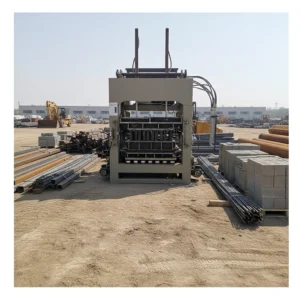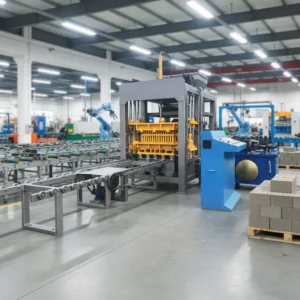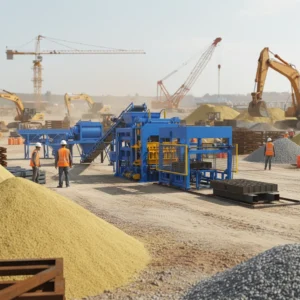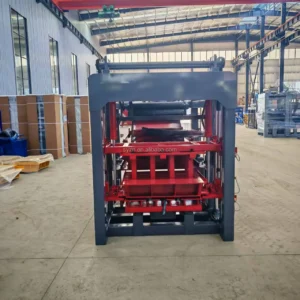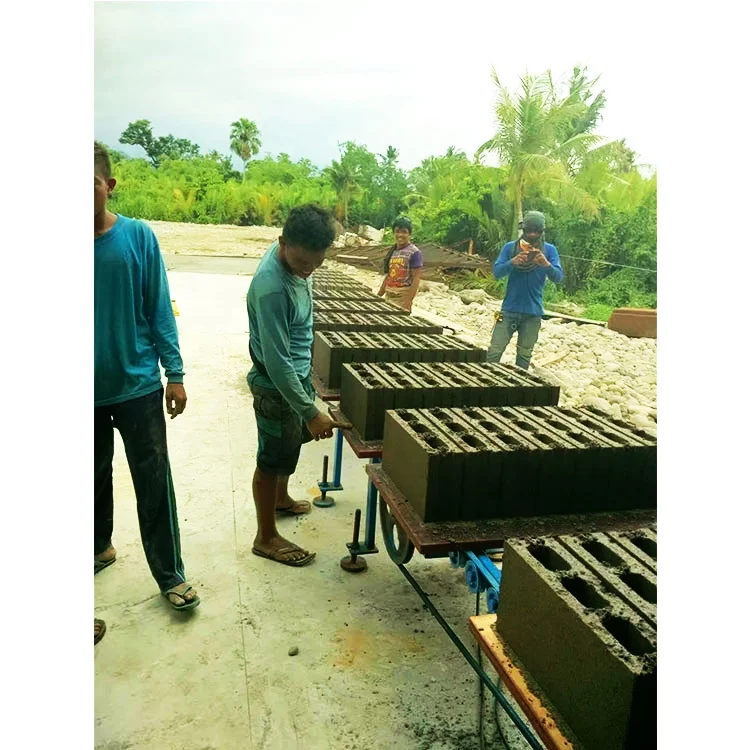
Line-Level Cycle Matching — The QTJ4-25 press is specified together with its JQ350 mixer, conveyor, and pallet handling so the 25-second molding cycle is continuously fed rather than starved.
Technical Specifications
| Parameter | Value |
|---|---|
| Model | QTJ4-25 |
| Product Type | Semi-Automatic Concrete Block Making Machine |
| Overall Dimensions (L×W×H) | 6400×1500×2700 mm |
| Molding Cycle | 25 s |
| Vibration Frequency | 2800–5100 r/min |
| Exciting Force | 60 kN |
| Total Power | 17.9 kW |
| Mixer Model | JQ350 |
| Pallet Size | 850×550×20 mm |
| Total Weight | 2500 kg |
| Applied Products | Concrete hollow blocks (8 inch, 6 inch), solid bricks |
| Raw Materials | Crushed stone, sand, cement, dust, fly ash |
| Output Capacity (Hollow Block 390×190×190 mm) | 480 pcs/h, 3800 pcs/8 hr |
| Output Capacity (Hollow Block 400×150×200 mm) | 600 pcs/h, 4800 pcs/8 hr |
| Output Capacity (Solid Brick 240×115×53 mm) | 2100 pcs/h, 17000 pcs/8 hr |
| Automation Level | Semi-automatic |
| Hydraulic Station | Equipped |
| Stacking Method | Manual with trolley |
| Pallet Material Options | Fiber glass or wooden |
| Control System | Basis not stated in source — confirm PLC / MCC / manual |
| Voltage & Frequency | Basis not stated in source — confirm voltage, frequency, phase |
Application Suitability
| Application | Material or Output |
|---|---|
| Hollow block production for building walls | Crushed stone, sand, cement, fly ash — 8 inch and 6 inch formats |
| Solid brick production for masonry | Sand, cement, dust — standard 240×115×53 mm format |
| On-site block production for housing projects | Locally sourced aggregates with cement binder |
| Small to medium-scale block plant startup | Mixed aggregate feed with semi-automatic handling |
| Format expansion for existing concrete product manufacturers | Hollow block and solid brick added to current range |
What "4800 Blocks per Shift" Actually Requires from the Rest of the Line
A block making machine production line only delivers its rated output when every upstream and downstream station keeps pace with the press cycle.
I once configured a semi-automatic line for a South Asian contractor where the press cycled fine on its own, but the mixer discharge and material feed could not keep up with the 25-second molding interval. The host machine sat idle for seconds at a time, and actual daily throughput dropped well below expectation. The block making machine production line was unbalanced because the supporting equipment had been selected independently rather than as a matched set. That experience changed how I approach every quotation — the press is never sized alone [NEED_CITE: line-level capacity calculation methods for concrete block plants].
Mixer-to-Press Feed Synchronization
The JQ350 mixer in this line is matched to the QTJ4-25 cycle rate so that fresh material arrives at the hopper before each molding stroke begins. When mixer batch volume and discharge interval are calculated against the 25-second press cycle, the host machine runs continuously instead of waiting. This is where a block making machine production line either earns its capacity figure or loses it. The mixer model, conveyor belt speed, and hopper gate timing must all be locked in before the line is built.
Pallet Flow and Curing Area Alignment
The 850×550×20 mm pallet size is not an arbitrary choice — it determines how many wet blocks fit in the curing area, what forklift capacity is needed, and how many pallets must circulate through the system. A typical semi-automatic line of this class requires a substantial pallet inventory to keep the press running while earlier batches cure [NEED_CITE: pallet circulation requirements for semi-automatic block lines]. Fiber glass or wooden pallet options allow the buyer to match local availability and curing conditions. If the pallet dimensions do not align with the buyer’s existing shelving or transport equipment, the entire downstream workflow stalls.
Vibration, Pressure, and Mix Design Interdependence
The 60 kN exciting force operating across a 2800–5100 r/min frequency range must be set against the buyer’s specific aggregate gradation and cement ratio. Higher vibration frequency compacts finer sand mixes effectively, while coarser crushed stone demands stronger amplitude at lower frequency. The hydraulic station provides the clamping pressure that holds the mould steady during vibration. When these two forces are mismatched to the local raw material, block density varies from batch to batch and breakage during curing increases noticeably. Getting this right at the configuration stage prevents costly material substitutions later.
The Cost of Treating the Press as a Standalone Purchase
When a buyer sources the block machine separately from the mixer, conveyor, and pallet system, the interfaces between stations become nobody’s responsibility. Voltage and frequency may not match the site supply, delaying commissioning for weeks [NEED_CITE: voltage and frequency standards by export market]. Pallet size may conflict with the forklift already in the yard. Mould change procedures may require tools not included in the shipment. Each of these gaps shows up as lost production time after the machine has been paid for and shipped, and none of them are visible in a press-only quotation.
Why This Line Is Quoted as a Coordinated System
Every station in the QTJ4-25 line is specified against the same cycle time and block format assumption, so the capacity calculation holds across the full workflow. The mixer output rate, conveyor speed, and pallet feed interval are all derived from the 25-second press cycle rather than selected from a generic catalogue. Pallet material and quantity recommendations account for the buyer’s curing area dimensions. Mould options are limited to the formats the buyer’s market actually sells, avoiding unused mould inventory. Voltage, frequency, and control language are confirmed before production starts, not discovered at unpacking.
Documentation & Verification
- Line layout drawing showing station spacing and material flow direction for the QTJ4-25 configuration
- Capacity calculation sheet stating the block format assumed for each output figure
- Pallet specification with size, material, and recommended circulation quantity
- Hydraulic and electrical schematic covering the full line, not just the press
- Factory test record on the buyer’s target block format before dispatch
- Voltage, frequency, and control language confirmation document signed before production
Installation, Commissioning & Support
- Foundation plan matching the 6400×1500 mm footprint and 2500 kg operating weight
- Power supply confirmation for the 17.9 kW total load across all line stations
- Mixer and conveyor assembly sequence to align discharge with the press hopper
- Vibration frequency and hydraulic pressure calibration against the buyer’s mix design
- Operator training on mould change procedure and pallet circulation workflow
- Wear parts list covering hydraulic seals, vibration springs, and mould liners
Preparing Your Line Inquiry
To configure a balanced block making machine production line around the QTJ4-25, share your target block formats and daily output requirement along with the raw materials available locally. Confirm your site voltage, frequency, and the language your operators read on control panels. Provide the dimensions of your curing area and the forklift capacity you already have so pallet size and material can be matched accordingly.
Frequently Asked Questions
Q: How is daily output calculated, and which block format does each capacity figure assume?
A: Each output figure is tied to a specific block dimension. For example, 4800 pieces per 8-hour shift is rated on 400×150×200 mm hollow blocks, while 3800 pieces assumes 390×190×190 mm format. The capacity calculation accounts for the 25-second molding cycle and assumes continuous material feed and pallet supply throughout the shift.
Q: What supporting equipment is included versus optional in the line quotation?
A: The standard line includes the JQ350 mixer, conveyor, pallet feed system, and manual trolley for transfer. Automatic stacking and cubing systems are available as an upgrade path. Pallet quantity and material are specified based on your curing area. Confirming what is included avoids manual handling bottlenecks after installation.
Q: How do pallet size and material affect the curing workflow on site?
A: The 850×550×20 mm pallet must fit your existing curing racks and forklift tines. Fiber glass pallets suit humid curing environments while wooden pallets are often sourced locally. The total pallet count determines how many blocks can cure simultaneously while the press continues running on fresh pallets.
Q: Can the vibration force be adjusted to match my local aggregate and mix design?
A: The vibration frequency range of 2800–5100 r/min and 60 kN exciting force can be set during commissioning to suit your specific crushed stone gradation and cement ratio. Matching vibration parameters to the actual mix prevents inconsistent block density and reduces breakage during curing and transport.
Q: What is the upgrade path from this semi-automatic line to higher automation?
A: The QTJ4-25 semi-automatic line can be expanded with automatic pallet feeding, stacking, and cubing modules as production volume grows. The base press and mould system remain the same, so the upgrade focuses on material handling stations rather than replacing the core machine.