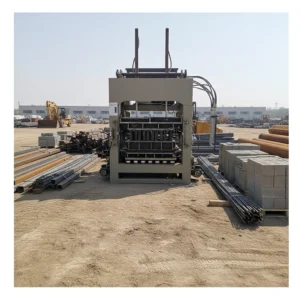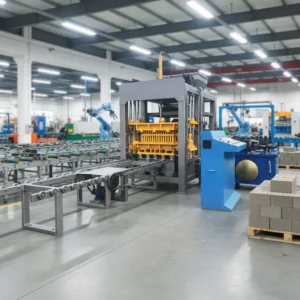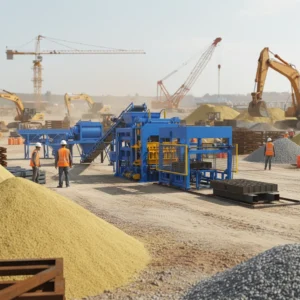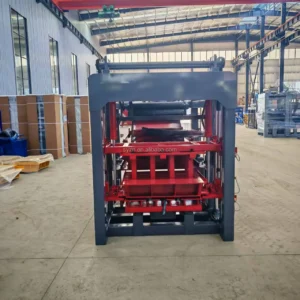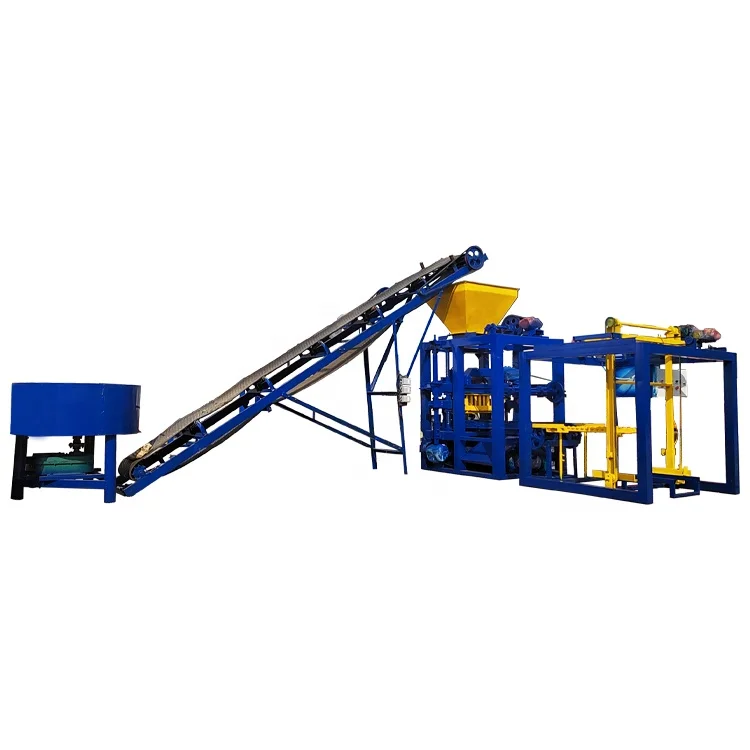
Matched line configuration — mixer, conveyor, pallet and press timed to one cycle, so the QTJ4-24 never sits idle waiting for the next batch.
Technical Specifications
| Parameter | Value |
|---|---|
| Product Type | Semi Automatic Concrete Block Making Machine |
| Overall Dimensions (L×W×H) | 3600mm × 1700mm × 2560mm |
| Total Mass | 3.5 T |
| Main Machine Power | 11.95 kW |
| Pallet Size | 900mm × 450mm |
| Molding Cycle | 24–26 s |
| Mould Format Capacity | 400×200×200 mm (4 pcs/mould); 390×240×190 mm (3 pcs/mould); 390×120×190 mm (6 pcs/mould); 240×115×53 mm (21 pcs/mould) |
| Vibration Type | Table vibration feeding, fluctuation vibration molding |
| Feeding Method | Manual feeding, two feed way options |
| Control | Electrical control with mechanical interworking |
| Compatible Mixer | JQ350 or JQ500 vertical mixer |
| Compatible Conveyor | 6 m or 8 m belt conveyor |
| Stacking Method | Manual |
| Warranty | 1 year for whole machine (excluding spare parts) |
Application Suitability
| Application | Material or Output |
|---|---|
| Small-scale hollow block plant | Crushed stone, sand, cement, water |
| On-site housing project production | Local aggregate with site-sourced sand |
| Paving brick run for landscaping contractors | Fine aggregate and pigment blends |
| Standard solid brick for masonry | River sand and Portland cement |
| First plant for new entrepreneurs | Low-capital mix designs using regional materials |
What the QTJ4-24 Block Machine Production Line Leaves Out of the Quotation
A press cycle of 24–26 seconds means nothing if the mixer and pallet handler cannot keep up.
I once watched a small block plant lose nearly half its shift output because the mixer discharged slower than the press cycled. The operator stood by the hopper watching an empty belt while cured blocks piled up on the floor with no rack space left. When a buyer receives a quotation for the QTJ4-24 block machine production line, the document often covers only the press itself [NEED_CITE: typical block machine quotation scope for semi-automatic lines]. Pallet supply, raw material batching, wet product handling and curing area layout remain the buyer’s problem — and those missing stations are where real daily throughput disappears.
How the Stations Connect Around the Press
A complete QTJ4-24 block machine production line starts well before the press. Raw material moves from stockpile to mixer, mixed batch travels up the belt conveyor into the press hopper, the press cycles onto a pallet, and the wet block on its pallet moves to the curing area. Each hand-off must finish within the 24–26 second molding window, or the press sits idle and daily output drops below what the cycle time promises.
Matching Mixer Discharge to the Belt Conveyor
The JQ350 vertical mixer suits a line running a single block format at steady pace, while the JQ500 gives headroom when the operator switches between hollow block and paving brick in the same shift. Belt length matters too: a 6 m conveyor keeps the footprint tight for a site contractor working inside a compound wall, whereas an 8 m belt reaches further when the stockpile sits outside the press shed [NEED_CITE: belt conveyor routing for small block plants]. Choosing the wrong combination leaves the press starving for material during peak hours.
Reading the Specs That Decide Line Behaviour
The 11.95 kW main machine power drives both vibration and pressing action, which together compact the mix into the mould cavity. Vibration alone leaves voids; pressure alone cracks the block face. Table vibration feeds material evenly into the mould, then fluctuation vibration during compaction settles the aggregate into a dense matrix. The 900 mm × 450 mm pallet size dictates how many blocks sit on each board and how the curing racks must be spaced. If a buyer already owns forklifts with narrow forks or curing racks built for a different pallet dimension, the mismatch forces a rework of the entire downstream area before the first block is produced.
The Cost of Ignoring Line Synchronization
When pallet handling is left manual without a planned flow path, wet blocks sit on the press table while the operator walks them to the curing rack one by one. The next cycle cannot start until the table clears, turning a 26-second press cycle into a two-minute real-world cycle. Over an eight-hour shift this gap compounds into a noticeable shortfall against expected output [NEED_CITE: pallet handling impact on semi-automatic block line throughput]. Equally, if the local aggregate is coarser than the mix the machine was configured for, vibration force may not settle the material fully, leaving blocks with weak edges that crack during curing.
Why Source the QTJ4-24 Block Machine Production Line Here
The line is specified as a matched set — press, mixer, conveyor and pallet dimensions confirmed together rather than quoted as separate items from different suppliers. Mould selection starts from the block format the buyer’s market actually buys, with piece counts per mould stated so daily capacity can be calculated per format. Automation level is selectable, allowing a buyer to begin with manual pallet handling and add stacking equipment later as volume grows. Installation support includes operator training on the specific mix and mould combination chosen. Voltage, frequency and PLC display language are confirmed before dispatch to avoid commissioning delays on arrival.
Documentation & Verification
- Line layout drawing showing mixer, conveyor, press and curing area positions
- Capacity calculation sheet stating the block format assumed for each output figure
- Mould drawing with format dimensions and piece count per cavity
- Pallet specification including material grade and load rating for curing rack design
- Factory test record run on buyer’s target block format before dispatch
- Voltage, frequency and control language written confirmation before shipment
Installation, Commissioning & Support
- Foundation pad leveled for the 3600 mm × 1700 mm press footprint with anchor bolt template
- Dedicated electrical circuit rated for the 11.95 kW main motor plus mixer and conveyor loads
- Machine shipped in bolted assembly sections for container loading and on-site reassembly
- First-run commissioning with mix adjustment to local aggregate and target block strength
- Operator training on mould change procedure and daily vibration table inspection
- Wear parts list covering vibration springs, mould liners and hydraulic seals with reorder codes
Before You Send the Inquiry
Tell us the block format your market sells most and the daily volume you need from a single shift. Share your local aggregate type and the curing area dimensions available on site, along with the forklift and pallet rack you already have. Confirm your site voltage and frequency so the motor and control panel are wound correctly before the line leaves the factory.
Frequently Asked Questions
Q: How is daily output calculated when different block formats share the same line?
A: Each format produces a different piece count per mould — four hollow blocks or twenty-one standard bricks per cycle at the same 24–26 second rate. We provide a capacity sheet showing realistic daily figures for each format you plan to run, so you can plan shift length around your actual product mix.
Q: What mixer and conveyor sizes keep the press from waiting between cycles?
A: A JQ350 mixer with a 6 m belt works for single-format steady production. When you switch between hollow block and paving brick in the same shift, the JQ500 with an 8 m belt holds enough batch volume to fill the hopper between discharge intervals, keeping the press fed.
Q: How should pallet size be chosen to match the curing area and forklift?
A: The 900 mm × 450 mm pallet must fit your existing curing rack spacing and forklift fork width. We confirm these dimensions with your site layout before the order, so pallets move straight from press to rack without a secondary handling step or a forklift change.
Q: What electrical wiring and protection does the complete line require?
A: The full line — press at 11.95 kW, mixer and conveyor combined — needs a dedicated supply with correctly rated breakers for each station motor. We confirm voltage and frequency before dispatch and supply a wiring diagram matching your local grid standard.
Q: Can the line be upgraded from manual pallet handling to semi-automatic stacking later?
A: Yes. The QTJ4-24 press table and pallet exit height are set so an automatic pallet return system or stacking station can be added when volume justifies the investment, without replacing the press or changing the mould set.