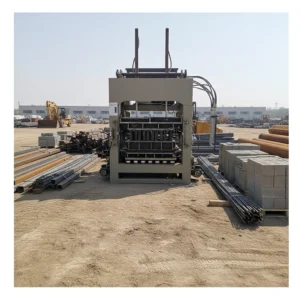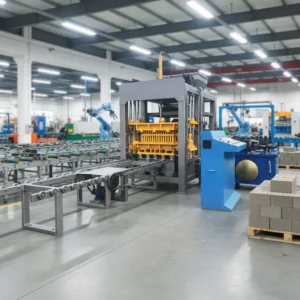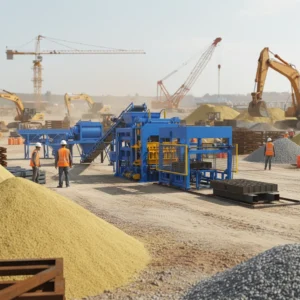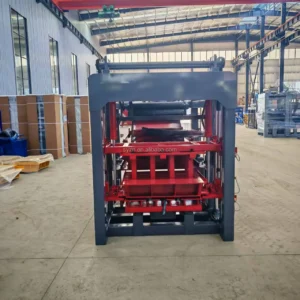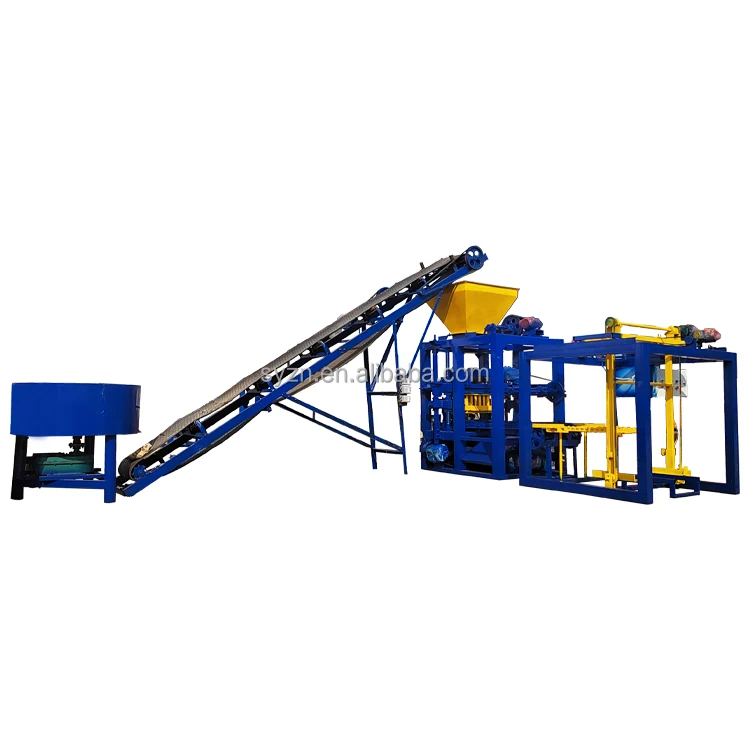
Line-Matched Press Station — The QTJ4-24 is specified as one station in a complete block making machine production line where mixer discharge, conveyor speed, and pallet feed are aligned so the press cycle is never interrupted.
Technical Specifications
| Parameter | Value |
|---|---|
| Product Type | Semi-Automatic Concrete Block Making Machine |
| Model | QTJ4-24 |
| Main Machine Power | 11.95 kW |
| Overall Dimensions (L×W×H) | 3600 mm × 1700 mm × 2560 mm |
| Total Mass | 3.5 T |
| Pallet Size | 900 mm × 450 mm |
| Molding Cycle | 24–26 s |
| Vibration Type | Table vibration feeding + fluctuation vibration molding |
| Feeding Method | Manual feeding, two feed ways available |
| Automation Level | Semi-automatic (mechanical + manual operations) |
| Control System | Electrical control cabinet with mechanical interworking |
| Mould Formats | 400×200×200 mm (4 pcs/mold), 390×240×190 mm (3 pcs/mold), 390×120×190 mm (6 pcs/mold), 240×115×53 mm (21 pcs/mold) |
| Supporting Line Equipment (optional) | J350 / JQ350 / JQ500 mixer, 6 m / 8 m belt conveyor |
| Electrical Wiring | Main machine 3×6 mm², Mixer 3×4 mm², Conveyor 3×2.5 mm², General power 3×16 mm² |
| Voltage & Frequency | To be confirmed before commissioning |
| Output Capacity | (basis not stated in source — confirm block format, material, thickness) |
| Warranty | 1 year for whole machine (excluding spare parts) |
| Assembly State | Stationary machine, requires precast concrete ground for installation |
| Certification | CE available where applicable |
Application Suitability
| Application | Material or Output |
|---|---|
| Small-scale block and brick production plants | Hollow blocks, solid blocks, and standard bricks from crushed stone, sand, and cement |
| On-site block making for construction contractors | Masonry units produced directly at the project yard using locally sourced aggregate |
| Entry-level block manufacturing for entrepreneurs | Multiple format runs from a single press by changing moulds between batches |
| Building material distributors adding a local supply line | Paving bricks and wall blocks produced for regional construction demand |
Why the Mixer-Conveyor-Press Bottleneck Matters More Than the Press Alone
A block making machine production line is only as fast as its slowest upstream station.
I have watched a semi-automatic press sit idle for eight seconds per cycle because the mixer could not discharge fast enough into the hopper. The press itself was running a 24-second cycle, but the operator spent half the shift waiting for material to arrive on the belt conveyor. [NEED_CITE: production line bottleneck analysis in small-scale concrete plants] When the stations are quoted separately by different suppliers, nobody owns the gap between them.
Press Station Placement Within the Turnkey Block Plant
The QTJ4-24 occupies the center of the line, receiving mixed material from the belt conveyor and discharging pressed blocks onto pallets. Because the block making machine production line runs on a repeating cycle, every station upstream must complete its task within the press window or the entire line stalls.
Mixer selection — J350, JQ350, or JQ500 — determines batch volume per mix, and the belt conveyor length (6 m or 8 m) must physically bridge the mixer discharge point to the press hopper without an awkward transfer angle. These are not catalogue choices; they are dictated by your yard layout and the daily output you intend to reach with the QTJ4-24.
Matching Discharge Rates Across Every Station
The mixer batch time, conveyor belt speed, and press hopper capacity must all resolve within the 24–26 second molding cycle. [NEED_CITE: cycle time synchronization in semi-automatic block plants] If the J350 mixer takes longer to discharge one batch than the conveyor can transport it, material backs up and the press operator manually shovels the overflow — exactly the failure mode a turnkey block plant is designed to prevent. We calculate each station’s throughput against the specific block format you intend to run most often, then confirm the conveyor length and mixer size before the quotation is finalized.
Pallet Handling and Curing Area Alignment
The 900 × 450 mm pallet size defines the footprint of every downstream decision: curing rack spacing, forklift tine width, and the square meters your yard must allocate for drying. When a buyer’s existing curing racks were built for a different pallet dimension, the entire wet-block transfer process breaks down on day one. We cross-check pallet size against your yard drawing before the line ships, so pallets, racks, and handling equipment arrive as a matched set rather than a surprise.
Vibration, Pressure, and Block Density
The QTJ4-24 uses a two-stage vibration sequence — table vibration during material feeding and fluctuation vibration during molding — to compact the mix into the mould cavity. The 11.95 kW main machine power drives both the vibration motor and the mechanical pressing action. Denser blocks req* a 200 mm hollow block cavity; insufficient compaction shows up as inconsistent weight between the top and bottom of the same block. The electrical-mechanical interworking in the control cabinet prevents the press from firing the vibration sequence when the mould is not fully seated, reducing damage from operator error during format changes.
The Cost of Skipping Line Integration
When each station is sourced independently, the electrical wiring specifications rarely align. The QTJ4-24 requires 3×6 mm² for the main machine, 3×4 mm² for the mixer, and 3×2.5 mm² for the conveyor, all fed from a 3×16 mm² general power line. [NEED_CITE: electrical load planning for small concrete block plants] A buyer who connects these to undersized circuits faces tripped breakers during startup, and the commissioning delay is blamed on the press manufacturer even though the wiring was specified on the original drawing.
Why This Line Is Configured as One System
The mixer, conveyor, and press are quoted together because the electrical cabinet, wiring gauge, and cycle timing are calculated as a single system. The mould format list — four standard sizes with pieces-per-mold counts — is provided so capacity can be stated per format, not as a single headline number. Pallet size is locked against your yard dimensions before shipment. Voltage and frequency are confirmed in writing, and the control language is set to match your operators. [NEED_CITE: CE machinery directive compliance for exported block making equipment] Factory testing runs the full sequence with your chosen mould installed, not an empty press cycle.
Documentation & Verification
- Line layout drawing with station spacing matched to your yard dimensions
- Capacity calculation sheet stating the block format assumed for output figures
- Electrical schematic with wiring gauge per station and total load summary
- Pallet specification cross-referenced to your curing rack and forklift dimensions
- Factory test record on your chosen mould format before dispatch
- Voltage, frequency, and control language confirmation document
Installation, Commissioning & Support
- Precast concrete foundation required; machine dimensions 3600 × 1700 × 2560 mm define the pad area
- Dedicated electrical circuit for the 11.95 kW main machine plus mixer and conveyor loads
- Machine ships as a stationary unit and is bolted to the prepared ground on arrival
- First-run commissioning includes cycle timing verification with your local aggregate mix
- Operator training covers mould change procedure and electrical-mechanical interworking safety
- Wear parts list and mould maintenance schedule provided at handover
What We Need to Configure Your Line
Before we size the mixer and conveyor, share the block format your market moves in highest volume and the daily output you need to reach. Include your yard layout with curing area dimensions, the forklift model you already run, and the voltage and frequency at your site. If you have an existing mixer or belt conveyor, send the model plate details so we can confirm whether it fits into the line or needs replacement.
Frequently Asked Questions
Q: How is daily output calculated per block format, and which format is the quoted capacity based on?
A: Output depends on mould cavity count and cycle time. The QTJ4-24 produces 4 pieces per mold at 400×200×200 mm, or 21 pieces per mold at 240×115×53 mm, each within a 24–26 second cycle. We state capacity per format so you can calculate daily totals against your actual production mix, not a generic figure.
Q: How do the mixer, conveyor, and press cycle times match so the press is not left idle?
A: We calculate the mixer batch discharge time and conveyor transfer duration against the 24–26 second press cycle. The J350, JQ350, or JQ500 mixer is selected so one batch fills the press hopper within that window, and the 6 m or 8 m conveyor length is chosen to bridge the distance without a material gap.
Q: What pallet size is specified, and does it fit my existing curing area and forklift?
A: The standard pallet is 900 × 450 mm. Before shipment we cross-check this against your curing rack spacing and forklift tine width. If your yard uses a different pallet dimension, we adjust the specification so the line integrates with your existing handling equipment.
Q: What voltage, frequency, and control language will the line be configured for before shipment?
A: Voltage and frequency are confirmed in writing before production starts. The electrical control cabinet and PLC display language are set to match your site’s power supply and your operators’ preferred language, documented on the pre-shipment confirmation sheet.
Q: Which stations are included in the line quotation, and which are left to the buyer to source?
A: The quotation covers the press, selected mixer, belt conveyor, pallets, moulds, and electrical cabinet with wiring specifications. Items not included — such as curing racks, forklift, water supply, and foundation concrete — are listed explicitly so you know the full scope before ordering.