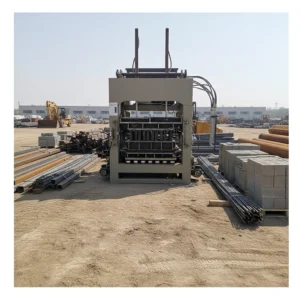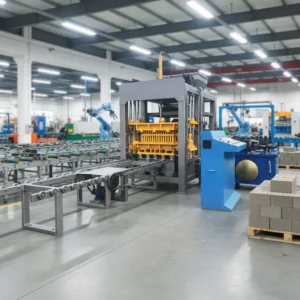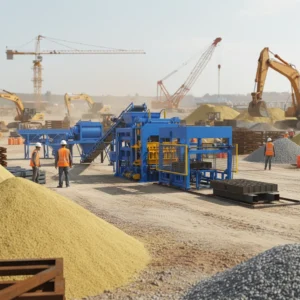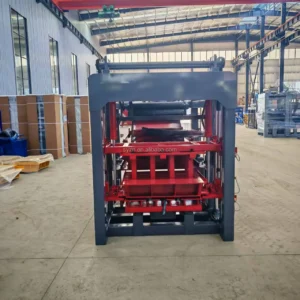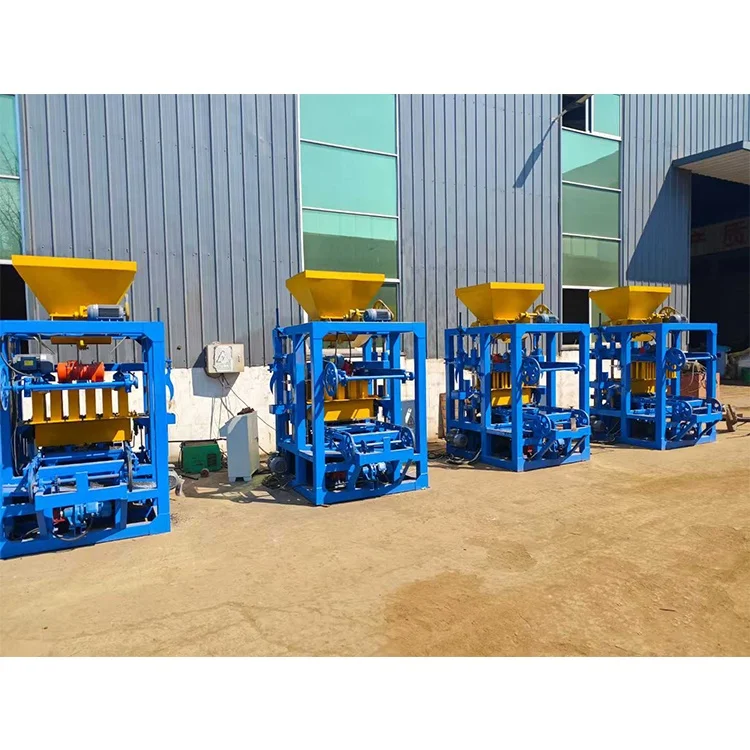
Matched Line Stations — mixer, conveyor and press specified together so the QTJ4-24 block making machine production line for hollow block never waits for material or pallets during a shift.
Technical Specifications
| Parameter | Value |
|---|---|
| Model | QTJ4-24 |
| Product Type | Semi-Automatic Concrete Block Making Machine |
| Rated Power (Main Machine) | 11.95 kW |
| Overall Dimensions (L×W×H) | 3600 mm × 1700 mm × 2560 mm |
| Net Weight | 3.5 T |
| Pallet Size | 900 mm × 450 mm |
| Cycle Time | 24–26 s (basis not stated in source — confirm block format) |
| Vibration Type | Table vibration feeding + fluctuation vibration molding |
| Control System | Electrical control cabinet with mechanical interlocking |
| Automation Level | Semi-automatic (manual feeding, mechanical interlocking) |
| Companion Mixer | JQ350 or JQ500 vertical mixer |
| Belt Conveyor | 6 m or 8 m length |
| Mould Formats | 400×200×200 mm / 390×240×190 mm / 390×120×190 mm / 240×115×53 mm |
| Voltage & Frequency | Configurable to buyer market (exact rating to confirm) |
| Assembly State | Stationary, installed on precast concrete ground |
Application Suitability
| Application | Material or Output |
|---|---|
| Hollow block production | Crushed stone, sand, cement and water mix |
| Solid standard brick (240×115×53 mm) | Local aggregate blended with cement |
| Paving block production | Dense aggregate mix, mould-dependent |
| Multi-cellular brick | Lightweight aggregate or sand-cement blend |
| Small-scale block plant | Daily output matched to local aggregate characteristics |
| On-site contractor production | Compact line footprint for project-site installation |
Why the Line Layout Decides Your Actual Daily Output
A block press only runs as fast as the slowest station feeding it.
Buyers often compare machines on cycle time alone, then discover that manual pallet handling, undersized mixers or poorly positioned conveyors leave the press idle for half the shift. The semi-automatic block making machine production line is designed so that mixer discharge, conveyor delivery, pallet feeding and press cycle are calculated together, preventing bottlenecks that cut real throughput well below the quoted figure. When local aggregate has high clay content, the mix must stay workable long enough to reach the hopper without segregating — a mismatch between mixer batch size and press cycle is the most common reason output drops on the first week [NEED_CITE: raw material feed coordination in block plants].
Line Flow: From Mixer Discharge to Press Hopper
The QTJ4-24 connects to a JQ350 or JQ500 vertical mixer through a 6 m or 8 m belt conveyor, and the selection between these options depends on the distance from the mixing station to the press. The semi-automatic block making machine production line must keep a continuous supply of fresh mix arriving at the hopper before each 24–26 second moulding cycle completes. If the conveyor is too short or the mixer batch too small, the operator waits for the next batch, and the press sits idle. This station-to-station matching is the core reason the line is specified as a system rather than a collection of individual machines.
Pallet Flow and Curing Area Alignment
The 900×450 mm pallet size determines how the curing racks must be spaced and which forklift can handle them downstream. When a buyer already has curing racks built for a different pallet dimension, the entire wet-block handling process breaks down — blocks must be manually transferred or the racks must be rebuilt. The semi-automatic block making machine production line accounts for pallet dimensions from the start, ensuring that the distance from press discharge to curing area is walkable and that standard pallet jacks or forklifts can load the racks without re-stacking [NEED_CITE: pallet size compatibility with curing infrastructure].
How Vibration and Feed Method Affect Block Density
Table vibration feeding combined with fluctuation vibration molding fills the mould cavity evenly before the main vibration cycle compacts the mix. This two-stage vibration is critical when producing hollow blocks, where uneven fill leads to thin cell walls that crack during curing. The electrical-mechanical interlocking system ensures that the mould lifting and vibration sequence cannot be triggered out of order, reducing operator error that would otherwise cause inconsistent density across a batch. For buyers sourcing aggregate with varying moisture content, this controlled feed-and-vibrate sequence keeps block weight and strength within acceptable tolerance.
What Happens When Line Stations Are Not Matched
A mixer that discharges faster than the conveyor can carry material creates spillage and mix segregation at the transfer point. An undersized conveyor running at full speed still delivers less volume per minute than the press hopper consumes, forcing the operator to hand-feed material into the mould. Pallets that are too heavy for manual handling slow down the return loop, and the press waits empty. These mismatches are not visible in a catalogue specification sheet — they only appear during the first production run, when real daily output falls far short of expectation [NEED_CITE: block line station mismatch consequences].
Why This Line Is Specified as a System
The QTJ4-24 is configured against the buyer’s actual mix design and local aggregate, not a default catalogue setting — so vibration parameters and cycle timing reflect the material the plant will actually use. Mould design covers the formats the buyer’s market sells, including custom drawings where standard formats do not match local building codes. Pallet size, material and thickness are selected to match the buyer’s existing curing racks and forklift capacity, not chosen in isolation. Automation level is selectable, allowing a buyer to start with semi-automatic operation and add automatic stacking later. Installation includes operator training so the crew understands how each station’s timing affects the next.
Documentation & Verification
- Line layout drawing showing mixer-to-press alignment and pallet flow direction
- Capacity calculation stating the block format assumed for daily output
- Voltage, frequency and control panel language confirmation sheet
- Pallet specification matched to buyer’s curing racks and forklift
- Factory test record on buyer’s target block format before dispatch
- Operation and maintenance manual with wear parts list
Installation, Commissioning & Support
- Precast concrete ground required for stationary installation of the 3.5 T machine
- 11.95 kW main power requires dedicated circuit matching local voltage and frequency
- Machine arrives in assembly-ready state with belt conveyor and mixer positioned on-site
- First-run commissioning adjusts vibration timing to buyer’s actual mix design
- Operator training covers mould change sequence and mechanical interlocking operation
- Wear parts and mould list provided for first replacement planning
Before You Request a Quote
Provide the block format your market sells most, the daily output you need, and the local aggregate source with its typical moisture and clay content. Share your workshop floor area, ceiling height and the curing rack dimensions you already have or plan to build. Confirm the local voltage, frequency and the language your operators need on the control panel — these details determine how the semi-automatic block making machine production line is configured before production begins.
Frequently Asked Questions
Q: How is daily output calculated for each block format on this line?
A: Output is calculated by multiplying the number of pieces per mould by the number of cycles achievable in a shift, using the 24–26 second cycle time as a starting point. The actual figure depends on the block format, mix workability and how quickly pallets return from the curing area. We provide a per-format capacity sheet so you can compare hollow block versus solid brick throughput before ordering.
Q: Does the quotation include pallet handling and curing equipment?
A: The line quotation covers the mixer, belt conveyor and press as a matched system. Pallet handling, stacking and curing rack equipment are specified separately based on your existing infrastructure. We confirm pallet size (900×450 mm), material and thickness against your curing area layout and forklift capacity so wet blocks can be moved without manual re-stacking.
Q: How must the mixer and conveyor be positioned to avoid feed delays?
A: The JQ350 or JQ500 mixer must discharge directly onto the belt conveyor, which runs 6 m or 8 m to the press hopper. Positioning depends on your workshop layout — the conveyor length is selected so that one full mixer batch arrives at the hopper before the current mould cycle finishes, preventing idle time between cycles.
Q: What voltage and control language will be configured for my market?
A: Voltage and frequency are confirmed during the quotation stage to match your local supply standard. The electrical control cabinet with mechanical interlocking is configured with the display and manual language your operators need, so commissioning is not delayed by language barriers or incorrect power connection on arrival.
Q: Is the pallet size compatible with standard curing racks and forklifts?
A: The 900×450 mm pallet is sized for common curing rack spacing and standard pallet jack or small forklift handling. We verify compatibility with your existing racks before shipment — if your racks are built to a different dimension, the pallet specification is adjusted so blocks can be loaded directly without transfer.