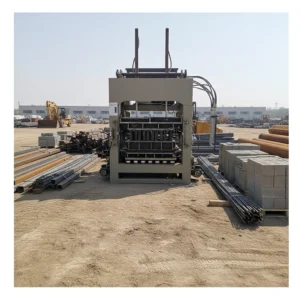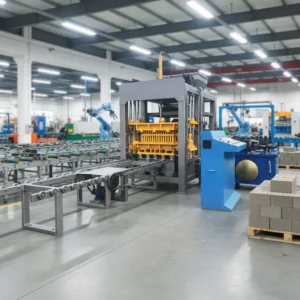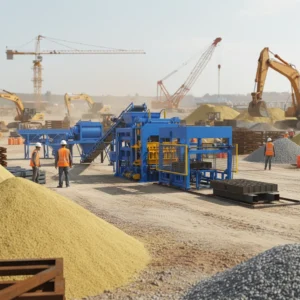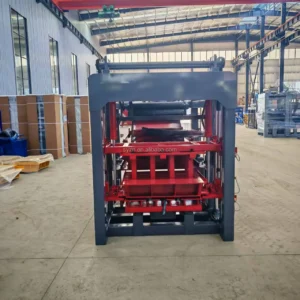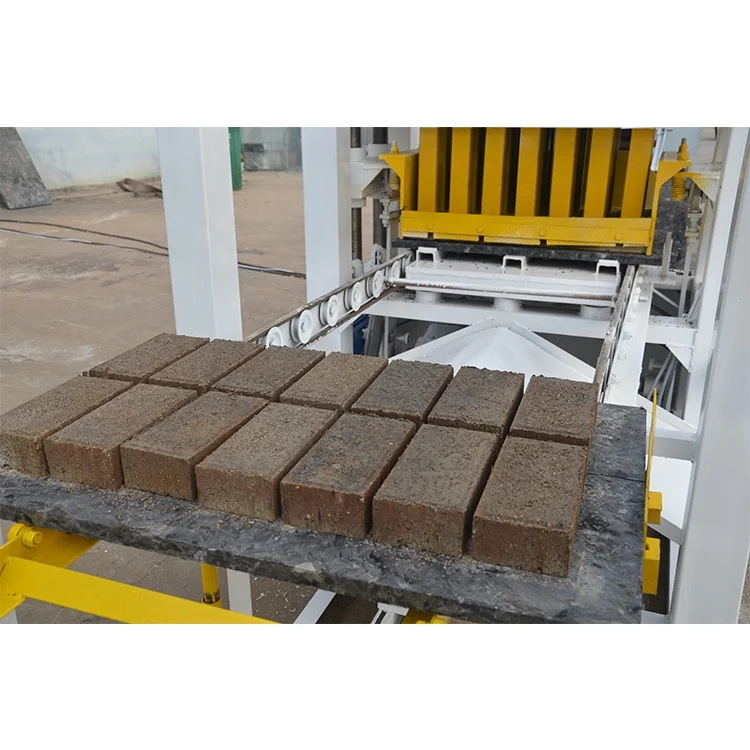
System-Matched Feed Rate — the QTJ4-24 line pairs the press with a JQ350/JQ500 vertical mixer and 6 m or 8 m belt conveyor so the 24–26 s molding cycle is never starved of material between stations.
Technical Specifications
| Parameter | Value |
|---|---|
| Model | QTJ4-24 |
| Product Type | Semi-Automatic Concrete Block Making Machine |
| Main Machine Power | 11.95 kW |
| Overall Dimensions (L×W×H) | 3600 mm × 1700 mm × 2560 mm |
| Total Mass | 3.5 T |
| Pallet Size | 900 mm × 450 mm |
| Molding Cycle | 24–26 s |
| Mould Format Capacity | 400×200×200 mm (4 pcs/mould); 390×240×190 mm (3 pcs/mould); 390×120×190 mm (6 pcs/mould); 240×115×53 mm (21 pcs/mould) |
| Automation Level | Semi-automatic (manual feeding, electrical control with mechanical interworking) |
| Vibration Type | Table vibration feeding, fluctuation vibration molding |
| Feed Method | Manual feeding, two feed ways available |
| Matching Line Equipment | J350 or JQ350/JQ500 vertical mixer; 6 m or 8 m belt conveyor |
| Control System | Electrical control cabinet with knife switch, mechanical-electrical interworking |
| Voltage & Frequency | Configurable to site supply (basis not stated in source — confirm with buyer) |
| Hydraulic Pressure | (basis not stated in source — confirm) |
| Vibration Force | (basis not stated in source — confirm) |
| Stacking Method | Manual |
| Warranty | 1 year (excluding spare parts) |
Application Suitability
| Application | Material or Output |
|---|---|
| Hollow block production | Crushed stone, river sand, fly ash, cement blends for 400×200×200 mm or 390×240×190 mm formats |
| Multi-cellular brick production | Lightweight aggregate and cement mixes for 390×120×190 mm blocks |
| Standard solid brick production | Dense aggregate and cement blends for 240×115×53 mm bricks |
| Paving brick production | High-density aggregate and cement mixes for interlocking or rectangular pavers |
| On-site contractor block production | Locally sourced aggregate for project-specific block volumes with compact line footprint |
What the 24–26 Second Cycle Actually Means for Your Daily Shift
A 24–26 s cycle is only real if the mixer discharges, the conveyor delivers, and the operator feeds pallets faster than the press cycles.
When I first visited a semi-automatic plant running this class of machine, the press was idle for several seconds each cycle because the upstream mixer batch had not finished blending. The operator stood waiting while the belt conveyor ran empty. That idle time accumulated across the shift, and the actual daily output fell noticeably below what the cycle time alone suggested. Sizing the QTJ4-24 block machine production line means verifying that the J350 or JQ500 mixer discharge rate and the belt conveyor speed both exceed the press demand, not just quoting a molding cycle figure [NEED_CITE: cycle time versus line throughput mismatch in semi-automatic block plants].
How the Mixer and Conveyor Keep the Press Fed
The QTJ4-24 block machine production line pairs the press with either a J350 or a JQ350/JQ500 vertical mixer. The choice depends on the batch volume your mix design calls for and how quickly the blended material must reach the press hopper. A 6 m or 8 m belt conveyor bridges the gap. If the conveyor is too short for your raw material staging area, the loader operator becomes the bottleneck. If the mixer batch size is smaller than what one molding cycle consumes, the press waits between cycles and throughput drops. Matching these three stations — mixer, conveyor, press — is what turns a standalone machine into a continuous line.
Pallet Handling and Why 900 × 450 mm Matters Beyond the Press
The 900 mm × 450 mm pallet size determines how your curing yard is laid out, what forklift tine spacing you need, and how many wet blocks move in a single trip. A pallet chosen without checking the curing rack dimensions means blocks sit on the ground or require a second handling step. In my experience on site, the pallet spec is often confirmed last, yet it governs the entire downstream flow from press output through curing to dispatch [NEED_CITE: pallet sizing and curing area coordination in block plants].
Reading the Specs That Govern Block Density
The vibration system uses table vibration for feeding and fluctuation vibration for molding. Table vibration settles material into the mould cavity before full compaction begins, while fluctuation vibration applies the main densification force. Together they determine whether a hollow block meets the compressive strength your local building code requires. The electrical control cabinet uses mechanical-electrical interworking to prevent the press from firing when the mould or feed box is out of position, reducing damage from operator error. Total machine power at 11.95 kW covers both vibration motors and the feed mechanism, so your site wiring must account for starting current on top of the running load. The 3.5 T total mass gives the frame enough inertia to absorb vibration without transmitting it into the foundation, provided the concrete pad is level and cured.
When the Line Stops Because One Station Was Sized Wrong
A mixer that discharges too slowly forces the press operator to wait. A belt conveyor that cannot clear material from the mixer outlet causes spillage and housekeeping problems. Pallets that do not match the curing rack spacing require workers to restack blocks by hand before they enter the yard. Each of these mismatches shows up after commissioning, when the line is supposed to be running at full output. Fixing them later means replacing equipment that was never wrong in isolation — it was just wrong for the stations around it [NEED_CITE: upstream and downstream station matching in block production lines].
Why Buyers Specify the Full Line Here
Block machinery is our single focus, so the QTJ4-24 press, mould, pallet, mixer and conveyor are specified as one matched system rather than assembled from separate suppliers. Configuration is set against your actual mix design and local aggregate, not a catalogue default. Mould design covers the formats your market sells, including custom drawings if your region uses a non-standard block size. The automation level is selectable — you can start with this semi-automatic line and add automatic stacking later without replacing the press. Installation includes operator training so your crew understands the mechanical-electrical interworking and feed sequence from day one.
Documentation & Verification
- Line layout showing mixer, conveyor and press positions with capacity stated per block format
- Pallet specification sheet matched to your curing rack dimensions and forklift tine spacing
- Hydraulic and electrical schematic for local maintenance teams
- Voltage and control language confirmation before production begins
- Factory test record on your specified block format before dispatch
- Operation and maintenance manual with wear parts and mould list
Installation, Commissioning & Support
- Concrete foundation pad leveled within tolerance for the 3600 mm × 1700 mm machine footprint
- Dedicated power circuit sized for the 11.95 kW running load plus motor starting current
- Mixer and belt conveyor assembled and aligned to the press hopper on site
- First-run parameter setting for vibration duration matched to your mix design
- Operator training on the mechanical-electrical interworking and manual feed sequence
- Wear parts and mould list provided for local procurement planning
What to Share Before Requesting a Quote
To size the QTJ4-24 block machine production line accurately, we need your target block format and the daily output you expect from an eight-hour or ten-hour shift. Share your local aggregate type and whether you have existing curing racks or forklifts the pallets must fit. Confirm your site voltage and frequency, and let us know the control panel language your operators require.
Frequently Asked Questions
Q: How do I calculate realistic daily output for each block format?
A: The 24–26 s molding cycle applies to one press stroke. Multiply by the pcs-per-mould figure for your chosen format — for example, 4 pcs/mould for 400×200×200 mm hollow blocks — then deduct time for pallet changes, mixer batching pauses, and mould swaps. A line layout with per-format capacity is provided before order confirmation.
Q: Which mixer and conveyor combination avoids bottlenecking the press?
A: The JQ350 suits lighter mix designs with faster discharge, while the JQ500 handles denser blends and larger batches. The 6 m or 8 m belt conveyor is selected based on the distance between your raw material staging area and the press hopper. Both options are confirmed during the line layout stage.
Q: What installation conditions does the QTJ4-24 require on site?
A: A level concrete pad capable of supporting the 3.5 T machine mass plus dynamic vibration loads. A dedicated power circuit for the 11.95 kW main machine power with allowance for starting current. Sufficient clearance around the 3600 mm × 1700 mm footprint for pallet feeding and manual stacking access.
Q: How are pallet size and material chosen for my curing area?
A: The standard 900 mm × 450 mm pallet is checked against your curing rack shelf dimensions, forklift tine spacing, and the stacking height your yard allows. If your existing racks use a different spacing, the pallet spec is adjusted before production so blocks move directly from press to cure without restacking.
Q: Can this semi-automatic line be upgraded to higher automation later?
A: The QTJ4-24 press can be paired with automatic pallet feeding, stacking, and cubing equipment in a future phase. The core press and moulds remain in service; the upgrade adds handling stations around it. Planning the foundation and electrical capacity for the future layout during initial installation avoids costly rework.