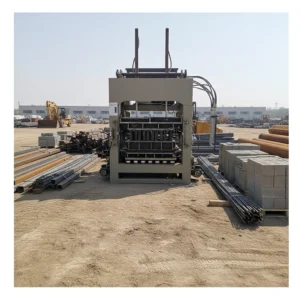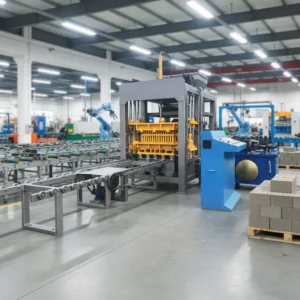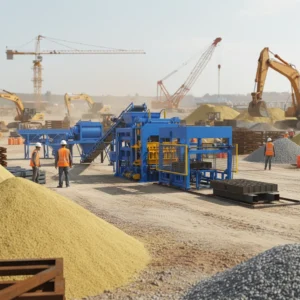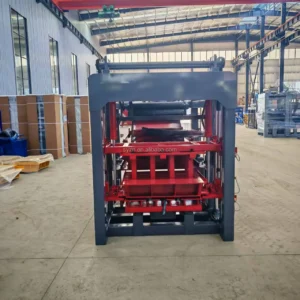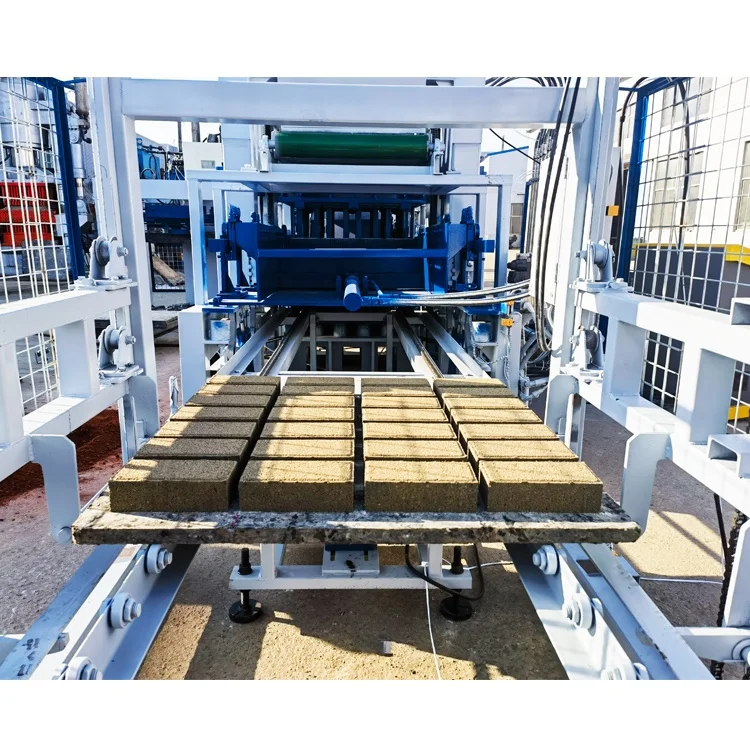
Matched Line Engineering — The QT8-15 is configured as a complete production chain where the JS750 mixer, pallet feeder, and block conveyor are timed to the 15–20 s press cycle so no station sits idle waiting for the next step.
Technical Specifications
| Parameter | Value |
|---|---|
| Model | QT8-15 |
| Product Type | Automatic Hydraulic Concrete Block Making Machine |
| Overall Dimensions (L×W×H) | 8300 × 1860 × 3000 mm |
| Cycle Time | 15–20 s (basis to be confirmed by block format) |
| Vibration Force | 55 kN |
| Rated Power | 37.2 kW |
| Mixer Model | JS750 |
| Pallet Size | 1020 × 900 mm |
| Total Weight | 8 T |
| Control System | PLC control unit |
| Automation Level | Automatic |
| Applied Products | Paver, solid block, hollow block, curbstone |
| Raw Materials | Crushed stone, sand, cement, dust, fly ash |
| Included Equipment | Block making machine, hydraulic station, PLC control system, pallet feeder, material feeder, block conveyor, block sweeper, block mould, spare parts and tools |
Application Suitability
| Application | Material or Output |
|---|---|
| Paver production for municipal walkways and parking areas | Crushed stone and sand with cement binder |
| Hollow block manufacturing for load-bearing walls | Sand, cement, and fly ash mixes |
| Solid block output for partition and boundary walls | Crushed stone, dust, and cement |
| Curbstone forming for road and drainage edging | Coarse aggregate with high cement content |
Why Quoting Only the Press Leaves Money on the Floor
A block press that waits for pallets or mix material is a block press that is not producing.
I have watched plant layouts where a high-capacity press sat idle for seconds at a time because the mixer batch was not ready or the pallet feeder ran out of stock. Over a ten-hour shift those idle windows add up to hundreds of missing blocks. The QT8-15 concrete block making machine production line addresses this by specifying the JS750 mixer, material feeder, pallet feeder, and block conveyor as one package with cycle times that align to the press demand [NEED_CITE: production line synchronization standards for concrete block plants].
How the Stations Connect Around the Press
The material feeder delivers raw mix to the hopper at a rate timed to the press cycle, so the mould box fills completely on every stroke. The JS750 mixer batches upstream and holds enough volume to cover the press demand without forcing the press to pause. The PLC control unit monitors the sequence and coordinates pallet release with mould descent.
A mismatch at any of these hand-off points causes the press to skip a cycle or produce an under-filled block. That is why the QT8-15 concrete block making machine production line quotes every station together rather than leaving the buyer to source conveyors and feeders separately and hope the speeds align.
Where Bottlenecks Typically Hide in a Block Line
The most common constraint I see is not the press itself but the pallet return loop. If cured blocks are not cleared from pallets fast enough, the pallet feeder runs dry and the press stops. The 1020 × 900 mm pallet size on this line defines how many pallets fit in the curing area and how many a standard forklift can move per trip [NEED_CITE: pallet circulation rates in concrete block curing yards].
The block sweeper included in this configuration cleans pallet surfaces before they re-enter the feeder, reducing residue build-up that can cause the next block to stick or crack on demoulding. These small stations are where daily output is actually won or lost.
Reading the Numbers Behind the 15–20 s Cycle
The vibration force of 55 kN works with the hydraulic station to compact the mix inside the mould. Higher vibration amplitude improves density in hollow block formats where the walls are thin, while curbstone production typically demands greater hydraulic pressure to push coarse aggregate into tight corners. The 15–20 s cycle time applies to a specific block format and mix; denser paver formats may push the cycle toward the upper end of that range.
The 37.2 kW rated power covers the press motor, hydraulic pump, and vibration system. The JS750 mixer draws additional power on its own circuit, which must be factored into the total plant electrical load. The 8300 × 1860 × 3000 mm footprint of the press alone means the full line — mixer, feeders, conveyor, and curing rack space — requires a considerably larger floor area. Buyers should confirm ceiling height clearance for the 3000 mm machine height plus overhead material feed chutes.
What Happens When Line Stations Are Sourced Separately
When the mixer, pallet feeder, and conveyor come from different suppliers, nobody owns the cycle-time match. The mixer vendor quotes batch capacity per hour without knowing the press cycle, and the pallet feeder vendor quotes speed without knowing the pallet weight when loaded with wet concrete. The result is a line that technically runs but never reaches its nameplate output [NEED_CITE: equipment integration challenges in multi-vendor block production lines].
Repair responsibility also fractures. When the press stops because the feeder stalled, each vendor points at the other’s equipment. Specifying the full QT8-15 concrete block making machine production line from a single source means one party is accountable for the hand-offs between every station.
Why Buyers Plan Their Full Line Here
Block machinery is the single focus of this operation, so the press, mould, pallet, and handling equipment are specified as one matched system rather than assembled from unrelated catalogues. The JS750 mixer is paired to the QT8-15 throughput, not selected from a generic mixer range.
Configuration is set against the buyer’s actual mix design and local aggregate, meaning the vibration and pressure parameters are adjusted before shipment rather than left at a factory default. Pallet size and material are confirmed against the buyer’s existing curing racks and forklift capacity to avoid surprises on arrival. The PLC control unit language and voltage are locked in during the order stage so commissioning is not delayed by a display the operator cannot read.
Documentation & Verification
- Line layout drawing showing station spacing and pallet circulation path for the QT8-15
- Capacity calculation stating which block format the 15–20 s cycle time assumes
- Hydraulic and electrical schematic for local maintenance of the press and feeder stations
- Voltage, frequency, and PLC display language confirmation signed before production
- Factory test record on the buyer’s specified block format before dispatch
- Operation and maintenance manual covering all included stations
Installation, Commissioning & Support
- Foundation plan sized to the 8 T machine weight and 55 kN vibration load
- Dedicated electrical circuit for the 37.2 kW press plus separate feed for the JS750 mixer
- Machine dismantling for container loading and reassembly sequence on site
- First-run parameter setting for hydraulic pressure and vibration matched to local aggregate
- Operator training on PLC control unit covering fault codes and mould change procedure
- Wear parts list with hydraulic seals and mould liner replacement intervals
What to Prepare Before Requesting a Quote
Share the block formats your market actually sells — hollow block, paver, solid block, or curbstone — along with the target daily output for each. Provide the raw materials available locally, including aggregate type and gradation, and the voltage and frequency at your site. If you already have curing racks or forklifts, send their dimensions so the 1020 × 900 mm pallet can be verified against your existing handling setup.
Frequently Asked Questions
Q: How does the 15–20 s cycle time change between hollow block and paver production?
A: The cycle range depends on the block format and mix density. Hollow blocks typically fill and compact faster because the mould cavity is partially open, while pavers require longer vibration to achieve surface finish and density. The exact cycle per format is confirmed during line configuration based on your mix design and target strength.
Q: Does the JS750 mixer keep up with the QT8-15 press without causing delays?
A: The JS750 is selected to match the press throughput so that a fresh batch is available before the hopper runs empty. If your mix design has a long blending time or your raw materials require pre-wetting, the mixer cycle is checked against the press demand during the line layout stage to confirm there is no bottleneck.
Q: How does the 1020 × 900 mm pallet size affect my curing area and forklift?
A: Pallet dimensions determine how many blocks cure per square meter and whether your existing forklift forks can carry a loaded pallet safely. We confirm pallet size against your curing yard layout and forklift capacity before production so that pallet handling on arrival matches your site equipment.
Q: Can automatic stacking and cubing be added to this line later?
A: The line configuration includes the core stations from mixing through conveying. Automatic stacking and cubing stations can be integrated into the PLC control sequence as an upgrade when production volume justifies the investment. The control architecture is designed to accommodate these additions without replacing the existing PLC unit.
Q: Does the PLC control the entire line or only the press?
A: The PLC control unit coordinates the press cycle with the pallet feeder and material feeder to maintain synchronization across stations. Mixer batching and conveyor operation are integrated into the same sequence, so the operator manages the full line from one control interface rather than adjusting each station independently.