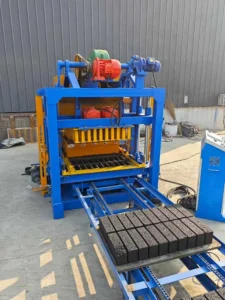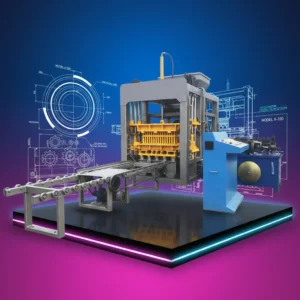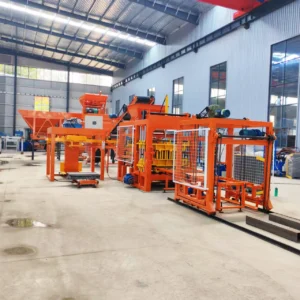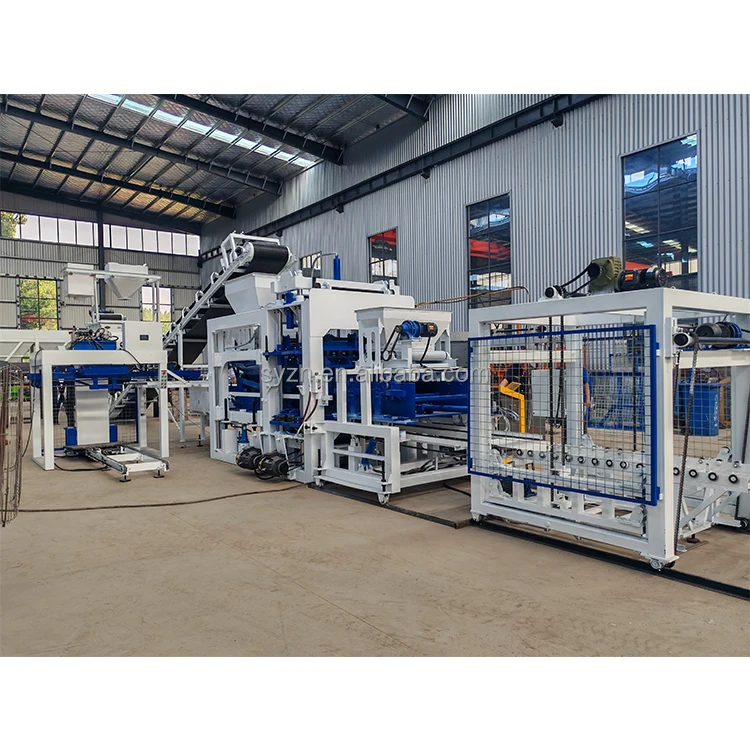
Matched System Integration — Every station from raw material feeding to block stacking is sized against the QT8-15 cycle so the press never idles waiting upstream or downstream.
Technical Specifications
| Parameter | Value |
|---|---|
| Model | QT8-15 |
| Product Type | Hydraulic Automatic Concrete Block Making Machine |
| Overall Dimensions (L×W×H) | 8300 × 1860 × 3000 mm |
| Rated Pressure | 32 MPa |
| Vibration Form | Platform Vibration |
| Vibration Frequency | 2800–4500 RPM |
| Pallet Size | 950 × 900 mm |
| Molding Cycle | 15–25 s (basis not stated in source — confirm block format, material and thickness) |
| Overall Power | 47 kW |
| Control System | PLC with touch screen interface |
| Block Comprehensive Strength | 15 MPa |
| Included Mould | One hollow mould |
| Supporting Equipment | JS750 mixer, 8 m belt conveyor, automatic stacker |
Application Suitability
| Application | Material or Output |
|---|---|
| Hollow block production | Crushed stone, cement, sand, water — standard concrete mix |
| Solid block manufacturing | Dense aggregate blends for load-bearing masonry units |
| Paving block and kerbstone | High-strength concrete with fine aggregate grading |
| On-site construction supply | Local raw materials matched to project specifications |
Why "Cycles per Hour" Tells Only Half the Story for an Automatic Block Making Machine Production Line
A quoted cycle rate means nothing unless the mixer, conveyor and stacker can keep pace with the press.
In my years doing after-sales across the Pearl River Delta, I have walked into plants where the block press sat idle for seconds between cycles — not because the machine was slow, but because the belt conveyor could not deliver material fast enough or the stacker was still clearing the previous pallet. Buyers had paid for an automatic block making machine production line expecting continuous operation, yet real daily output fell well short of the brochure figure. The bottleneck was never the press itself; it was the gap between stations that nobody had calculated before shipment [NEED_CITE: typical throughput losses from mismatched station cycle times in block plants].
How Station Timing Shapes Real Output
The QT8-15 completes a molding cycle in 15–25 seconds, but that window only counts what happens inside the press. The JS750 mixer must finish its batch and discharge into the conveyor hopper before the next cycle begins, and the 8-meter belt conveyor must transport the fresh mix without spillage or delay. When any one of these intervals exceeds the press cycle, the PLC simply holds the press — and the automatic block making machine production line runs below its rated rhythm.
Where the Stacker Becomes the Real Gatekeeper
After demolding, finished blocks ride out on pallets toward the automatic stacker, which handles two pallets simultaneously across three to six layers. If the curing area is too far from the press or the forklift rotation is slow, stacked pallets pile up and the conveyor backs into the demolding zone. I have seen operators manually clearing pallets because the downstream path was never factored into the line layout — turning an automated setup back into a labor-intensive one [NEED_CITE: workflow studies on pallet handling congestion in semi-automated block plants].
Reading the Specs That Actually Matter on Site
Platform vibration at 2800–4500 RPM combined with 32 MPa hydraulic pressure determines how densely the concrete is compacted inside the mould. Higher vibration frequency works well for finer aggregate mixes, while coarser stone demands more hydraulic force to close voids. The 950 × 900 mm pallet size must match the curing rack spacing and forklift tine width already in use at the buyer’s facility — a mismatch here forces either a rack rebuild or a pallet reorder before the first production run. The 47 kW overall power draw requires a dedicated circuit with adequate breaker capacity, and the PLC touch screen language must be confirmed before dispatch to avoid a stalled commissioning on arrival.
The Hidden Cost of Treating the Press as a Standalone Purchase
When a buyer sources only the press and bolts on a mismatched mixer or a smaller stacker later, the integration gaps surface during commissioning. The conveyor may be too short to reach the mixer discharge, forcing a manual transfer point. The stacker may handle only one pallet at a time, cutting the effective throughput in half. I have spent days on site rewiring PLC I/O because the buyer’s existing equipment spoke a different protocol than the press controller. These are not machine defects — they are configuration oversights that delay production and erode the return on the automatic block making machine production line investment [NEED_CITE: common commissioning delays caused by incomplete line integration in block manufacturing].
What a Matched Configuration Actually Delivers
The QT8-15 ships as a defined line: press, JS750 mixer, 8-meter belt conveyor, and two-pallet automatic stacker with three-to-six-layer capacity. Each station’s cycle time is calculated against the 15–25 second press window so material flows continuously. Moulds are specified against the buyer’s target block format and local aggregate, not pulled from a catalogue default. The PLC program covers every station, and voltage, frequency and display language are locked in before the machine leaves the factory. Factory test records document actual cycle performance on the agreed block format, giving the buyer a verified baseline before container loading.
Documentation & Verification
- Line layout drawing with station-by-station cycle time for the agreed block format
- Factory test record showing QT8-15 output on buyer’s specified mix design
- Hydraulic and electrical schematic covering all integrated stations
- Voltage, frequency and PLC language confirmation sheet signed before dispatch
- Pallet specification matched to buyer’s curing rack and forklift dimensions
Installation, Commissioning & Support
- Foundation plan sized to the 8300 × 1860 mm machine footprint and vibration load
- Power circuit rated for the 47 kW total draw with dedicated breaker and earth bond
- Mixer and conveyor alignment verified against the press feed opening on site
- PLC program parameters tuned to buyer’s local aggregate and mix ratio
- Operator training covering mould change, stacker layer adjustment and daily maintenance checkpoints
Before You Request a Quote
To size this automatic block making machine production line correctly, I need to know which block format you plan to produce, your target daily output, and the local aggregate and cement available at your site. Share your existing curing area dimensions and forklift capacity so the 950 × 900 mm pallet can be verified against them. Confirm your facility’s voltage and frequency, and let me know if you already have upstream batching or downstream handling equipment that needs to tie into the PLC.
Frequently Asked Questions
Q: How is daily output calculated for different block formats on this line?
A: The QT8-15 molding cycle runs 15–25 seconds, but daily output depends on the block format assumed — a hollow block cycle differs from a paving block cycle in vibration duration and demolding time. We calculate output per format and state the assumed format in the line layout so the figure reflects actual production, not a generic maximum.
Q: Does the 950 × 900 mm pallet fit my existing curing racks and forklift?
A: That depends on your rack bay width and forklift tine spacing. We ask for these dimensions during the inquiry stage and adjust the pallet specification if needed, because a mismatch means either rebuilding your curing area or ordering new pallets before the first run.
Q: How do the mixer, conveyor and stacker cycle times align with the press?
A: The JS750 mixer batch time, the 8-meter belt conveyor transfer interval and the automatic stacker’s two-pallet handling cycle are each calculated against the 15–25 second press window. If any station runs longer, the PLC holds the press — so we confirm every interval during line configuration.
Q: What voltage and PLC language options are confirmed before dispatch?
A: We lock in voltage, frequency and PLC display language during the order stage and document the confirmation in a signed sheet. This prevents commissioning delays caused by incorrect power supply wiring or an unreadable interface when the machine arrives on site.
Q: Is the automatic stacker included, and how many layers does it handle?
A: Yes, the automatic stacker is part of the standard line configuration. It handles two pallets simultaneously and stacks three to six layers depending on the block height and your curing rack clearance, reducing manual labor after the press.