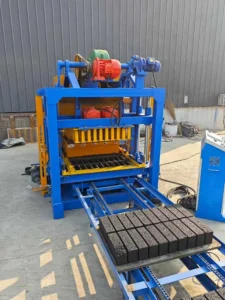
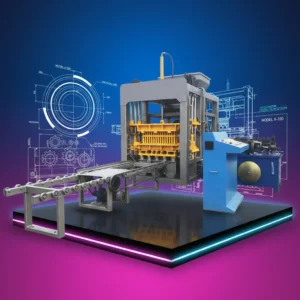
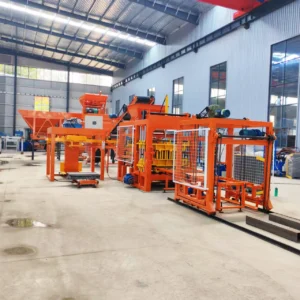
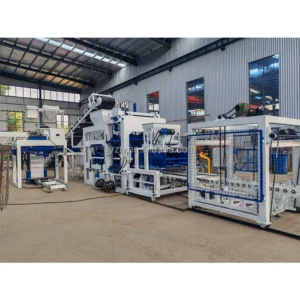
Single-Focus Line Synchronization — every station from raw material intake to stacking is specified against the 25-second press cycle so the QTJ4-25 is never left idle between molds.
Technical Specifications
| Parameter | Value |
|---|---|
| Model | QTJ4-25 |
| Product Type | Automatic Concrete Block Making Machine |
| Rated Power | 16.58 kW |
| Voltage & Frequency | Configured to buyer’s local supply (basis to be confirmed) |
| Control System | PLC controlled, fully automatic |
| Overall Dimensions (L×W×H) | 6400 × 1500 × 2700 mm |
| Net Weight | 5000 kg |
| Output Capacity | 4600 pcs / 8 hours (basis not stated in source — confirm block format, material, thickness) |
| Molding Cycle | 25 seconds |
| Pallet Size | 850 × 480 mm |
| Vibration System | Vibration motor with large vibration box (hydraulic pressure not included) |
| Automation Level | Fully automatic — pallet feeding, material feeding/scraping, block stacking |
| Motor Brand | Siemens motor |
| Frame Construction | Thickened steel frame |
| Warranty | One year |
| Key Features | Automatic pallet feeder, integrated material scraper, PLC synchronization across stations |
Application Suitability
| Application | Material or Output |
|---|---|
| Medium-sized block factory — hollow block mass production | Concrete, sand, cement, crushed stone, water |
| Solid brick and paver production line | Fly ash, lime, cement, fine aggregate |
| On-site contractor block plant for housing projects | Locally sourced aggregate blended with cement |
| Format-diverse plant switching between hollow, solid, and paver | Interchangeable moulds on common pallet size |
What "4600 Pieces per Shift" Actually Means for Your Line
Capacity is only meaningful when the block format, mould, and mix design are stated alongside it.
Buyers routinely receive a single output figure without the assumption behind it. A QTJ4-25 rated at 4600 pieces over eight hours may deliver that number on one specific hollow block format with a particular mix, but produce considerably fewer units on a denser paver or a thicker wall block. When the automatic block machine production line is planned around an unverified headline number, upstream mixers are sized too small and downstream curing racks run out of space before the shift ends. I have seen plants where the press sat idle for several seconds every cycle simply because the pallet feeder could not return a board fast enough [NEED_CITE: line synchronization loss from mismatched station cycle times]. The result is a line that never reaches the throughput the buyer paid for.
Station-by-Station Timing Across the QTJ4-25 Line
The 25-second molding cycle sets the heartbeat that every other station must match. Raw material feeding must deliver a measured batch to the mixer within that window, the mixer must discharge a consistent volume before the next scrape, and the pallet feeder must slide a fresh 850 × 480 mm board into position before the press head descends. If any single station drifts beyond 25 seconds, the automatic block machine production line accumulates idle time that compounds across an eight-hour shift. The PLC on the QTJ4-25 coordinates pallet infeed, material distribution, vibration, and block ejection in one sequence, but upstream mixing and downstream stacking sit outside that loop and must be sized independently.
Matching Mixer Batch Size and Pallet Feeder Speed
A common mismatch occurs when the mixer batch volume is calculated for peak press demand but the discharge gate or conveyor cannot empty fast enough. Equally, a pallet feeder rated for a lighter board may slow down once pallets absorb moisture during curing and gain weight. Both scenarios force the QTJ4-25 to pause mid-cycle, negating the advantage of its fully automatic control. Specifying the mixer output in kilograms per cycle and confirming the pallet feeder motor torque against wet-board weight keeps the automatic block machine production line running without operator intervention [NEED_CITE: pallet weight gain during steam curing and its effect on feeder motors].
Reading the Specs That Determine Line Compatibility
The 850 × 480 mm pallet size dictates the width of every conveyor, the slot pitch of the curing rack, and the fork pocket spacing on your existing forklift. Choosing a different pallet dimension after the line is built means replacing or modifying each of those downstream components. The vibration motor and large vibration box deliver compaction force without a hydraulic circuit, which simplifies maintenance but limits the maximum pressure the press can apply — an important consideration when the target block requires high density. The thickened steel frame and Siemens motor support continuous operation across long shifts, while the PLC coordinates automatic pallet feeding, material scraping, and block stacking to reduce manual handling between cycles. The 16.58 kW total connected load must be matched by a dedicated circuit with the correct voltage and frequency confirmed before production begins, otherwise commissioning stalls at first power-up.
The Cost of Overlooking Downstream Station Alignment
When supporting equipment is left out of the quotation, the buyer is forced to source conveyors, stackers, and curing racks separately — often after the press has already shipped. Pallets that do not match the feeder guide rails jam at the entry point, and a stacker that cannot keep pace with a 25-second cycle leaves finished blocks piled on the floor. Voltage and frequency assumptions made at order stage without written confirmation can mean the PLC display arrives in a language the operators cannot read, delaying production by days while replacement HMI panels are sourced [NEED_CITE: commissioning delays caused by unconfirmed PLC language and voltage]. Each of these gaps turns a planned automatic block machine production line into a collection of mismatched machines that never reach rated output.
Why Source the Complete Line From One Equipment Partner
Block machinery is our single focus, so the QTJ4-25 press, mould, pallet, and handling stations are specified as one matched system rather than assembled from separate suppliers. Configuration is set against your actual mix design, local aggregate, and target block format — not a catalogue default. Mould design covers the formats your market sells, and custom drawings are available for non-standard shapes. Automation level is selectable, letting a buyer start with semi-automatic pallet handling and move to full stacking and cubing later. Installation support includes on-site commissioning and operator training so the line reaches stable output before the service team leaves.
Documentation & Verification
- Line layout showing station spacing and pallet flow matched to the 25-second cycle
- Capacity calculation sheet stating which block format and mix the 4600 pcs figure assumes
- Pallet specification with dimensions, material grade, and moisture tolerance for curing rack compatibility
- Electrical schematic listing voltage, frequency, breaker rating, and PLC I/O map
- Factory test record documenting cycle times across at least one confirmed block format
- Wear parts and mould list identifying replacement intervals for vibration box liners and scraper blades
Installation, Commissioning & Support
- Foundation pad leveled to within tolerance across the 6400 × 1500 mm machine footprint
- Dedicated 16.58 kW circuit with confirmed voltage and frequency before the press is energized
- Pallet feeder guide rails aligned to the 850 × 480 mm board and existing curing rack slot pitch
- PLC display language and alarm codes verified against operator preference during commissioning
- Siemens motor insulation resistance checked after transit before first continuous run
- Vibration box liner and scraper blade spare set supplied for first scheduled change-out
What to Include in Your Inquiry
Send us the block formats you plan to produce, including dimensions and target compressive strength, along with the local aggregate types available. Confirm your site voltage, frequency, and preferred PLC display language so the automatic block machine production line arrives ready to commission. If you already have curing racks or forklifts on site, share their dimensions so pallet and conveyor specifications align before production starts.
Frequently Asked Questions
Q: How is the 4600 pcs/8h capacity verified — which block format does it assume?
A: That figure is published without a stated block format, mould type, or mix design. Before the line is finalized, we run a capacity calculation on your specific block dimensions and local material blend, then document the verified output in the layout sheet so daily expectations are realistic.
Q: How do I match the 25-second press cycle with my mixer and pallet feeder?
A: We calculate the mixer discharge volume per cycle and specify a pallet feeder motor rated for wet-board weight. Both stations are timed against the QTJ4-25 PLC sequence so no station waits on another during continuous production.
Q: What supporting equipment is included in the line quotation?
A: Raw material feeding, mixing, pallet feeding, automatic stacking, and curing rack handling can all be included. The quotation clearly lists each station, so you know exactly what is supplied and what remains your responsibility before the order is placed.
Q: Is the 850 × 480 mm pallet compatible with my existing curing racks?
A: We cross-check the pallet dimensions against your rack slot pitch and forklift fork spacing. If a mismatch exists, we adjust the pallet spec or recommend rack modifications before the line ships to avoid downtime on arrival.
Q: How are voltage, frequency, and PLC language confirmed before shipment?
A: A written confirmation form is exchanged after order placement, listing supply voltage, hertz, and HMI language. The factory test is then run on those exact settings, and the test record is included in the documentation package.