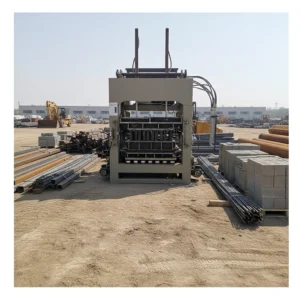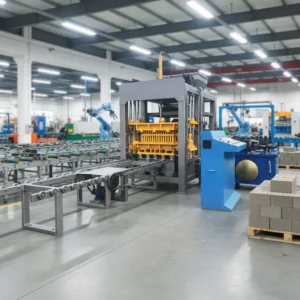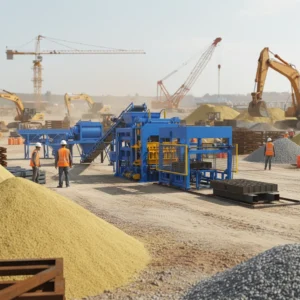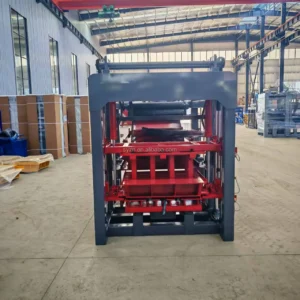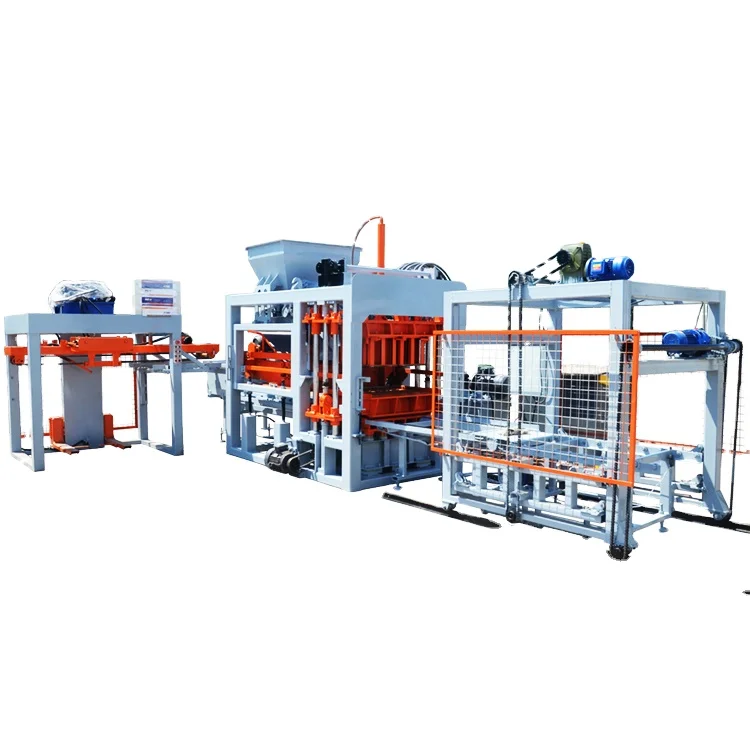
Coordinated Line Stations — The QT6-15 block making machine production line integrates press, pallet feeder, brick conveyor and sweeper as one cycle-matched system so the press never waits on upstream or downstream gaps.
Technical Specifications
| Parameter | Value |
|---|---|
| Model | QT6-15 |
| Product Type | Fully Automatic Hydraulic Vibration Block Making Machine |
| Overall Dimensions (L×W×H) | 7400×1900×2660 mm |
| Vibration Frequency | 4600 r/min |
| Exciting Power | 40-50 kN |
| Rated Power | 31.25 kW |
| Mixer Model | JQ350 |
| Pallet Size | 850×550×25 mm |
| Total Weight | 7 T |
| Control System | PLC control system |
| Included Equipment | block making machine, hydraulic station, PLC control system, pallet feeder, brick conveyor, block sweeper |
| Applied Products | paver, solid block, hollow block, curbstone |
| Raw Materials | crushed stones, sand, cement, dust, fly ash |
| Output Capacity (Hollow Block 400×200×200 mm) | 1200-1680 pcs/hr, 9600-13440 pcs/8hr (basis: 400×200×200 mm hollow block, 15-20 s cycle) |
| Output Capacity (Hollow Block 400×150×200 mm) | 1800-2400 pcs/hr, 14400-19200 pcs/8hr (basis: 400×150×200 mm hollow block, 15-20 s cycle) |
| Output Capacity (Solid Brick 240×115×53 mm) | 3240 pcs/hr, 16200-19440 pcs/8hr (basis: 240×115×53 mm solid brick, 15-20 s cycle) |
| Molding Cycle | 15-25 s (basis not stated in source) |
| Automation Level | Fully automatic |
Application Suitability
| Application | Material or Output |
|---|---|
| Block and paver production plants | Hollow blocks, solid bricks, pavers, and curbstones from crushed stones, sand, cement, fly ash |
| On-site construction production | Local housing and development projects using site-available aggregates |
| Format expansion for concrete product manufacturers | Adding new block dimensions to an existing range using the same raw material base |
| First plant setup by entrepreneurs | Semi-to-fully automatic block line with defined footprint and utility requirements |
Why the Cycle Rate Is Only Half the Story
A press that cycles fast but waits for pallets or downstream clearing produces far fewer blocks per shift than its nameplate suggests.
Many quotations quote cycles per hour without stating which block format that figure assumes, or they leave pallet feeding and wet-block conveying out of the scope entirely. When those stations are added later as separate purchases, the timing rarely matches, and the press sits idle for seconds every cycle. On a QT6-15 block making machine production line, those gaps compound across an eight-hour shift into thousands of unrealized blocks. I have seen plant layouts where the press was rated for a certain output but the actual throughput was noticeably lower because the pallet return loop could not keep up. [NEED_CITE: typical output variance between quoted cycle rate and actual shift production in block plants]
Line Station Coordination and Cycle Matching
The QT6-15 block making machine production line is built around the principle that every station must match the press cycle, not the other way around. The pallet feeder delivers boards to the press at a rate synchronized with the molding cycle, and the brick conveyor removes wet blocks before the next pallet arrives. The block sweeper cleans pallets before they re-enter the loop. This coordination is controlled through the PLC system, which sequences each station so the press is never starved or blocked.
Where Bottlenecks Typically Hide in Block Lines
Bottlenecks in block production rarely appear at the press itself. They show up at the transitions — pallet entry, wet-block exit, and pallet return. If the brick conveyor runs even slightly slower than the press discharge, blocks back up and the press must pause. If pallet cleaning is incomplete, residue builds up on the board surface and affects the next molding cycle. These are not press failures; they are line design failures. Specifying the QT6-15 as a coordinated set of stations rather than a standalone machine removes the most common sources of unplanned downtime. [NEED_CITE: common causes of throughput loss in automatic block production lines]
How Pressure, Vibration, and Pallet Size Interact
The hydraulic station on the QT6-15 delivers consistent pressure across the mold cavity, while the vibration system operates at 4600 r/min with 40-50 kN exciting force. These two forces work together — vibration settles the mix into the mold, and hydraulic pressure compacts it to target density. If either is mismatched to the local aggregate or mix design, block strength drops. The 850×550×25 mm pallet size determines how many blocks fit per cycle and must align with the buyer’s curing rack dimensions and forklift capacity. A pallet that does not match existing handling equipment forces the buyer to replace curing infrastructure or handle blocks manually, negating the automation the line was meant to provide.
The Cost of Leaving Stations Out of the Quotation
When pallet feeding, brick conveying, or pallet sweeping are treated as optional add-ons rather than integral stations, the buyer ends up staffing those positions manually. Wet blocks stacked by hand cool unevenly, pallets returned without cleaning cause surface defects, and the actual shift output falls below the capacity calculation. These costs do not appear on the machine invoice — they appear as extra labor, higher breakage rates, and missed delivery schedules week after week. [NEED_CITE: hidden operational costs from incomplete block line specifications]
Why Buyers Specify the Full Line Here
Every station on the QT6-15 block making machine production line is matched and tested as one system, not assembled from separate suppliers after the fact. The capacity calculation states the block format assumed for each output figure, so buyers can compare real daily throughput across formats. The pallet size and material are confirmed against the buyer’s existing curing area and forklift before production begins. Voltage, frequency, and PLC display language are locked in before the machine enters assembly, preventing commissioning delays on arrival. Mould design covers the formats the buyer’s market actually sells, including custom drawings when standard molds do not fit the local specification.
Documentation & Verification
- Line layout drawing with capacity calculation stated per block format
- Hydraulic and electrical schematic for local electrician reference
- Voltage, frequency, and PLC language confirmation record before production
- Factory test record on buyer’s specified block format before dispatch
- Pallet specification sheet matched to curing rack and forklift requirements
- Wear parts and mould list with part numbers for reordering
Installation, Commissioning & Support
- Foundation plan based on 7400×1900 mm footprint and 7 T total weight
- Power supply verification for 31.25 kW rated load with dedicated circuit
- Dismantled for container loading with reassembly sequence documented
- First-run parameter setting on buyer’s local aggregate and mix design
- Operator training on PLC controls, mould change, and daily maintenance
- Spare mould and hydraulic wear parts list provided at delivery
What to Prepare Before Requesting a Proposal
Send the target block formats with dimensions, the daily output you need for each, and a sample or description of your local aggregate including moisture and clay content. Confirm your site voltage and frequency, the language your operators will use on the PLC display, and the dimensions of your existing curing racks and forklifts. If you have upstream batching equipment or downstream stacking systems already in place, include those details so the line can be configured to connect without gaps.
Frequently Asked Questions
Q: How are the press cycle, pallet feeder, and brick conveyor synchronized to avoid bottlenecks?
A: The PLC control system on the QT6-15 sequences each station so the pallet feeder delivers a board exactly when the press is ready, and the brick conveyor clears wet blocks before the next cycle begins. Timing parameters are set during commissioning based on the buyer’s specific block format and mix, ensuring no station waits on another during continuous production.
Q: What block format is assumed in each capacity figure, and how does output change across formats?
A: Each output figure states its basis — for example, 1200-1680 pieces per hour is based on a 400×200×200 mm hollow block with a 15-20 second cycle. Smaller formats like 400×150×200 mm hollow blocks yield higher piece counts per cycle, while solid bricks produce the highest piece count. Actual daily output depends on the format mix the plant runs.
Q: Is the pallet size compatible with my existing curing racks and forklift?
A: The standard pallet for the QT6-15 is 850×550×25 mm. Before production, we confirm this size against the buyer’s curing rack spacing and forklift tine width. If the existing handling equipment requires a different pallet dimension, the line stations are adjusted to match, avoiding costly infrastructure replacement after delivery.
Q: Which line stations are included and which require separate specification?
A: The QT6-15 block making machine production line includes the hydraulic station, PLC control system, pallet feeder, brick conveyor, and block sweeper. Raw material batching, automatic stacking, curing rack handling, and cubing systems are separate stations that can be added based on the buyer’s automation level preference and plant layout.
Q: What voltage, frequency, and PLC language will be configured before shipment?
A: These are confirmed with the buyer before production begins and documented in the pre-production specification record. The PLC display language is set to the operator’s preferred language, and the electrical system is built to match the site voltage and frequency, preventing commissioning delays after the machine arrives.