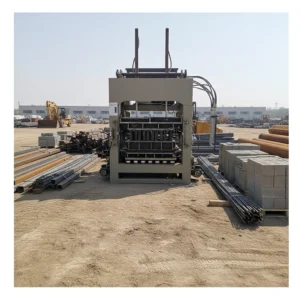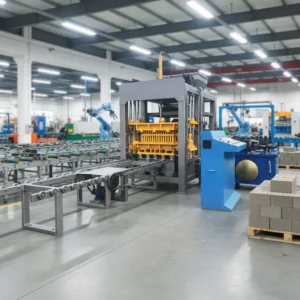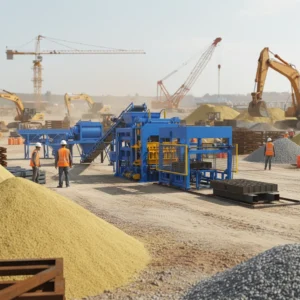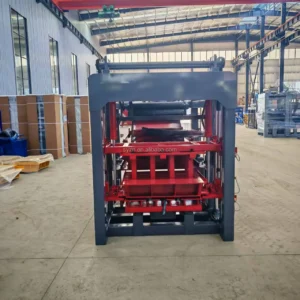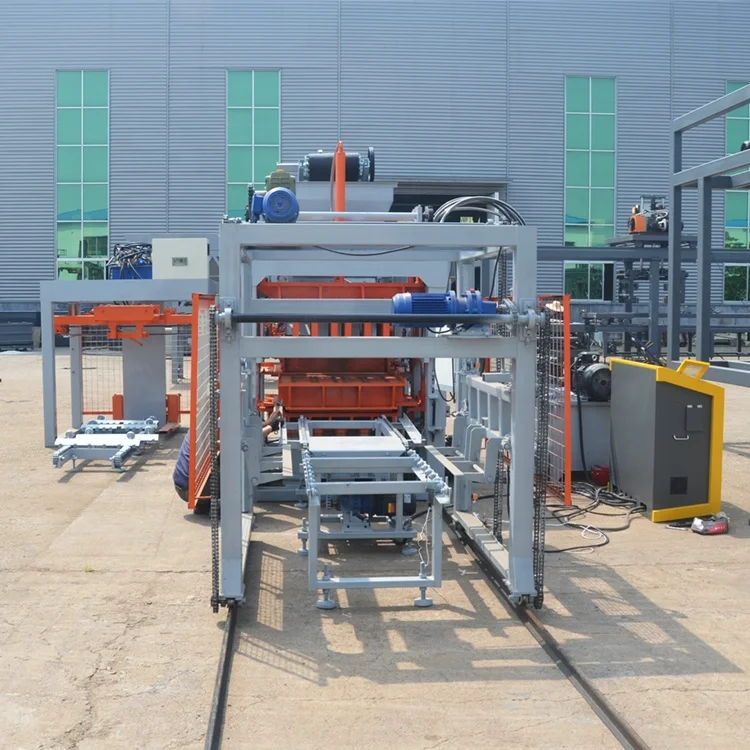
Matched Line Integration — every upstream mixer and downstream pallet handler is timed against the QT6-15 cycle, so the press never idles waiting for material or racks.
Technical Specifications
| Parameter | Value |
|---|---|
| Product Type | Hydraulic Concrete Block Making Machine |
| Model | QT6-15 |
| Overall Dimensions (L×W×H) | 8200×1700×2950 mm |
| Total Mass | 7 T |
| Overall Power | 37 kW |
| Vibration Force | 45 kN |
| Vibration Frequency | 0-60 Hz (adjustable) |
| Vibration Form | Platform Vibration |
| Pallet Size | 880×850 mm |
| Molding Cycle | 15-20 s (basis not stated in source) |
| Moulding Mode | Automatic loading, vibration moulding |
| Demolding Method | Hydraulic |
| Control System | PLC (Programmable Controller) with touch screen |
| Hydraulic System | Independent integrated hydraulic station |
| Recommended Factory Area | 1200 m² |
| Output: Hollow Block 400×200×200 mm | 1080-1440 pcs/h, 8640-11520 pcs/8hr |
| Output: Solid Brick 240×115×53 mm | 5760-7680 pcs/h, 46080-61440 pcs/8hr |
| Output: Rectangular Paver 200×100×60 mm | 17280-23040 pcs/8hr (cycle 20-25 s) |
| Block Compressive Strength | >15 MPa |
Application Suitability
| Application | Material or Output |
|---|---|
| Hollow block production | Crushed stone, river sand, fly ash with cement binder |
| Solid brick manufacturing | Local aggregate blends, slag, construction waste |
| Rectangular paving brick | High-density mix for traffic-bearing surfaces |
| Zigzag interlocking paver | Interlocking profile for driveway and walkway projects |
Why the QT6-15 Block Making Machine Production Line Must Be Specified as a System
A press is only as productive as its slowest upstream or downstream station.
I have stood in plants where a high-output block machine sat idle for seconds every cycle because the mixer discharge could not keep pace, or because pallets were still being pulled off curing racks by hand. The rated output of a press means nothing if the batching station delivers material in surges or if the stacking station cannot clear finished pallets fast enough. When you source the QT6-15 block making machine production line, the feeder, mixer, pallet return conveyor and stacking equipment must each be timed to that 15-20 second window, or the entire investment underperforms from day one [NEED_CITE: production line bottleneck analysis for concrete block plants].
Feeder and Mixer Synchronization with the Press Cycle
Raw material delivery to the hopper must be continuous and volumetrically matched to the mould cavity fill requirement of the QT6-15 block making machine. A mixer that discharges in large batches rather than a controlled stream creates dead time — the press waits, vibration cycles are wasted, and daily tonnage drops well below the rated calculation.
Pallet Handling as the True Line Bottleneck
The 880×850 mm pallet is the unit that moves through every station. If the return conveyor cannot reposition empty pallets within the moulding cycle, or if the stacking station requires manual intervention, the press operator is forced to pause. A properly specified pallet circulation loop keeps the press running without interruption and delivers green blocks to the curing area in a predictable rhythm.
Reading the Specifications Beyond the Press [NEED_CITE: vibration frequency tuning for different aggregate gradations]
The 0-60 Hz adjustable vibration frequency and 45 kN vibration force are not standalone numbers — they define how the machine interacts with your specific local aggregate and mix design. A high-frequency, lower-amplitude setting suits fine sand mixes for pavers, while coarser aggregate with larger stone requires lower frequency and full force to achieve consolidation. The PLC touch-screen control allows operators to store profiles per block format, so switching from hollow blocks to paving bricks does not require manual trial-and-error on the shop floor. The independent integrated hydraulic station sits apart from the main vibration frame, which protects valves and seals from dust ingress and keeps hydraulic response consistent across long production shifts. Compressive strength above 15 MPa is achievable when vibration, hydraulic pressure and mix proportions are all aligned to the same target format.
The Cost of Treating the Press as an Island
When pallet size is chosen without checking the curing rack spacing or the forklift already in your yard, blocks end up stacked on the ground by hand. When voltage and PLC display language are not confirmed in writing before the machine enters production, commissioning stalls while adapters are sourced and software is reloaded. These are not warranty issues — they are specification gaps that shift cost and time onto the buyer after the equipment arrives [NEED_CITE: common commissioning delays caused by unconfirmed electrical specifications].
Sourcing the Full Line from a Single Responsible Party
Shandong Shiyue Intelligent Machinery focuses exclusively on block machinery, which means the press, moulds, pallets and handling equipment are engineered as one system rather than assembled from unrelated suppliers. Capacity calculations are stated per block format, so the output you plan against matches what the line actually delivers. Mould design covers the formats your local market demands, and custom drawings are available when a non-standard profile is needed. The automation level is selectable — a buyer can begin with semi-automatic pallet handling and add stacking and cubing modules as production volume grows. Installation support includes on-site commissioning and operator training so the line reaches stable output within the first production week.
Documentation & Verification
- Line layout drawing showing station spacing and pallet flow path for the QT6-15 configuration
- Capacity calculation sheet stating the block format and cycle time behind each output figure
- Pallet specification matched to your curing rack dimensions and forklift fork width
- Hydraulic and electrical schematics with confirmed voltage, frequency and PLC display language
- Factory test record on your requested block format before the line is packed for shipment
- Wear parts and mould list with part numbers for future reordering
Installation, Commissioning & Support
- Foundation plan sized to the 8200×1700 mm footprint with vibration isolation provisions
- Dedicated electrical circuit rated for the 37 kW total power draw and confirmed voltage
- Pallet return conveyor alignment verified against the 880×850 mm pallet during commissioning
- PLC touch-screen language set to the operator team’s working language before production starts
- Vibration frequency and hydraulic pressure profiles tuned to your local aggregate during first runs
- Wear parts kit covering high-contact hydraulic and vibration components for the initial operating period
What to Prepare Before Requesting a Quotation
Share your target block formats, the local aggregate type and gradation you plan to use, and the daily output volume your market requires. Confirm the voltage and frequency available at your site, along with the preferred PLC display language. If you have existing curing racks or forklifts, send their dimensions so pallet size and handling stations can be matched accordingly.
Frequently Asked Questions
Q: How is daily output verified per block format on the QT6-15 line?
A: Each output figure in the line capacity calculation is tied to a specific block format, mould cavity count and cycle time. The mixer discharge rate, pallet feed speed and stacking station cycle are all checked against that same number to confirm no station becomes a bottleneck during sustained production.
Q: How does pallet size affect the curing area and forklift selection?
A: The 880×850 mm pallet determines the spacing between curing rack uprights, the aisle width your forklift needs, and the stacking geometry at the cubing station. Confirming rack and forklift dimensions before the line is built avoids costly rework after delivery.
Q: Which stations must match the press cycle to prevent idle time?
A: The raw material feeder, mixer discharge, pallet return conveyor and stacking station all need cycle times that fit within the press moulding window. If any station runs slower, the press pauses and actual daily output falls below the rated calculation.
Q: How are voltage, frequency and PLC language confirmed before shipment?
A: These values are agreed in writing during the quotation stage and recorded on the electrical schematic. The PLC touch-screen display is set to the confirmed language, and a factory test is conducted under those settings before packing.
Q: What support is included once the line arrives at the site?
A: On-site installation guidance covers foundation placement, electrical connection and station alignment. Commissioning includes vibration and hydraulic tuning to your mix design, followed by operator training on format changeover, daily maintenance and PLC fault diagnosis.