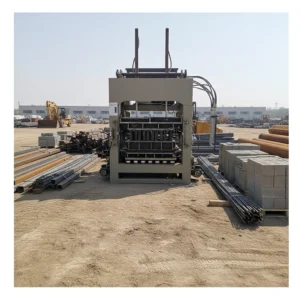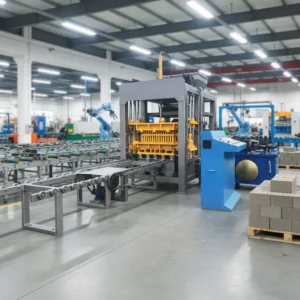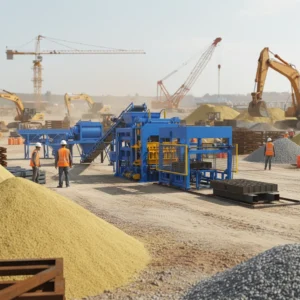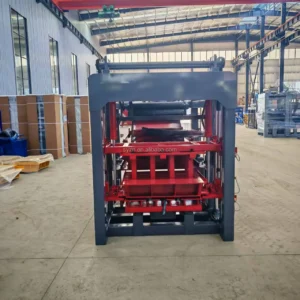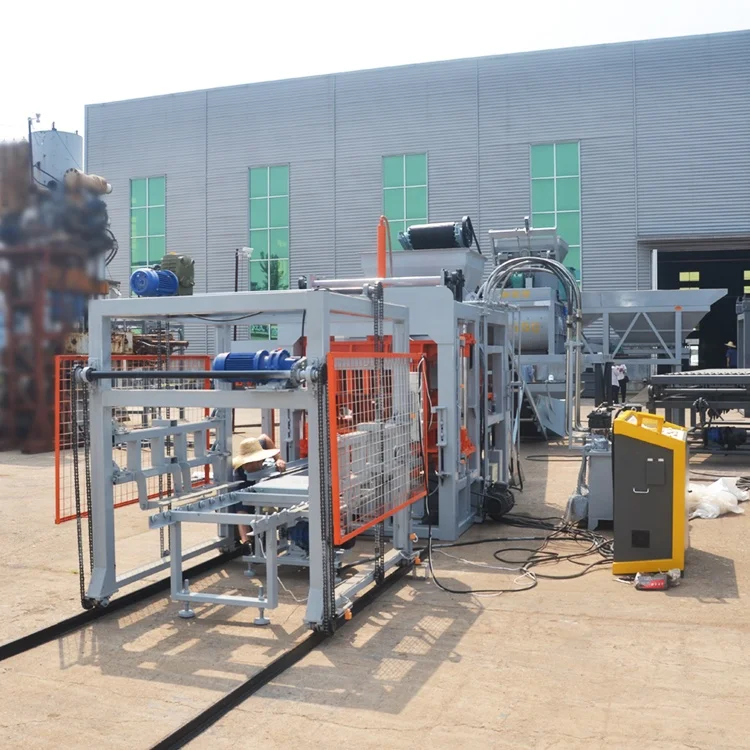
Matched line configuration — every station from raw material feeding through curing rack handling is timed against the QT6-15 press cycle so no single point creates idle time or bottleneck.
Technical Specifications
| Parameter | Value |
|---|---|
| Model | QT6-15 |
| Product Type | Concrete Hollow Block Making Machine |
| Overall Dimensions (L×W×H) | 8200×1700×2950 mm |
| Vibration Frequency | 0-60 Hz |
| Vibration Form | Platform Vibration |
| Moulding Mode | Load automatically, vibration moulding |
| Pallet Size | 880×850 mm |
| Molding Cycle | 15-20 s |
| Overall Power | 37 kW |
| Vibration Force | 45 kN |
| Total Mass | 7 T |
| Demolding Method | Hydraulic |
| Factory Area | 1200 m² |
| Control System | PLC (Programmable Controller) with touch screen |
| Output Capacity | 1080-1440 pcs/h (based on 400×200×200 mm hollow block, 6 pcs/mould) |
| Output Capacity | 1440-1920 pcs/h (based on 400×150×200 mm hollow block, 8 pcs/mould) |
| Output Capacity | 5760-7680 pcs/h (based on 240×115×53 mm solid brick, 32 pcs/mould) |
| Output Capacity | 2160-2880 pcs/h (based on 200×100×60 mm rectangular paver, 21 pcs/mould, cycle 20-25 s) |
| Output Capacity | 2160-2880 pcs/h (based on 225×112.5×60 mm zigzag paver, 15 pcs/mould, cycle 20-25 s) |
| Block Compressive Strength | >15 MPa |
| Hydraulic System | Independent integrated hydraulic station |
| Raw Material Adaptability | Waste ash, slag, and various aggregates; reduced cement dosage capable |
| Standards | CE (declaration where applicable) |
Application Suitability
| Application | Material or Output |
|---|---|
| Hollow block production plants | Crushed stone, sand, cement, and waste ash blends |
| On-site construction block making | Local quarry aggregate with cement binder |
| Paving block manufacturing | Fine aggregate and cement for rectangular and zigzag pavers |
| Solid brick production | Fly ash, slag, and cement mixes |
| Format expansion for existing product lines | Interchangeable moulds for multiple block dimensions |
What the "Pieces per Hour" Figure Hides When Stations Are Not Balanced
A press rated at 15-second cycles produces nothing if the pallet feeder is still retrieving the last board from the curing rack.
The QT6-15 block making machine production line is only as fast as its slowest upstream or downstream station. I have walked into plants where the press itself was running at full cycle rate, but finished blocks sat on pallets stacked by hand because no automatic stacker was in the quotation. Daily tonnage fell to a fraction of what the brochure promised. The bottleneck is rarely the press — it is the feeder, the mixer discharge rate, or the pallet return loop that was never scoped against the press timing [NEED_CITE: bottleneck analysis in multi-station production lines].
How Raw Material Feeding and Mixing Must Keep Pace With the Press
A 15-20 second molding cycle means the press demands a fresh batch roughly every three to four cycles. If the mixer discharge cannot keep up, the hopper runs dry and the operator waits. The raw material feeding system on this line is configured so the batch volume, mixer drum capacity, and discharge gate timing align with the press consumption rate, measured against the specific block format being run.
Pallet Circulation and Curing Rack Timing
Each pallet carrying a freshly pressed block must travel to the curing area, be stripped, and return to the press before the next cycle completes. The 880×850 mm pallet size on the QT6-15 is selected with reference to the buyer’s existing curing rack dimensions and forklift capacity. If the pallet return conveyor is undersized, or the curing racks are too far from the press, the entire line stalls waiting for boards [NEED_CITE: pallet circulation loop design for block plants].
Where the Hydraulic and Vibration Systems Intersect With Line Flow
The independent integrated hydraulic station is isolated from the main vibration frame, which protects seals and valve blocks from dust and harmonic stress. Platform vibration at 0-60 Hz with 45 kN force compacts the mix uniformly, and the hydraulic demolding lifts the mould without dragging block edges. Both systems must complete their sequence within the stated molding cycle, or the downstream stacker receives blocks at irregular intervals and the pallet return timing breaks down.
Reading the Specifications Against Actual Production
Vibration force of 45 kN and a frequency range up to 60 Hz determine how densely the aggregate is compacted. Higher density means higher compressive strength — rated above 15 MPa here — but it also means longer vibration time per cycle if the local aggregate is harder or the moisture content varies. The PLC touch screen allows the operator to adjust frequency and dwell time per format, which is essential when switching between hollow blocks and denser pavers. The 37 kW overall power rating covers the press, hydraulic pump, and vibration motors, but supporting stations like the mixer and conveyor drives draw from separate circuits that must be accounted for in the plant electrical layout.
When One Missing Station Collapses the Daily Output
I visited a site where the quotation included the press and moulds but nothing downstream. Blocks came off the machine and workers carried them by hand to a curing yard forty metres away. The QT6-15 block making machine production line was designed to run continuously, but without automatic stacking and pallet return, real output dropped to a level that made the investment difficult to justify. That is why every supporting station — feeding, mixing, pallet circulation, stacking, curing rack handling — must be in the same quotation and timed against the same cycle [NEED_CITE: impact of incomplete line configuration on block plant output].
Why Sourcing the Line From One Supplier Matters Here
Block machinery is a single focus for this operation, so the press, mould, pallet, and handling equipment are specified as one matched system rather than assembled from separate vendors. The configuration is set against the buyer’s actual mix design and local aggregate, not a catalogue default. Mould design covers the formats the buyer’s market sells, including custom drawings. Automation level is selectable — a buyer can start semi-automatic and add stacking later. Installation support includes operator training and a defined wear parts list so the first replacement does not halt production.
Documentation & Verification
- Line layout drawing showing every station position and pallet travel path
- Capacity calculation sheet stating the block format for each output figure
- Hydraulic and electrical schematic matching the as-built configuration
- Factory test record run on your target block format before dispatch
- Pallet specification sheet cross-referenced to your curing rack and forklift
- Voltage, frequency, and PLC display language confirmation document
Installation, Commissioning & Support
- Foundation plan sized to the 8200×1700 mm footprint and 7 T operating mass
- Dedicated electrical circuit rated for 37 kW total draw with correct voltage and frequency
- Hydraulic station pre-filled and pressure-tested before crating for shipment
- PLC touch screen set to the operator’s language before the machine leaves the factory
- On-site commissioning with cycle timing verified across every station in the line
- Wear parts and mould list provided with recommended first-order quantities
What to Send With Your Inquiry
To scope the line correctly, share the block formats your market buys, the daily output target for each format, and a sample or lab analysis of your local aggregate. Include your existing curing area dimensions and the forklift model you operate. Confirm the plant voltage, frequency, and the language your operators need on the PLC screen. If you already run a mixer or conveyor upstream, send the model and capacity so the QT6-15 block making machine production line can be matched to it rather than duplicated.
Frequently Asked Questions
Q: How is daily capacity calculated, and which block format is each figure based on?
A: Every output figure is tied to a specific block dimension and mould cavity count. For example, 1080-1440 pieces per hour applies to 400×200×200 mm hollow blocks with six cavities per mould, while 2160-2880 pieces per hour applies to 200×100×60 mm rectangular pavers with twenty-one cavities and a longer 20-25 second cycle. Daily totals are then derived from your planned shift hours.
Q: Which supporting stations are included in the line quotation?
A: The quotation covers raw material feeding, mixing, pallet feeding, automatic stacking, curing rack handling, and cubing — every station between the aggregate hopper and the cured, stacked output. Each station is timed against the press cycle so no single point becomes a bottleneck during continuous production.
Q: How must cycle times across stations be balanced so the press is not left idle?
A: The mixer discharge rate, pallet return conveyor speed, and stacker cycle are all calculated against the press molding cycle of 15-20 seconds for hollow blocks. If any station is slower, the press waits and actual output drops. The line layout shows the timing relationship so you can verify the balance before equipment is built.
Q: Is the pallet size and material chosen against my existing curing area and forklift?
A: Yes. The standard 880×850 mm pallet is a starting point, but the final size and material are confirmed against the curing rack spacing you already have and the forklift fork dimensions on site. This avoids a situation where new pallets do not fit existing racks or cannot be handled by your current equipment.
Q: How is the configuration adjusted to my local aggregate and mix design?
A: A sample of your local aggregate is tested to determine hardness, grading, and moisture behaviour. Vibration frequency, hydraulic pressure, and mould clearance are then set to match that specific mix rather than a catalogue default. This ensures block compressive strength stays above 15 MPa with the materials you can actually source.