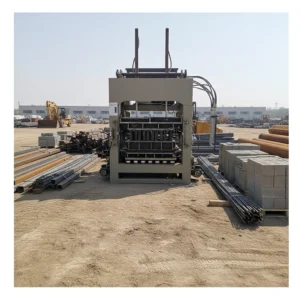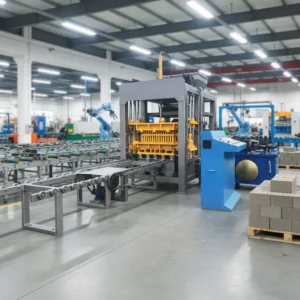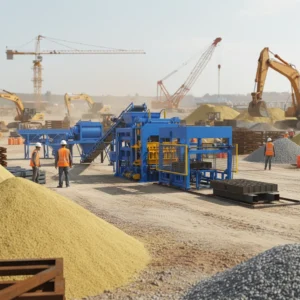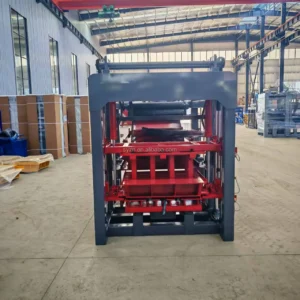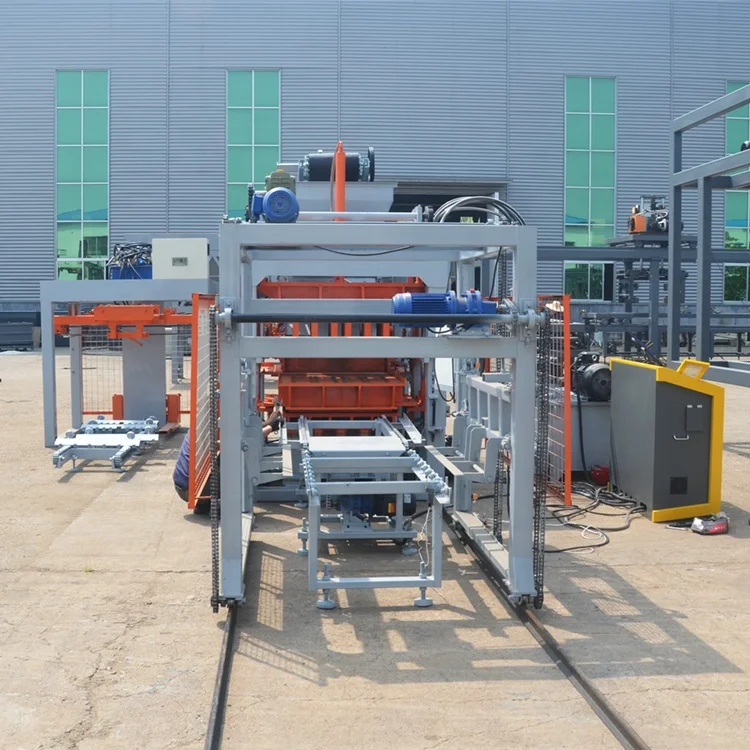
QT6-15 Cement Block Machine – Production Line
Matched line stations — raw material feeding, pallet circulation and stacking are configured around the QT6-15 press cycle so no station starves or bottlenecks.
Technical Specifications
| Parameter | Value |
|---|---|
| Model | QT6-15 |
| Product Type | Cement Block Making Machine / Hollow Brick Making Machine |
| Overall Dimensions (L×W×H) | 8200×1700×2950 mm |
| Total Mass | 7 T |
| Overall Power | 37 kW |
| Vibration Force | 45 kN |
| Vibration Frequency | 0-60 Hz |
| Vibration Form | Platform Vibration |
| Moulding Mode | Automatic loading, vibration moulding |
| Demolding Method | Hydraulic |
| Hydraulic System | Independent integrated hydraulic station |
| Pallet Size | 880×850 mm |
| Molding Cycle | 15-20 s (hollow block) / 20-25 s (paver) |
| Control System | PLC (Programmable Controller) with touch screen |
| Output Capacity (400×200×200 mm hollow block) | 1080-1440 pcs/hour, 8640-11520 pcs/8hr |
| Output Capacity (400×150×200 mm hollow block) | 1440-1920 pcs/hour, 11520-15360 pcs/8hr |
| Output Capacity (240×115×53 mm solid brick) | 5760-7680 pcs/hour, 46080-61440 pcs/8hr |
| Output Capacity (200×100×60 mm rectangular paver) | 2160-2880 pcs/hour, 17280-23040 pcs/8hr (basis: molding cycle 20-25 s) |
| Block Compressive Strength | >15 MPa |
| Factory Area | 1200 m² |
| Raw Material Adaptability | Waste ash, slag, and various aggregates; adjustable cement dosage |
| Assembly State | Fully assembled machine line |
| Standards | CE declaration (basis not stated in source) |
Application Suitability
| Application | Material or Output |
|---|---|
| Hollow block production for building walls | Local aggregate, cement, waste ash or slag |
| Solid brick manufacturing | Crushed stone, sand, cement blends |
| Rectangular paving block production | High-strength aggregate and cement mixes |
| Zigzag / interlocking paver production | Pigmented or standard concrete mixes |
| Medium-capacity block plant setups | Facilities with approximately 1200 m² available space |
Why "Pieces per Hour" Means Nothing Without the Rest of the Line
A press is only as fast as the slowest station feeding or clearing it.
I once watched a block production line in the Middle East where the press cycled perfectly every fifteen seconds, but the mixer discharged batch loads slower than the press consumed them. Wet blocks piled on pallets across the workshop floor because there was nowhere for them to go, and the press sat idle waiting for material. The capacity figure on the quotation was technically accurate, but the real daily output fell far short [NEED_CITE: common causes of output shortfall in block plants]. This is why the QT6-15 block production line is specified as a connected system — raw material feeding, mixing, pallet circulation, stacking and curing rack handling are each matched to the press cycle so that throughput holds steady across the full shift.
Stations That Must Keep Pace with the Press
A molding cycle of 15-20 seconds for hollow blocks means the press completes roughly three cycles per minute. Upstream, the batching and mixing station must deliver a consistent, proportioned mix to the hopper at a rate that never lets the press wait. Downstream, the pallet return system must clear formed blocks and deliver empty pallets back to the press within that same window. Every station on this turnkey hollow block making system is configured with the QT6-15 cycle time as the governing constraint, so capacity calculations reflect the entire line rather than the press in isolation.
Where Pallet Circulation Meets Curing Logistics
The 880×850 mm pallet size on the QT6-15 determines not only what fits in the press but also what fits on the curing racks and what the buyer’s existing forklift can handle. If the curing rack bays were built for a different pallet dimension, every loaded pallet requires manual repositioning — adding labour and slowing the line [NEED_CITE: pallet size mismatch impact on block curing workflows]. Before the line ships, pallet specification is cross-checked against the buyer’s curing area layout and material handling equipment, so pallets flow from press to rack to stacking without manual intervention.
Reading the Specifications Against Real Output
The 45 kN vibration force and independent integrated hydraulic station work together to compact the mix into the mould cavity at consistent density, producing blocks rated above 15 MPa compressive strength. The vibration frequency range of 0-60 Hz allows the operator to tune the table vibration to different mix designs — finer aggregates respond to higher frequency while coarser stone needs stronger amplitude. The PLC touch screen controls the press sequence and sends coordination signals to upstream batching and downstream pallet handling stations, keeping the entire block production line synchronized through a single control point. Overall power of 37 kW covers the press, hydraulic station and vibration motors; upstream mixers and conveyors draw from separate circuits.
What Happens When Line Stations Are Specified Separately
Buying the press from one supplier and the pallet handling from another often means the signal interfaces do not match. The press expects a pallet-present confirmation before cycling, but the pallet feeder uses a different sensor protocol. The stacker counts blocks per layer on a timer rather than receiving a count from the press PLC, leading to misaligned stacks and crushed edges. These mismatches do not appear until commissioning, when the buyer discovers the line requires additional wiring, programming and sometimes replacement components to function as a single unit [NEED_CITE: integration challenges in multi-supplier block lines]. Sourcing the QT6-15 as a matched line eliminates these interface gaps from the start.
Why This Line Holds Together
The QT6-15 configuration is set against the buyer’s actual mix design and local aggregate, not a catalogue default — a mix using waste ash behaves differently from one using crushed granite, and the vibration and pressure settings are adjusted accordingly. Mould design covers the formats the buyer’s market actually sells, with custom mould drawings available when standard formats do not match local demand. The automation level is selectable, so a buyer can start with semi-automatic pallet handling and add automatic stacking and cubing later as the plant scales. Line layout documentation states the block format assumed for each capacity figure, so daily output expectations align with reality. Factory testing runs the full line — press, feeding, pallet circulation and stacking — before dispatch, catching integration issues before the equipment leaves the floor.
Documentation & Verification
- Line layout and capacity calculation stating the block format assumed for each output figure
- Machine specification sheet with hydraulic and electrical schematics for the QT6-15
- Pallet specification cross-referenced to buyer’s curing rack and forklift dimensions
- Voltage, frequency and PLC display language confirmation before production starts
- Factory test record covering full line operation — press, feeding and stacking
- Operation and maintenance manual with wear parts and mould replacement list
Installation, Commissioning & Support
- Foundation must support 7 T total mass across the 8200×1700 mm footprint with level tolerance
- 37 kW overall power requires dedicated circuit; upstream mixer and conveyors on separate breakers
- Fully assembled line arrives in sections for on-site positioning and bolt-together connection
- Commissioning includes PLC language verification and cycle timing calibration per block format
- Operator training covers mould change procedure, hydraulic station maintenance and PLC fault diagnosis
- Wear parts list and mould inventory supplied for first replacement cycle planning
What We Need from You to Configure the Line
To size every station around the QT6-15 accurately, we need the block formats your market sells, the daily output target per format, and the raw materials available locally including aggregate type and cement supply. Your site voltage and frequency, PLC display language preference, and the dimensions of your curing area and existing forklift determine the pallet and handling specification. If you have upstream equipment already in place, share its capacity so the line integrates without gaps.
Frequently Asked Questions
Q: How is line capacity calculated, and which block format does each output figure assume?
A: Every capacity figure on this page is tied to a specific block format and molding cycle. For example, 1080-1440 hollow blocks per hour assumes the 400×200×200 mm format at a 15-20 second cycle. When you request a quotation, the line layout states the assumed format for each figure so daily output planning matches your actual product mix.
Q: What upstream feeding and mixing equipment is matched to the QT6-15 cycle time?
A: The batching and mixing station is sized so that a full mix batch is ready before the press hopper runs low. Mixer discharge rate, conveyor speed and hopper capacity are all calculated from the QT6-15 molding cycle of 15-20 seconds for hollow blocks, ensuring the press never idles waiting for material.
Q: How does pallet size relate to the curing rack and forklift the buyer already has?
A: The standard 880×850 mm pallet must fit the buyer’s curing rack bays and be liftable by the existing forklift. We confirm these dimensions before production so pallets move from press to rack to stacking without manual repositioning or equipment incompatibility on site.
Q: What downstream stacking and curing rack handling is included, and what is optional?
A: The base line configuration includes pallet return and basic stacking. Automatic cubing and curing rack handling systems are available as selectable options depending on the buyer’s automation level preference. Each option is detailed in the quotation so the buyer sees exactly which stations are included.
Q: How is voltage, frequency and PLC language confirmed before the line ships?
A: These are confirmed during the quotation stage before production begins. The buyer specifies local supply voltage and frequency, and the PLC touch screen display language. This information is locked into the production order so the QT6-15 arrives ready for commissioning without electrical modifications or interface confusion.