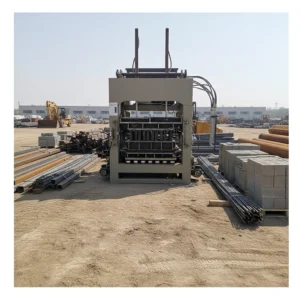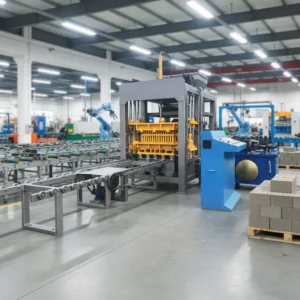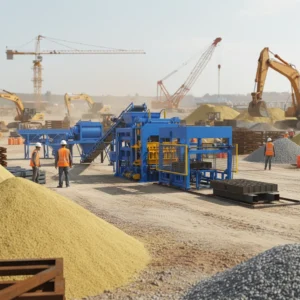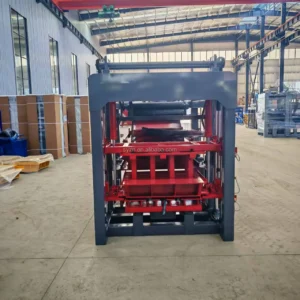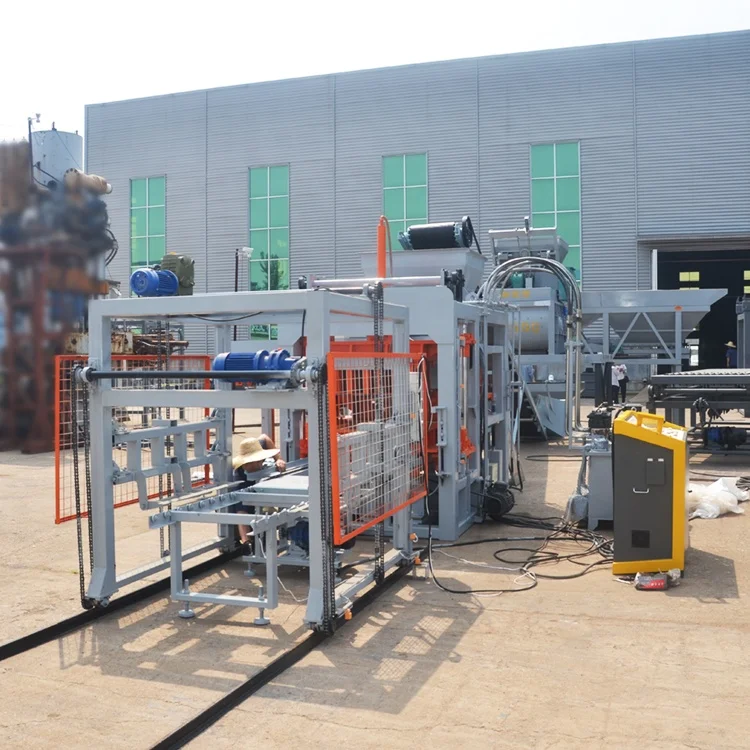
Integrated Line Engineering — every station from material feeding through stacking is timed against the QT6-15’s 15-20s molding cycle so the press never idles waiting upstream.
Technical Specifications
| Parameter | Value |
|---|---|
| Model | QT6-15 |
| Product Type | Hydraulic Block Making Machine |
| Overall Dimension | 8200×1700×2950 mm |
| Vibration Frequency | 0–60 Hz, adjustable |
| Vibration Form | Platform Vibration |
| Moulding Mode | Automatic load, vibration moulding |
| Pallet Size | 880×850 mm |
| Molding Cycle | 15–20 s (basis to be confirmed by block format) |
| Overall Power | 37 kW |
| Vibration Force | 45 kN |
| Total Mass | 7 T |
| Demolding Method | Hydraulic |
| Factory Area | 1200 m² |
| Control System | PLC with touch screen interface |
| Compressive Strength | >15 MPa |
| Hydraulic System | Independent integrated hydraulic station |
| Certification | CE |
Application Suitability
| Application | Material or Output |
|---|---|
| Hollow block production | 400×200×200 mm, 400×150×200 mm formats from crushed stone, cement and sand |
| Solid brick production | 240×115×53 mm from standard concrete mix |
| Rectangular paving brick | 200×100×60 mm with pigmented face mix |
| Zigzag interlocking brick | 225×112.5×60 mm for permeable driveway surfaces |
| Waste material utilisation | Fly ash, slag and recycled aggregate blends |
What the Block Production Line Equipment Quotation Often Leaves Out
A press rated at 15-20s per cycle is only as fast as the slowest station feeding it.
When a buyer sources the QT6-15 hydraulic press separately and pairs it with a mismatched pallet feeder or a mixer that batches too slowly, the actual daily output drops well below what the press is theoretically capable of delivering. I have walked onto sites in the Gulf region where pallet handling created a bottleneck that cost the plant thousands of blocks per week — the press sat idle for seconds at a time, waiting for the next pallet to arrive. That gap between quoted capacity and real output is almost always a line-integration problem, not a press problem [NEED_CITE: common causes of block plant throughput shortfall]. Specifying block production line equipment as one matched system prevents this from happening.
Timing Every Station to the Molding Cycle
The QT6-15 completes a molding cycle in 15-20 seconds, which means raw material feeding, mixing, pallet delivery and wet-product stacking must each finish their task within that same window. When block production line equipment is configured as a single package, the mixer discharge rate, the pallet feeder travel speed and the stacker lift interval are all set against this cycle so no station queues. The PLC touch screen interface sequences the full line, flagging any station that begins to drift out of sync before it causes a stoppage.
Pallet Logistics and Curing Area Coordination
An 880×850 mm pallet size is not arbitrary — it must align with the curing rack dimensions, the forklift tine spacing and the floor area available in the curing yard. If the pallets are too large for existing racks, the buyer either replaces the racks or runs fewer blocks per rack, both of which erode the line’s output. When block production line equipment is planned holistically, the pallet specification is confirmed against the buyer’s curing infrastructure before the order is placed, not discovered on arrival day [NEED_CITE: pallet handling coordination in concrete product plants].
How Hydraulic Pressure and Vibration Shape Block Density
The QT6-15 uses an independent integrated hydraulic station isolated from the main machine vibration, which keeps hydraulic seals and valves away from dust infiltration and mechanical shock. The 45 kN vibration force works together with hydraulic pressure to compact the concrete mix — vibration settles the aggregate while hydraulic pressure locks it into the mould cavity. Adjustable vibration frequency from 0 to 60 Hz lets the operator tune the energy input to different mix designs; a fly-ash-heavy blend typically needs a different frequency profile than a crushed-stone mix to reach the target compressive strength of more than 15 MPa. Platform vibration distributes force across the full pallet area, reducing density variation between the center and edges of each block.
The Hidden Cost of Picking Stations from Different Suppliers
When the mixer, pallet feeder and stacker come from separate vendors, no single party owns the cycle-time mismatch. The press supplier blames the feeder, the feeder supplier blames the mixer, and the plant owner absorbs the lost output. On a project in Saudi Arabia, I saw a block line where the pallet feeder ran two seconds slower per cycle than the press — over a ten-hour shift that added up to a meaningful shortfall in daily production. Line-integration responsibility must sit with one supplier who has calculated every station’s timing before the equipment ships [NEED_CITE: single-source responsibility in block plant engineering].
Why Sourcing the Full Line from One Supplier Matters
The QT6-15 and its supporting equipment are specified as a matched system, meaning the raw material feeder, mixer, pallet conveyor, stacker and curing rack handler are all selected to meet the press’s cycle requirements. Configuration is set against the buyer’s actual mix design and local aggregate rather than a default catalogue setting. Automation level is selectable — a plant can start with semi-automatic pallet handling and add automatic stacking and cubing later without replacing the press. Mould design covers the formats the buyer’s market actually sells, with custom drawings available. Installation support includes on-site commissioning and operator training so the line reaches its intended rhythm from the first production run.
Documentation & Verification
- Line layout drawing with capacity stated per block format
- Machine specification sheet confirming pallet size and cycle time
- Mould drawing and format list for all ordered block types
- Hydraulic and electrical schematic for on-site troubleshooting
- Voltage, frequency and PLC language confirmation before production
- Factory test record on the buyer’s target block format prior to dispatch
Installation, Commissioning & Support
- Foundation plan sized to the 8200×1700 mm footprint and 7 T operating mass
- Dedicated 37 kW power circuit with confirmed voltage and frequency for the destination market
- Machine shipped in dismantled modules with reassembly supervised on site
- PLC touch screen parameters set against the buyer’s mix design during commissioning
- Operator training covering mould change sequence and cycle-time monitoring
- Wear parts list and hydraulic seal kit supplied with the first shipment
- Preventive maintenance schedule aligned to vibration platform and hydraulic station intervals
What We Need to Configure Your Line
To size the block production line equipment around the QT6-15, we need the block formats you intend to produce, the target daily output per format, and the raw materials available locally including aggregate type and gradation. Details on your existing curing area dimensions, forklift specifications and site voltage help us match pallets and electrical systems before production begins. If you have upstream or downstream equipment already in place, sharing those specifications lets us confirm integration points in advance.
Frequently Asked Questions
Q: How are upstream station cycle times matched so the press maintains its rated output?
A: Each station — mixer discharge, pallet feeder, material hopper — is timed against the QT6-15’s 15-20s molding cycle during line design. The PLC touch screen interface monitors station readiness and adjusts conveyor speeds so the press receives a filled mould and a fresh pallet within its cycle window, preventing idle gaps that reduce actual throughput.
Q: What supporting equipment is included versus quoted separately?
A: The block production line equipment package can include raw material feeding, mixing, pallet feeding, automatic stacking and curing rack handling as one quotation. Buyers working to a phased budget can start with the press and pallet feeder, then add stacking and cubing modules later since the PLC control architecture supports expansion.
Q: Can the automation level start semi-automatic and upgrade later?
A: Yes. The QT6-15 line can begin with manual pallet handling or semi-automatic feeding and be upgraded to full automatic stacking and cubing once production volume justifies the investment. The PLC system is designed to accommodate additional I/O modules without replacing the main controller.
Q: How is pallet size selected to match my existing curing setup?
A: The 880×850 mm pallet dimension is confirmed against your curing rack spacing, forklift tine width and yard layout before the order enters production. If your existing infrastructure requires a different pallet size, the feeding and stacking stations are adjusted accordingly so every component handles the same pallet footprint.
Q: What happens when one station in the line goes down?
A: The PLC touch screen interface detects the fault and pauses upstream stations to prevent material buildup. Depending on the configuration, a buffer zone between the mixer and press holds enough material for several cycles, giving the operator time to clear minor stoppages without losing an entire batch.