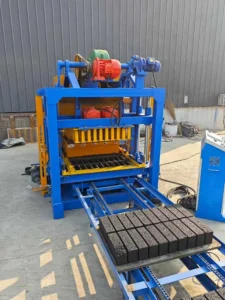
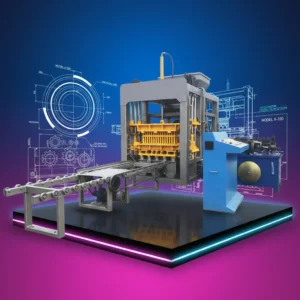
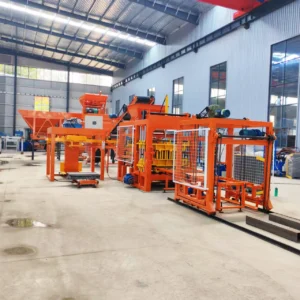
Integrated line pacing — every station from batching to stacking is timed to the QT6-15 press cycle so no equipment sits idle while upstream or downstream catches up.
Technical Specifications
| Parameter | Value |
|---|---|
| Model | QT6-15 |
| Product Type | Automatic Concrete Block Making Machine |
| Automation Level | Fully automatic, PLC-controlled unattended operation |
| Control System | PLC controller with configurable display language |
| Line Composition | Batching machine, mixer, cement silo, conveyor, block forming machine, stacker |
| Output Capacity | High output (basis not stated in source — confirm block format and material) |
| Cycle Time | Depends on block format, material and thickness (basis to be confirmed) |
| Mould Formats | Paving blocks, hollow blocks (full format list to be confirmed) |
| Pallet Handling | Forklift truck transport for formed blocks and empty return plates |
| Voltage & Frequency | Configurable to site supply (to be confirmed before production) |
| Certification | CE declaration available where applicable |
Application Suitability
| Application | Material or Output |
|---|---|
| Paving block production for municipal and commercial projects | Crushed stone, sand, cement and pigment mixes |
| Hollow block production for wall construction | Lightweight aggregate, sand, cement blends |
| On-site block production for housing developments | Locally sourced aggregate and cement |
| Expansion of existing concrete product range | Multiple format changes across paving and hollow blocks |
| First block plant setup for new entrepreneurs | Standard concrete mixes with common regional materials |
Why Quoted Capacity Rarely Survives the First Week on Site
A press rated for high output means nothing when the mixer batch time or conveyor speed cannot keep up with the forming cycle.
I spent months on a project in Dubai where the forming machine was capable, but the batching station delivered material slower than the press consumed it. The automatic block making machine production line spent half the day waiting. Daily output fell well below what the quotation suggested, and the buyer blamed the press instead of the gap between stations. When a quotation lists only the press capacity without showing how every upstream and downstream station matches that tempo, the real number is always lower [NEED_CITE: typical block line bottleneck causes in Middle East installations]. The turnkey block plant concept only works when pacing is calculated across the full sequence, not sold as a standalone figure.
Every Station Paced to the Press Cycle
The QT6-15 line includes a batching machine, mixer, cement silo, conveyor, forming press and stacker specified as one matched system. Each station’s cycle time is calculated against the press so that material arrives and pallets move without the forming machine pausing between strokes. This pacing is the reason a turnkey block plant delivers consistent daily volumes rather than intermittent bursts followed by idle time.
Pallet Flow and Curing Area Integration
Formed blocks leave the press on pallets that a forklift transports to the curing area, and empty plates return for the next cycle. The pallet size and material must align with the buyer’s existing curing rack spacing and forklift capacity. When the pallet specification is confirmed against the site’s actual handling equipment before production, the line slots into the curing workflow without requiring a separate investment in new racks or different forklifts [NEED_CITE: pallet and curing rack compatibility standards for concrete block plants].
Reading the Specifications That Matter
The PLC controller manages batching accuracy, forming cycle and stacking sequence from a single interface, which keeps batch-to-batch consistency tight across long production runs. The line composition — batching machine through stacker — tells a buyer exactly which stations are covered and which are left to source separately. Mould format coverage for paving and hollow blocks determines how many product types a plant can sell without adding another press. Pallet handling by forklift rather than manual carrying sets the labour requirement and the throughput ceiling for the curing end of the line.
What Happens When Line Stations Are Mismatched
When the conveyor runs faster than the mixer can discharge, material piles up and spills. When the stacker cycle is slower than the press output, formed blocks queue on the transfer table and operators start pulling pallets by hand. Either mismatch cancels out the capacity the buyer paid for, and the problem only becomes visible after installation when changing station positions is expensive and disruptive [NEED_CITE: cost of post-installation line reconfiguration in block plants].
Why Buyers Source the Full Line Here
The QT6-15 is specified as a complete line rather than a press sold alongside optional extras, so station pacing is calculated before the quotation is issued. Mould design covers the paving and hollow block formats the buyer’s market actually demands, including custom drawings when standard moulds do not match. Configuration is set against the buyer’s local aggregate and mix design instead of a catalogue default that may not suit regional materials. Automation level is selectable, allowing a buyer to begin with the current setup and add stacking or batching automation later. Installation support includes operator training on the PLC interface and the full material flow sequence.
Documentation & Verification
- Line layout drawing showing station positions, conveyor lengths and total footprint for the QT6-15
- Capacity calculation stated per block format with the assumed paving or hollow block dimensions
- Pallet specification sheet confirming size, material and load rating against buyer’s curing racks
- Voltage, frequency and PLC display language confirmation signed before production begins
- Factory test record on the buyer’s target block format before dispatch
- Hydraulic and electrical schematic for on-site maintenance reference
Installation, Commissioning & Support
- Foundation plan showing load points for the QT6-15 press, mixer and stacking station
- Electrical supply requirements covering voltage, frequency and dedicated circuit rating for the PLC-controlled line
- Dismantling and container loading sequence so the full line fits standard shipping configuration
- On-site commissioning covering station pacing verification and PLC parameter setting for the buyer’s mix
- Operator training on the control interface, mould change procedure and daily maintenance checklist
- Wear parts and mould inventory list with reorder lead times for continuous production
What We Need to Size Your Line Correctly
Send the target block formats with dimensions, the daily volume you need to hit, and the aggregate and cement types available locally. Include your site’s voltage and frequency, the curing area dimensions and the forklift model you already operate. If you have an existing mixer or batching station that will stay in place, share its batch capacity and discharge time so the new line can be paced around it.
Frequently Asked Questions
Q: How is daily output calculated for each block format on the QT6-15 line?
A: Daily output is calculated per block format — hollow, paving or solid — because each format has a different mould cavity count and cycle time. The capacity figure in a quotation must state which format and dimensions it assumes. Without that statement, the number reflects only the fastest possible format and overstates what the line will produce on the blocks you actually sell.
Q: Which supporting stations are included in the turnkey block plant quotation?
A: The line quotation covers the batching machine, mixer, cement silo, conveyor, forming press and stacker as one system. Pallets, curing racks and the forklift for pallet transport are confirmed separately based on the buyer’s existing site equipment. This split ensures the buyer knows exactly what arrives and what must be sourced locally.
Q: How do conveyor and mixer cycles stay matched to the press?
A: Conveyor speed and mixer batch time are set during line configuration so that each mixer discharge fills the press hopper before the next forming stroke begins. If the mixer batch time is longer than the press cycle, the line adds a holding hopper or a second mixer to close the gap and prevent idle time.
Q: Can pallet size be configured to match my current curing racks?
A: Pallet dimensions and material are confirmed against the buyer’s curing rack spacing and forklift fork width before production. This avoids a situation where delivered pallets do not fit existing racks or where the forklift cannot lift a loaded pallet safely.
Q: What does on-site commissioning of the full line involve?
A: Commissioning covers station alignment, conveyor tensioning, PLC parameter loading for the buyer’s mix design, and a production run on the target block format. Operator training follows on the control interface, mould change steps and daily maintenance points. Duration depends on line complexity and site readiness.