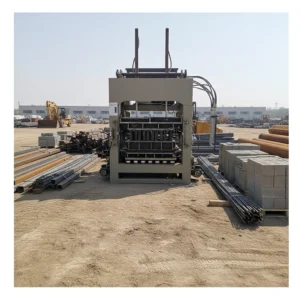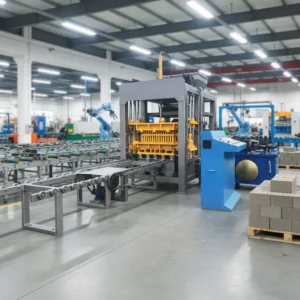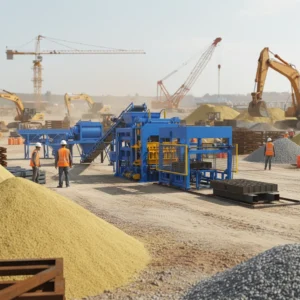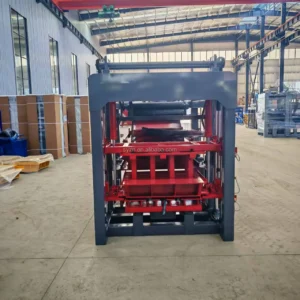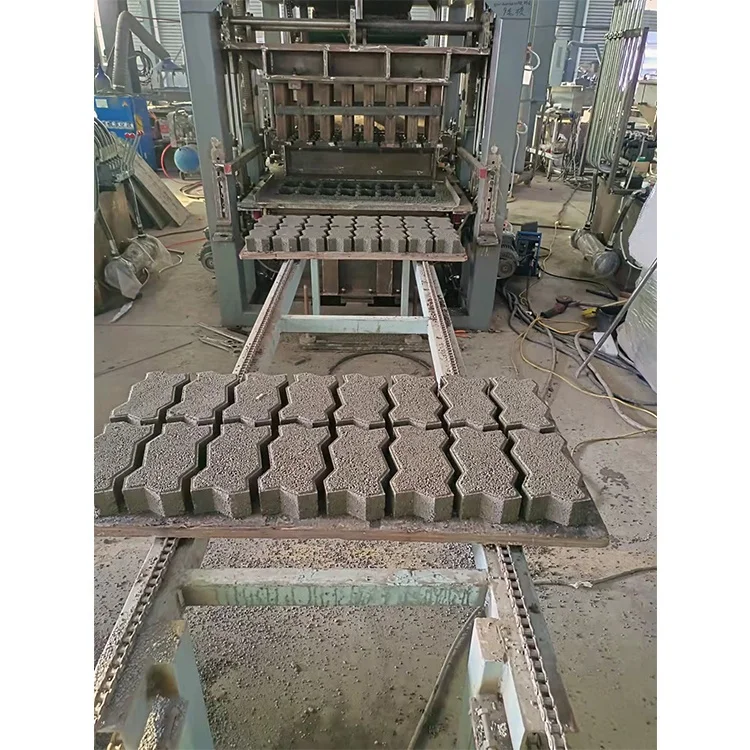
Matched Line Configuration — the QT5-15 press, JS500 mixer, pallet feeder and conveyor are specified as one connected system, so cycle times are balanced before the line ships rather than discovered on site.
Technical Specifications
| Parameter | Value |
|---|---|
| Model | QT5-15 |
| Product Type | Fully Automatic Concrete Block Making Machine |
| Overall Dimensions (L×W×H) | 7100×1600×2610mm |
| Molding Cycle | 15s |
| Vibration Frequency | 0-60Hz |
| Vibration Force (Exciting Power) | 40KN |
| Rated Power | 33.5kW |
| Mixer | JS500 |
| Pallet Size | 1100×550mm |
| Total Weight | 5T |
| Control System | PLC control system |
| Hydraulic Station | Included |
| Included Equipment | Block making machine, hydraulic station, PLC control system, pallet feeder, brick conveyor, block sweeper |
| Free Parts | Manual hydraulic trolley, spare parts and tools |
| Output Capacity (400×200×200mm hollow block, 5 pcs/mould) | 450 pcs/hr, 3600 pcs/8hr |
| Output Capacity (400×150×200mm hollow block, 6 pcs/mould) | 540 pcs/hr, 4320 pcs/8hr |
| Output Capacity (400×100×200mm solid brick, 8 pcs/mould) | 720 pcs/hr, 5760 pcs/8hr |
| Voltage & Frequency | Configurable to buyer site supply (basis to be confirmed) |
| Key Features | Fully automatic operation, hydraulic station, PLC control |
Application Suitability
| Application | Material or Output |
|---|---|
| Hollow block production for building walls | Crushed stones, sand, cement, fly ash |
| Solid brick manufacturing | Sand, cement, dust, aggregate |
| Concrete paver and interlocking brick runs | Crushed stones, sand, cement |
| Curbstone and kerbstone production | Cement, crushed stones, sand |
| On-site block production for housing projects | Local aggregate blended with cement |
What Happens When Stations Don’t Talk to Each Other
A block line is only as fast as its slowest connected station.
I was on a site in the Philippines where the press was cycling fine but sitting idle for two minutes every batch because the mixer was still finishing its second load. The buyer had purchased a high-speed press but a small mixer, and nobody had checked whether the JS500 or equivalent would keep up with a 15-second molding cycle across an eight-hour shift. The automatic block making machine production line looked good on paper but lost thousands of blocks per day to idle time between stations. The conveyor was too slow, the pallet feeder jammed on warped boards, and the sweeper couldn’t clear debris before the next pallet arrived. Every station was working — just not together. [NEED_CITE: block production line cycle time matching across stations]
How the Mixer-Press Handoff Works on This Line
The JS500 mixer is sized to match the press output tier so that mixed material arrives before the hopper empties. When an automatic block making machine production line runs at a 15-second cycle, the mixer must deliver a full batch within that window. If it cannot, the press waits and daily output drops regardless of how fast the mould closes. The QT5-15 configuration pairs these two stations so the press does not idle between batches.
Why Pallet Flow Dictates Real Daily Output
The pallet feeder, brick conveyor and block sweeper form a loop that must complete within the same 15-second window. If a pallet is not cleaned, positioned and ready when the press opens, the entire cycle stalls. On this line, the pallet size of 1100×550mm is specified alongside the feeder mechanism, so the buyer knows exactly which pallets to stock and how they move through the system. A mismatch here means operators manually shuffling pallets while the press stands still. [NEED_CITE: pallet handling impact on block production throughput]
Reading the Specs That Actually Shape Output
The 40KN vibration force works in combination with hydraulic pressure to compact the mix into the mould cavity. Higher vibration frequency up to 60Hz helps consolidate fine materials like fly ash and dust, while lower frequency suits coarse crushed stone. The 15-second molding cycle assumes a specific mix consistency — if local aggregate holds more moisture, cycle time may need adjustment on site. The PLC control system governs the sequence from pallet feed through block sweep, meaning timing parameters for each station can be tuned after installation rather than locked at factory defaults. The 33.5kW rated power covers the press, hydraulic station and supporting equipment running simultaneously, which affects the dedicated circuit the buyer must prepare before the line arrives.
The Cost of Treating the Press as a Standalone Purchase
When a buyer orders a press without specifying the supporting stations, the quotation looks cheaper but the real cost shows up during commissioning. Manual pallet handling adds labour, slows the cycle, and introduces inconsistency in block density because pallets arrive at different temperatures and moisture levels. A mixer that is too small forces the press to wait, and a conveyor that is too slow causes wet blocks to back up on the press table. These are not faults in the press itself — they are gaps in the line design that the buyer pays for every shift. [NEED_CITE: consequences of incomplete block line specification]
What Makes This Line Configuration Different
The entire line — press, JS500 mixer, pallet feeder, brick conveyor, block sweeper and PLC control — is specified and tested as one system before dispatch, so station cycle times are verified against each other at the factory. Mould options cover hollow block, solid brick, paver and curbstone formats, and the capacity figures above state exactly which block size each output assumes. The pallet size of 1100×550mm is chosen to match both the press platen and standard curing rack dimensions, avoiding the situation where pallets don’t fit the buyer’s existing handling equipment. Voltage, frequency and PLC display language are confirmed with the buyer before production starts, not discovered when the container opens. The line can start at the automation level the buyer needs now and accept additional stations later without replacing the press.
Documentation & Verification
- Line layout drawing showing station positions, pallet flow path and floor space for the QT5-15
- Capacity calculation sheet stating the block format assumed for each output figure
- Hydraulic and electrical schematic confirming how the JS500 mixer connects to the press cycle
- Factory test record demonstrating cycle time matching across all connected stations
- Voltage, frequency and PLC language confirmation sheet signed before production
- Pallet specification sheet listing size, material and load rating
Installation, Commissioning & Support
- Foundation plan based on 7100×1600mm footprint and 5T total weight with vibration isolation
- Dedicated 33.5kW circuit prepared to buyer-confirmed voltage and frequency before arrival
- Line stations assembled and pallet loop tested on site during commissioning
- PLC parameters tuned to buyer’s local mix design and aggregate moisture during first production run
- Operator training covering mould change, pallet feeder adjustment and daily maintenance
- Wear parts list and mould inventory supplied with the manual hydraulic trolley and tool kit
What We Need to Size Your Line Correctly
To configure the QT5-15 for your site, we need the block formats you plan to sell and the daily volume each format must reach. Share your local aggregate type, cement grade and available water quality so the mixer and press settings can be matched before production. Let us know your site voltage, frequency and preferred PLC display language. If you have existing curing racks, forklifts or pallets, send the dimensions so we can confirm compatibility with the 1100×550mm pallet system.
Frequently Asked Questions
Q: How is the 15-second cycle time maintained when the mixer, pallet feeder and conveyor are all running together?
A: The PLC control system sequences every station so that the JS500 mixer delivers its batch, the pallet feeder positions a clean board and the sweeper clears the previous block before the press completes its cycle. Timing parameters are set at the factory and fine-tuned during commissioning to match your actual mix consistency and pallet condition.
Q: What block formats can the QT5-15 produce on this line, and what is the realistic daily output for each?
A: The line produces hollow blocks, solid bricks, pavers and curbstones with mould changes. Output of 450 pcs/hr assumes a 400×200×200mm hollow block at 5 pcs/mould, while 720 pcs/hr assumes a 400×100×200mm solid brick at 8 pcs/mould over an 8-hour shift. Each figure states the format and mould cavity count.
Q: Which supporting equipment is included in the line scope, and what remains the buyer’s responsibility?
A: The quotation covers the block making machine, JS500 mixer, hydraulic station, PLC control system, pallet feeder, brick conveyor and block sweeper. The buyer provides the curing area, forklift for moving cured pallets, water supply and the electrical circuit to the confirmed voltage and frequency.
Q: How do I confirm voltage, frequency and PLC language before the line ships?
A: After order confirmation, we send a specification sheet listing your site voltage, frequency and preferred PLC display language. You review and sign it before production starts, so the electrical components and control interface match your site when the line arrives.
Q: What is the lead time from order to dispatch, and how is the line dismantled for container loading?
A: Lead time depends on current production schedule and is quoted at the order stage. The line is dismantled into press, mixer, conveyor and pallet feeder sections for container loading, with assembly drawings and marked connection points so your team can reassemble in sequence during commissioning.