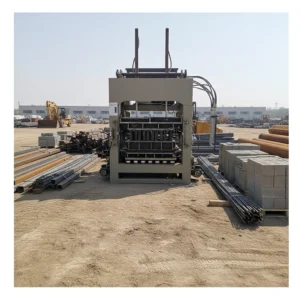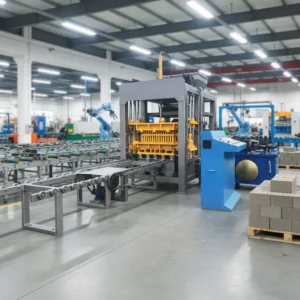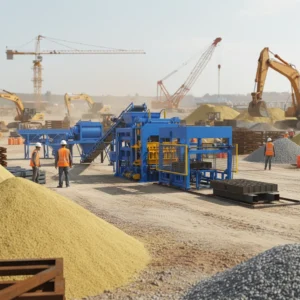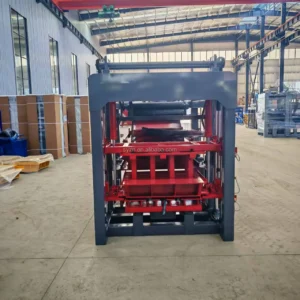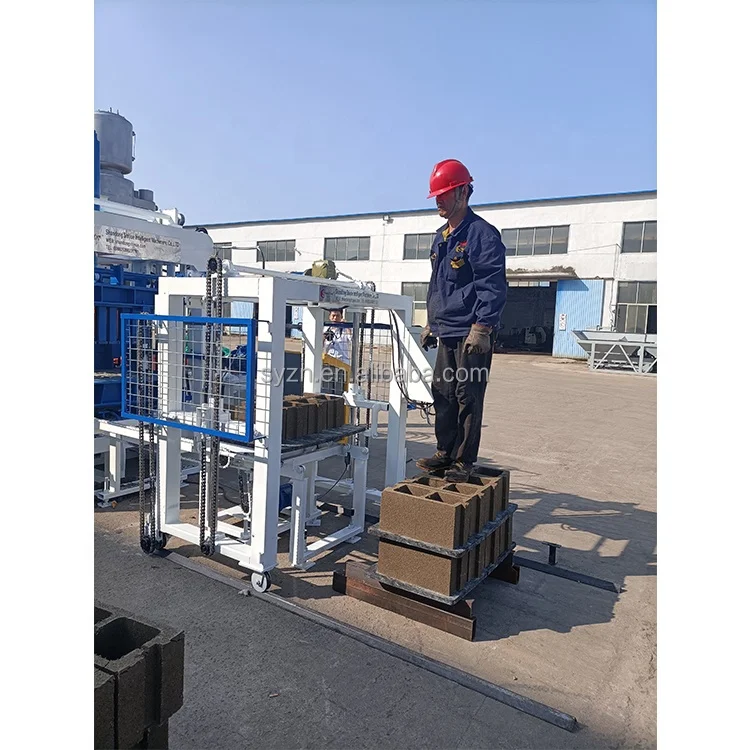
Matched Line Integration — every station from forced mixer to computer control is timed to the press cycle so the main unit never idles waiting for material or pallets.
Technical Specifications
| Parameter | Value |
|---|---|
| Model | QT4-18 |
| Product Type | Automatic Hollow Block Making Machine |
| Vibration Mode | Multiaxis synchronizer vibration (vertically downward) |
| Guide System | Long-period over-length guide bearing for upper mould and mould box alignment |
| Mixer System | Multiaxis forced mixer (adaptable to raw materials of different nature) |
| Hydraulic System | High thermal efficiency, low heat productivity |
| Control System | Computer controlled, fully automatic |
| Rack Construction | High-strength steel with special welding technique (vibration shock resistant) |
| Automation Level | Fully automatic |
| Mould Format | Hollow brick |
| Output Capacity | Basis not stated in source — confirm block format, material and thickness |
| Pallet Size | Not stated in source |
| Voltage & Frequency | Not stated in source |
Application Suitability
| Application | Material or Output |
|---|---|
| Hollow brick production for building envelope walls | Crushed stone, sand, cement and fly ash blends |
| Concrete block manufacturing for construction plants | Local aggregate with cement binder |
| Building material producers expanding hollow format range | Standard concrete mix designs |
Why "Fully Automatic" Means Nothing Without Line Balance
A press that runs faster than its mixer can feed is not an automatic hollow block making machine production line — it is an expensive bottleneck.
I once watched a site in the Gulf where the main unit cycled perfectly, but the mixer discharged at roughly two-thirds of the press demand. Operators stood idle during the gap, and wet product piled up at the far end because no one had sized the stacking station. Two weeks of lost output followed before the contractor brought in a second mixer as a patch. [NEED_CITE: typical cycle time mismatch losses in block plants] The lesson was simple: every station upstream and downstream of the press must match its rhythm, or the automation label is meaningless.
How Stations Connect Around the QT4-18
The multiaxis forced mixer adapts to different aggregate densities, which means discharge consistency stays even whether you run lightweight pumice or dense river sand. That consistency matters because the press expects a predictable charge volume every cycle. When the mixer output fluctuates, the automatic hollow block making machine production line either overfills the mould box or leaves voids that weaken the finished block.
Timing the Full Loop from Raw Feed to Curing Rack
Computer control on this unit coordinates the hydraulic cycle, vibration sequence and mould movement into one programmed loop. What sits outside that loop — pallet feeding, wet stacking, curing rack handling — must be engineered to keep pace. If the stacker cannot lift a full rack before the next press cycle finishes, the operator manually intervenes and the line drops back to semi-automatic throughput. [NEED_CITE: block plant station synchronization standards] Planning each station’s cycle against the press timing prevents that regression.
Reading the Specs That Actually Shape Daily Output
Multiaxis synchronizer vibration directs force vertically downward, which produces uniform density from top to bottom of the hollow brick. Sideways vibration components would create weak planes, especially in tall formats. The long-period over-length guide bearings keep the upper mould and mould box aligned through thousands of cycles daily, preventing the flash and dimensional drift that forces rejection at the curing yard. High-strength welded rack construction absorbs continuous vibration shock without frame fatigue, which matters when the line runs two shifts back to back. Hydraulic system thermal efficiency keeps oil temperature stable, so pressure does not fade during afternoon ambient peaks common in Middle East sites.
What Happens When Pallets and Handling Are Left Off the Quote
Quotations that end at the press leave the buyer sourcing pallets, racks and forklifts independently. Mismatched pallet dimensions mean the curing area cannot accept standard racks, forcing custom welding on site. Undersized forklifts cannot lift a full wet rack, so operators split loads and double handling time. These are not theoretical issues — I have counted extra labor hours on three separate projects where pallet spec was an afterthought. [NEED_CITE: hidden costs of incomplete block line quotations] The result is always the same: the automatic hollow block making machine production line runs at a fraction of its designed capacity.
Why Buyers Spec the Full Line from One Source
Block machinery is our single focus, so the QT4-18 press, forced mixer, hydraulic unit and computer control are specified together against your target format and local aggregate. Configuration is set against your actual mix design rather than a catalogue default. Mould design covers the hollow formats your market sells, with custom drawings available. Automation level is selectable so a plant can start semi-automatic and add stacking later. Installation support includes on-site commissioning with operator training tied to your specific line layout.
Documentation & Verification
- Line layout showing station spacing and cycle timing for your hollow brick format
- Machine specification sheet confirming vibration mode, mixer type and control system
- Hydraulic and electrical schematic matching your confirmed voltage and frequency
- Factory test record run on your mix design before dispatch
- Operation and maintenance manual in your chosen PLC display language
Installation, Commissioning & Support
- Foundation plan matched to the high-strength welded rack footprint and vibration load
- Dedicated power circuit sized to the computer control and hydraulic motor draw
- Machine dismantled for container loading with reassembly supervised on site
- First-run commissioning verifying multiaxis vibration alignment and guide bearing tracking
- Operator training covering mould change, mixer loading sequence and fault diagnostics
- Wear parts list for guide bearings and hydraulic seals with recommended replacement intervals
What We Need to Size Your Line
Provide the hollow brick dimensions your market requires, the daily volume you plan to produce, and the aggregate sources available near your site. Confirm your facility voltage and frequency so the computer control panel is built to match. Share your existing curing area dimensions and forklift capacity so pallets and racks are specified to fit.
Frequently Asked Questions
Q: How is daily output calculated, and which block format is assumed?
A: Output is always stated against a specific hollow brick dimension, wall thickness, and mix design. Without that basis, the figure is not comparable across suppliers. We provide a capacity table that names the exact format and cycle count used for each calculation, so you can verify the number against your own product mix.
Q: Which upstream and downstream stations are included in the line?
A: The quotation specifies the forced mixer, pallet feeder, press, stacker and any curing rack handling as a matched set. Each station’s cycle time is listed so you can see where they align with the QT4-18 press timing and where buffer space may be needed.
Q: How do cycle times match across stations so the press is not left idle?
A: We calculate the slowest station in the loop — often the mixer discharge or the stacker lift — and size it to finish before the press completes its cycle. If a station cannot keep pace, we adjust its specification rather than accept a bottleneck.
Q: What voltage, frequency and control language options are confirmed before shipment?
A: Your local supply standard and the operator’s preferred language are confirmed before the computer control panel is built. This avoids rewiring on arrival and ensures the display is readable during training and daily operation.
Q: What installation and operator training support is provided on-site?
A: Our team supervises reassembly, runs the first production cycles on your actual mix, and trains operators on the QT4-18 controls, mould change procedure and daily maintenance. Training covers the full line, not just the press, so every station is included.