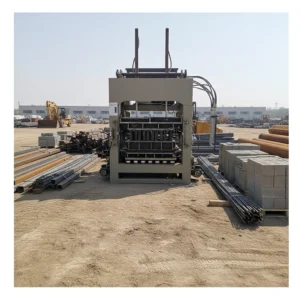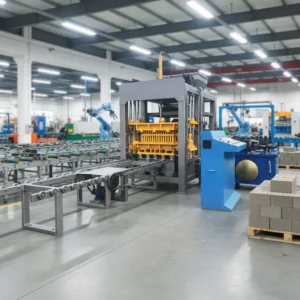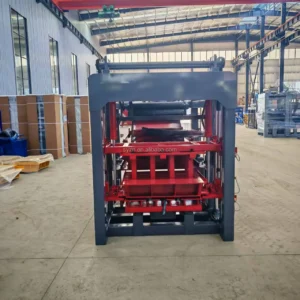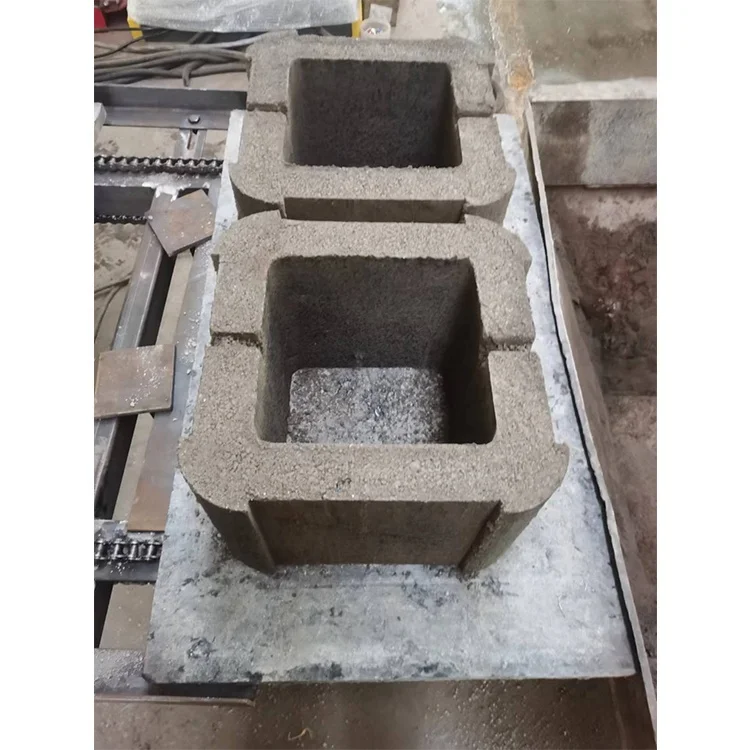
QT4-18 Concrete Block Machine for Hollow Solid Paver – Complete Line
Matched Line Cadence — every station from the JQ350 mixer through to the output conveyor is timed against the QT4-18 press cycle so no single link drags the whole operation down.
Technical Specifications
| Parameter | Value |
|---|---|
| Product Type | Automatic Hydraulic Concrete Block Making Machine |
| Model | QT4-18 |
| Overall Dimensions (L×W×H) | 3900 × 1600 × 2300 mm |
| Total Weight | 3 T |
| Rated Power | 24 kW |
| Vibration Force | 40–50 kN |
| Molding Cycle | 15–25 s |
| Pallet Size | 850 × 550 × 25 mm |
| Mixer Model | JQ350 |
| Control System | PLC control system |
| Hydraulic System | High-pressure hydraulic station |
| Mould Format Options | Hollow block, solid block, paver, curbstone |
| Output — 400×200×200 mm hollow block | 1,200–1,680 pcs/h (15–20 s cycle) |
| Output — 400×150×200 mm hollow block | 1,800–2,400 pcs/h (15–20 s cycle) |
| Output — 240×115×53 mm solid brick | 3,240 pcs/h (15–20 s cycle) |
| Daily Output (8 hr) — 400×200×200 mm hollow | 9,600–13,440 pcs |
| Daily Output (8 hr) — 400×150×200 mm hollow | 14,400–19,200 pcs |
| Daily Output (8 hr) — 240×115×53 mm solid | 16,200–19,440 pcs |
| Raw Materials | Crushed stone, sand, cement, fly ash, dust |
| Included Equipment | Block press, hydraulic station, PLC, pallet feeder, brick conveyor, block sweeper |
| Free Accessories | Manual hydraulic trolley, spare parts, tools |
| Voltage & Frequency | Configurable to buyer’s local grid (confirm before production) |
| PLC Display Language | Configurable (confirm before production) |
Application Suitability
| Application | Material or Output |
|---|---|
| Hollow block production for building walls | Crushed stone, sand, cement, fly ash — 400×200×200 mm and 400×150×200 mm formats |
| Solid brick runs for residential and commercial masonry | Cement and fine aggregate — 240×115×53 mm standard brick format |
| Interlocking paver manufacturing for driveways and walkways | Pigmented concrete mix — various paver mould options |
| Curbstone output for road and landscaping edging | Heavy-duty mix with coarse aggregate — curbstone mould required |
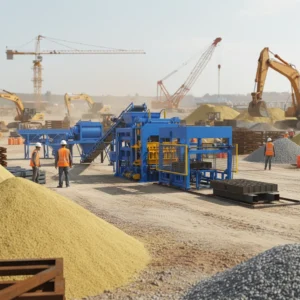
| On-site block production for construction contractors | Locally sourced aggregate and cement, matched to project-spec mix design |
What "1,200 Blocks per Hour" Actually Means for Your Line
A press cycle is only as fast as the slowest station around it.
Buyers often anchor on the headline output number and discover after installation that the mixer, pallet feeder, or conveyor cannot keep pace. The concrete block production line equipment around the QT4-18 is specified as a matched set — not a press plus whatever else was cheapest at the time. When the JQ350 mixer delivers a batch every cycle and the pallet feeder releases on the same 15–25 second window, the press never sits idle waiting for material. [NEED_CITE: impact of line bottleneck on daily block output]
I once spent two weeks on a West African site where the buyer sourced a separate pallet feeder from a different supplier. The feeder cycle ran two seconds slower than the press. Over an eight-hour shift, that gap compounded into hundreds of missed cycles. Every station here is timed against the same master clock before the line ships.
Stations That Keep Pace With the Press
The JQ350 mixer is sized so that a full batch reaches the press hopper within the QT4-18 molding cycle, eliminating the dead time that occurs when a larger mixer finishes early or a smaller one finishes late. The pallet feeder accepts the 850 × 550 × 25 mm pallet and positions it under the mould table on the same PLC signal that triggers the press descent. This concrete block production line equipment layout removes the manual pallet shuffle that slows semi-automatic setups.
The brick conveyor and block sweeper sit downstream, clearing finished pallets and brushing loose material before the next cycle begins. Each station connects through the shared PLC control system, so adjusting the cycle for a denser curbstone mix automatically cascades the timing change through feeder and conveyor alike.
Where Peripheral Equipment Choices Matter
Pallet specification deserves the same attention as the press itself. The 850 × 550 mm pallet must match the curing rack dimensions and the forklift tine spacing already on site, otherwise cured blocks sit on the floor waiting for transport. [NEED_CITE: pallet size compatibility with curing racks and material handling] The hydraulic station delivers consistent high-pressure output paired with 40–50 kN vibration force, but if the pallet material flexes under that force, block density varies across the mould face. Bamboo, PVC, and steel pallets each behave differently under vibration — the choice must be locked in during configuration, not after arrival.
How Vibration Force and Hydraulic Pressure Shape Block Density
The QT4-18 pairs a 40–50 kN vibration force with a high-pressure hydraulic station to compact the concrete mix from both directions simultaneously. Vibration liquefies the mix inside the mould cavity while hydraulic pressure from above forces aggregate particles into a tight matrix. If vibration is too low relative to pressure, the block surface cracks; if pressure is too low, the block crumbles at the edges during demoulding. The molding cycle of 15–25 seconds allows the operator to extend the press time when switching to a denser curbstone format or shorten it for lightweight hollow blocks, keeping density consistent across formats.
Pallet thickness at 25 mm is chosen to absorb the vibration energy without dampening it. A thinner pallet transmits too much force to the conveyor frame, while a thicker one deadens the vibration before it reaches the mix. This balance affects every block that leaves the press table.
The Cost of Mismatched Line Stations
When a buyer pieces together a line from separate suppliers, the integration risk lands on the factory floor. A mixer that delivers faster than the pallet feeder can accept material causes hopper overflow and mix waste. A conveyor that runs slower than the press cycle creates a queue of loaded pallets that block the sweeper, forcing an operator to intervene manually every few minutes. [NEED_CITE: hidden costs of uncoordinated block line equipment procurement] These problems do not show up in the quotation phase — they appear on the first production day, when the line is expected to run at full pace.
Why Sourcing the Whole Line Together Changes the Outcome
Every station in this concrete block production line equipment package is specified against the buyer’s actual block format, local aggregate, and site footprint — not a catalogue default. The line layout drawing shows cycle time at each station so that no bottleneck hides behind the press headline number. Mould options for hollow block, solid brick, paver, and curbstone are confirmed with drawings before production, so the buyer knows the changeover procedure and tooling requirements upfront.
Voltage, frequency, and PLC display language are documented in writing before the build starts, eliminating the commissioning delay that occurs when a control panel arrives with the wrong language or the wrong voltage rating. The factory test runs the full line — mixer, press, feeder, conveyor — together, not the press alone.
Documentation & Verification
- Line layout drawing showing every station from JQ350 mixer to output conveyor with cycle times noted
- Capacity calculation sheet stating output per block format, not a single headline number
- Mould drawing and format list for each mould ordered, with dimensional tolerances
- Pallet specification sheet confirming 850 × 550 × 25 mm size, material type, and quantity matched to curing area
- Voltage, frequency, and PLC display language confirmation signed off before production begins
- Factory test record covering the full line run, not just the standalone press
Installation, Commissioning & Support
- Foundation plan provided for the 3,900 × 1,600 mm press footprint and all peripheral stations
- Electrical single-line diagram for the 24 kW rated power, specifying dedicated circuit breaker sizing
- Hydraulic station pre-filled and pressure-tested; on-site connection limited to hose and power hook-up
- PLC commissioning includes cycle timing verification across mixer, pallet feeder, press, and conveyor
- Operator training covers mould change procedure for each format included in the order
- Wear parts list with recommended reorder points for hydraulic seals, vibration springs, and mould liners
What We Need Before Quoting Your Line
Send the block formats your market actually sells, along with target daily output for each. Share your local aggregate type and the cement grade available in your area so the mix design can be factored into the cycle configuration. Confirm your site voltage, frequency, and the PLC display language your operators will read. If you have existing curing racks or forklifts, provide their dimensions so the pallet and conveyor specifications align with what is already on the ground.
Frequently Asked Questions
Q: How do I verify that every station in the line can match the press cycle time?
A: Before production, you receive a line layout drawing that lists the cycle time at each station — mixer batch delivery, pallet feed, press mold, conveyor clearing. Each time is set against the QT4-18 molding cycle of 15–25 seconds. The factory test runs the full sequence together and the test record is shared with you, so you see actual timing data, not theoretical values.
Q: What happens if the mixer output or pallet feeder falls behind the press?
A: The press sits idle, and missed cycles accumulate across the shift. That is why the JQ350 mixer and pallet feeder are specified together with the press rather than sourced separately. The PLC coordinates the start signal across all stations, so if one station has not completed its step, the press does not begin the next cycle and no material is wasted.
Q: Can I add automatic stacking or cubing to this line later as an upgrade?
A: Yes. The QT4-18 line layout reserves physical space and PLC I/O points for a future stacker or cubing module at the output end. When you are ready, the upgrade connects to the existing control system without replacing the main PLC or rewiring the press. We provide the interface specifications at the initial quotation stage so the upgrade path is documented.
Q: How is the line layout adapted to my site footprint and curing area?
A: We work from your site dimensions and curing rack layout to position each station. The conveyor length, pallet return path, and block sweeper location are drawn to fit your available floor space. If your curing area is outdoors or on a different level, the layout adjusts pallet flow direction accordingly before any steel is cut.
Q: Which raw material feeding configuration suits my local aggregate and mix design?
A: The feeding setup depends on whether your aggregate is crushed stone, river sand, fly ash, or a blend. We configure the hopper gate openings, mixer water dosing, and batch timing around the specific materials you can source locally. Providing a sample mix ratio and aggregate grading at the inquiry stage lets us set the configuration before the line is built.