
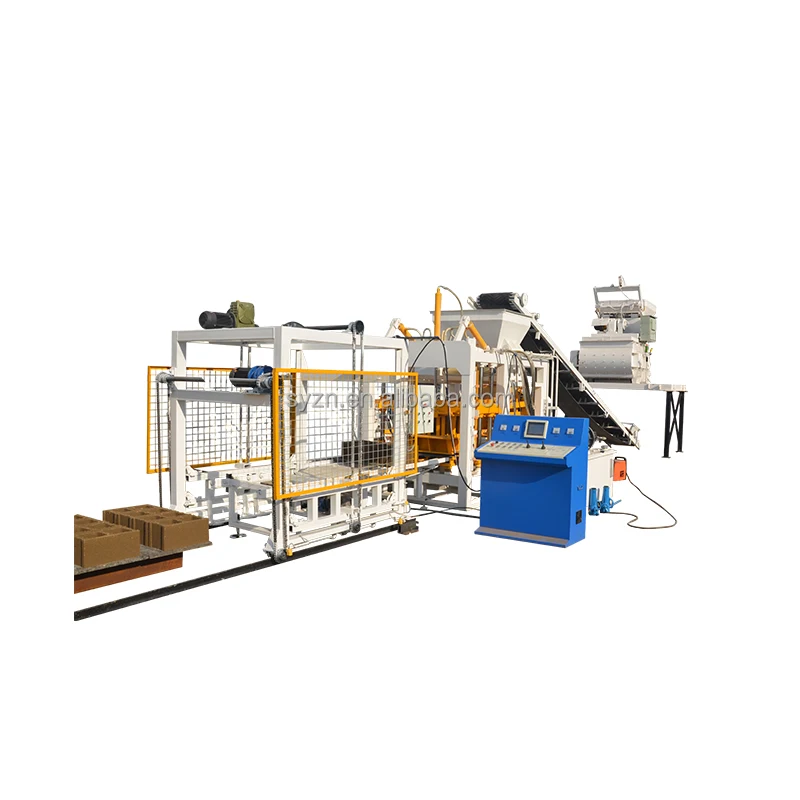
Matched Line Engineering — The QT4-15A is specified as a complete production line with pallet feeder, brick conveyor, and block sweeper integrated into one PLC-coordinated system, not assembled from separate suppliers after the fact.
Technical Specifications
| Parameter | Value |
|---|---|
| Product Type | Automatic Concrete Block Making Machine |
| Model | QT4-15A |
| Overall Dimensions (L×W×H) | 7100 × 1600 × 2610 mm |
| Molding Cycle | 15–25 s |
| Vibration Frequency | 4600 r/min |
| Vibration Force | 40–50 kN |
| Total Power | 18.45 kW |
| Mixer Model | JQ350 |
| Pallet Size | 850 × 550 × 25 mm |
| Total Weight | 3 T |
| Control System | PLC control system |
| Hydraulic Station | Included |
| Applied Products | Paver, solid block, hollow block, curbstone |
| Raw Materials | Crushed stones, sand, cement, dust, fly ash |
| Automation Level | Automatic (pallet feeder, brick conveyor, block sweeper included) |
| Output Capacity | 408 pcs/hr based on 400×200×200mm hollow block, 4 pcs/mould |
| Output Capacity | 510 pcs/hr based on 400×150×200mm hollow block, 5 pcs/mould |
| Output Capacity | 2100 pcs/hr based on 240×115×53mm solid brick, 18 pcs/mould |
| Included Auxiliary Equipment | Hydraulic station, PLC control system, pallet feeder, brick conveyor, block sweeper, manual hydraulic trolley, spare parts and tools |
| Voltage & Frequency | Basis to be confirmed with buyer before production |
| Hydraulic Pressure | Basis to be confirmed with manufacturer catalog |
| Mould Change Time | Basis to be confirmed depending on block format |
Application Suitability
| Application | Material or Output |
|---|---|
| Hollow block production for commercial buildings | Crushed stone, sand, cement, fly ash in 400×200×200mm and 400×150×200mm formats |
| Solid brick production for residential masonry | Local aggregate and cement in 240×115×53mm format |
| Paver production for walkways and parking areas | Fine aggregate and cement mixes in interlocking or rectangular formats |
| Curbstone production for road infrastructure | Dense aggregate and cement in heavy-duty curb profiles |
| On-site block production for project contractors | Locally sourced crushed stone and cement, output staged to match project phasing |
What "Blocks per Hour" Leaves Out When You Buy the Press Alone
A block press that cycles in 15 seconds means nothing if the mixer cannot feed it in time or the pallet feeder jams every third cycle.
I have stood on plant floors watching a high-cycle press sit idle for 40 seconds per round because the upstream mixer was undersized for the mix design the buyer actually ran. The press was rated for a certain output, but the line never reached it. [NEED_CITE: mismatched station timing causes idle time in block production lines]. When you evaluate an automatic block making machine production line, the capacity figure must be traced across every station from mixing through curing, not just the press alone.

How Station Timing Holds the Line Together
The QT4-15A automatic block making machine production line coordinates the press cycle with pallet feeding and brick conveying through a shared PLC control system. The press completes a molding cycle between 15 and 25 seconds, and the pallet feeder must deliver a fresh pallet within that window. If either station runs slow, the press waits, and hourly output drops below what the spec sheet states.
The brick conveyor then carries finished blocks off the line before the next pallet enters, closing the loop. This timing coordination is configured before shipment so the buyer receives a line where each station is matched to the press cycle, not a collection of machines that must be tuned on site.
Why the Mixer and Pallet Loop Matter Just as Much
The JQ350 mixer included in this line is sized to prepare enough material for the QT4-15A press within its cycle window, using raw materials such as crushed stone, sand, cement, and fly ash. A smaller mixer would force the press to wait for material, which is exactly the failure I have seen on lines where the buyer sourced the mixer separately to save on the initial order. [NEED_CITE: mixer capacity must match press cycle volume in concrete block lines].
The manual hydraulic trolley and block sweeper included in the auxiliary equipment close the handling loop after the press. Blocks are swept clean and moved to curing without requiring a separate purchase or a manual lifting crew. This is what separates a complete automatic block making machine production line from a quotation that only covers the press and leaves the buyer to figure out pallet handling on their own.
Reading the Specs That Actually Determine Your Output
The vibration system operates at 4600 r/min delivering 40–50 kN of exciting force. This force, combined with hydraulic pressure, compresses the mix into the mould cavity to achieve block density and strength. The vibration frequency and force must be matched to the pallet size of 850 × 550 × 25 mm, because the energy transfers through the pallet into the material. A mismatch here causes uneven compaction and weak blocks at the pallet edges.
The total power of 18.45 kW covers the press, hydraulic station, and auxiliary drives. Buyers need to confirm voltage and frequency for their local grid before production starts, because a motor wound for the wrong frequency will run at the wrong speed and throw off every cycle time in the line. [NEED_CITE: voltage and frequency standards by export market].
The moulding cycle of 15–25 seconds varies by block format and mix design. The stated output of 408 pieces per hour for 400×200×200mm hollow blocks assumes 4 pieces per mould and consistent cycle timing. Switching to solid bricks at 18 per mould raises the hourly figure, but only if the pallet feeder and conveyor can keep pace at that higher throughput.

The Cost of Skipping Line-Level Specification
When a buyer orders only the press and adds the mixer, pallet feeder, and conveyor later from different suppliers, each station runs on its own timing logic. The result is a line that never reaches its rated output, and the buyer blames the press. [NEED_CITE: equipment integration failures in block production plants]. I have been called to sites where the line sat half-finished because the pallet size on the feeder did not match the curing racks the buyer already owned, forcing a pallet reorder before production could start. These problems are not mechanical failures — they are specification failures that happen before the machines even ship.
Why This Line Is Specified as One System
The QT4-15A is quoted as a matched line, meaning the press, hydraulic station, PLC, pallet feeder, brick conveyor, and block sweeper are all included in one scope so station timing is set before dispatch. Mould design covers the formats the buyer’s market actually sells, with custom drawings available when standard formats do not match. The automation level is selectable, so a buyer can start with the automatic configuration and add stacking or cubing equipment later without replacing the press. Pallet size and material are confirmed against the buyer’s curing area and forklift before production begins, preventing the arrival-day mismatch that stops commissioning. Voltage, frequency, and PLC display language are confirmed in writing so the electrical system and operator interface are ready when the line is powered on.
Documentation & Verification
- Line layout drawing showing station connections and cycle timing for the QT4-15A
- Capacity calculation stating the block format assumed for each output figure
- Mould drawing and format list with pallet specification matched to curing setup
- Hydraulic and electrical schematic with confirmed voltage and frequency
- Factory test record on buyer’s specified block format before dispatch
- Operation and maintenance manual with wear parts and mould list
Installation, Commissioning & Support
- Foundation plan based on QT4-15A overall dimensions of 7100 × 1600 × 2610 mm and 3T operating weight
- Power supply confirmation for 18.45 kW total load at buyer’s local voltage and frequency
- PLC control system configured with operator display language before shipment
- On-site commissioning with cycle timing verification across press, pallet feeder, and conveyor
- Operator training covering mould change procedure and daily maintenance checkpoints
- Wear parts list and hydraulic seal kit included for first replacement cycle
What to Include in Your Inquiry
To size the QT4-15A to your plant, provide the block formats you sell locally, your target daily output, and the raw materials you can source — especially the aggregate type and cement grade. Confirm your site voltage, frequency, and the language your operators need on the PLC display. If you have existing curing racks or forklifts, send the pallet dimensions so the feeder and pallet spec are matched before the line ships.
Frequently Asked Questions
Q: How are cycle times matched between the press and pallet feeder so neither station is idle?
A: The PLC control system coordinates the QT4-15A press cycle with the pallet feeder and brick conveyor timing before dispatch. Each station’s response time is set so the press receives a fresh pallet within its 15–25 second molding window. The timing parameters are documented in the line layout drawing provided with your order.
Q: What is the realistic daily output for each block format?
A: Output depends on the block format and pieces per mould. For 400×200×200mm hollow blocks at 4 pieces per mould, the rated output is 3264 pieces per 8-hour shift. For 240×115×53mm solid bricks at 18 pieces per mould, the figure is 17000 per shift. These figures assume continuous operation with matched upstream and downstream stations.
Q: Which stations are included in the line scope and which are buyer-supplied?
A: The QT4-15A line includes the block making machine, hydraulic station, PLC control system, pallet feeder, brick conveyor, block sweeper, and manual hydraulic trolley. The buyer typically supplies the raw material storage, curing area, and forklift. If stacking or cubing automation is needed, it can be added to the scope.
Q: How do I confirm voltage, frequency, and PLC language before the line ships?
A: These details are confirmed in writing during the quotation stage. The buyer provides the local supply voltage, frequency, and preferred PLC display language. The hydraulic station and PLC control system are configured accordingly, and the electrical schematic reflects these settings before production begins.
Q: What pallet size does the line assume, and can it match my existing curing racks?
A: The standard pallet size for the QT4-15A is 850 × 550 × 25 mm. If your curing racks or forklift require a different pallet dimension, this must be confirmed before production so the pallet feeder and mould are built to match. Changing pallet size after the line ships requires feeder modification on site.



