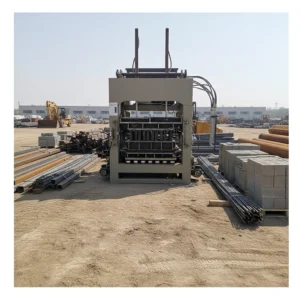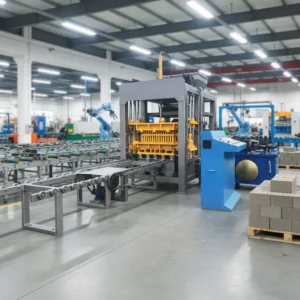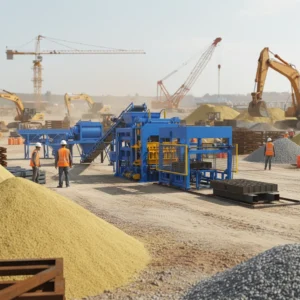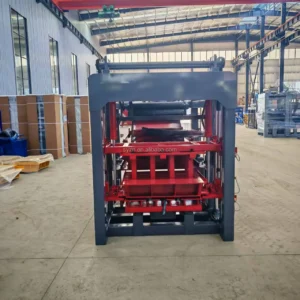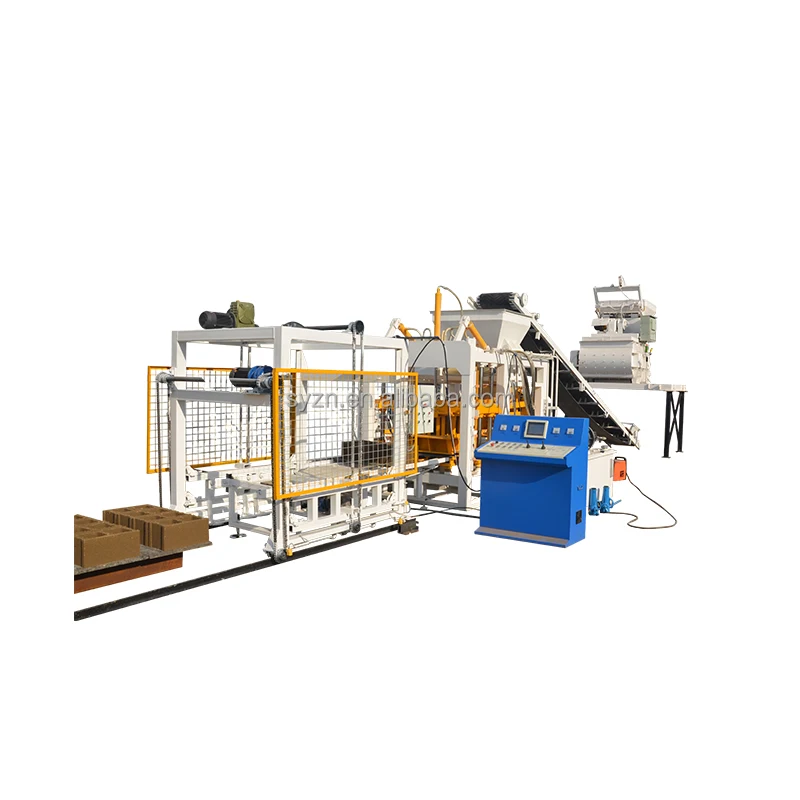
Integrated line synchronization — The QT4-15A block making machine production line is quoted with its JQ350 mixer, pallet feeder, and brick conveyor as a single matched system, so the press never waits on upstream or downstream stations.
Technical Specifications
| Parameter | Value |
|---|---|
| Model | QT4-15A |
| Product Type | Fully Automatic Hydraulic Block Making Machine |
| Overall Dimensions (L×W×H) | 7100 × 1600 × 2610 mm |
| Net Weight | 3 T |
| Molding Cycle | 15–25 s |
| Vibration Frequency | 4600 r/min |
| Exciting Power | 40–50 KN |
| Rated Power | 18.45 kW |
| Mixer Model | JQ350 |
| Pallet Size | 850 × 550 × 25 mm |
| Control System | PLC |
| Hydraulic Station | Included |
| Pallet Feeder | Included |
| Brick Conveyor | Included |
| Block Sweeper | Included |
| Output Capacity (Hollow Block 400×200×200 mm) | 408 pcs/hr, 3264 pcs/8hr (basis: 4 pcs per mould) |
| Output Capacity (Hollow Block 400×150×200 mm) | 510 pcs/hr, 4080 pcs/8hr (basis: 5 pcs per mould) |
| Output Capacity (Solid Brick 240×115×53 mm) | 2100 pcs/hr, 17000 pcs/8hr (basis: 18 pcs per mould) |
| Voltage & Frequency | To be confirmed before order |
| PLC Language | To be confirmed before order |
| Certification | To be confirmed |
Application Suitability
| Application | Material or Output |
|---|---|
| Hollow block production | Crushed stone, sand, cement, fly ash — formats 400×200×200 mm and 400×150×200 mm |
| Solid brick production | Cement, sand, and fine aggregate — standard 240×115×53 mm format |
| Paver production | Cement, crushed stone, and dust for interlocking and standard paving formats |
| Curbstone production | Dense aggregate mixes with high hydraulic pressure and vibration consolidation |
| On-site contractor block production | Local raw material sourcing for housing and infrastructure project sites |
What "Pieces per Hour" Means When the Whole Line Is Counted
A press cycle time only matters if the pallet feeder, mixer, and conveyor can keep the same pace.
When I was procuring equipment for a plant in Jakarta, a supplier quoted an attractive cycle figure on the host machine alone. The pallet feeder arrived undersized, and the mixer could not sustain the consumption rate during continuous runs. The press sat idle between cycles while operators waited for the next pallet and fresh mix. The rated output was never reached because the bottleneck simply moved to a different station on the line. This is the gap that a QT4-15A block making machine production line is designed to close — by specifying every station together from the start. [NEED_CITE: common causes of throughput loss in block production lines]
Synchronization Between the Press and the Pallet Feeder
The QT4-15A block making machine production line includes a dedicated pallet feeder matched to the 15–25 second molding cycle. Each time the press completes a moulding sequence, the feeder must deliver a clean pallet to the conveyor in time for the next cycle. If the feeder is slower than the press, the host machine waits. If it is faster, pallets pile up and misalign. The feeder in this line is rated to operate within the same cycle window as the press, keeping the sequence continuous across an eight-hour shift.
Mixer Throughput and Press Consumption
The JQ350 mixer is sized to supply material at a rate that prevents the hopper above the press from running dry. A block press consuming mix every 15 to 25 seconds demands a steady flow from the mixer, especially when running dense hollow block formats that use more material per cycle. If the mixer batch time is longer than the press consumption rate, operators must pause production or accept incomplete mould fills, which leads to weak blocks that fail compressive strength tests. [NEED_CITE: relationship between mixer batch time and press consumption rate in block plants]
Reading the Capacity Figures Correctly
The output figures for the QT4-15A are stated per block format: 408 pieces per hour assumes a 400×200×200 mm hollow block with 4 pieces per mould, while 2100 pieces per hour assumes a 240×115×53 mm solid brick with 18 pieces per mould. Switching formats changes both the pieces-per-cycle count and the moulding cycle duration, so the real daily output depends entirely on which format the plant runs most often. A buyer planning to run primarily large hollow blocks should base their capacity calculation on the 408 pcs/hr figure, not the solid brick number.
Pallet Specification and the Curing Area Connection
The pallet size on this line is 850 × 550 × 25 mm. This dimension must align with the buyer’s existing curing racks, forklift fork width, and stacking configuration. A pallet that is too wide for the curing rack will not seat properly, risking block damage during the curing period. A pallet material that does not suit the local humidity can warp, causing uneven block surfaces. Before the line is finalized, the pallet specification should be validated against the actual curing infrastructure at the installation site.
The Hidden Cost of Treating the Press as a Standalone Purchase
When a buyer sources only the host machine and adds pallet feeders, conveyors, and mixers from separate suppliers later, the integration risk falls entirely on the buyer. Cycle times rarely match across brands. PLC signals must be hardwired between machines that were never designed to communicate, and the result is a line that requires constant manual intervention. [NEED_CITE: integration challenges when combining block press with third-party supporting equipment] Stations that were individually adequate become bottlenecks in sequence, and the daily output settles well below what any single machine’s specification sheet promised.
Why Source the Complete Line Here
Block machinery is our single focus, so the QT4-15A press, JQ350 mixer, pallet feeder, brick conveyor, and block sweeper are specified as one coordinated system rather than assembled from unrelated suppliers. The configuration is set against the buyer’s actual mix design and local aggregate, not a catalogue default. Mould design covers the formats the buyer’s market actually sells, with custom drawings available. The automation level is selectable, so a plant can begin with the included semi-automatic supporting equipment and add automatic stacking later. Installation support includes operator training on the full line, not just the press.
Documentation & Verification
- Line layout drawing showing station spacing and material flow from mixer to conveyor
- Capacity calculation sheet stating the block format assumed for each output figure
- Factory test record with the full line — press, mixer, feeder, conveyor, sweeper — running together
- Voltage, frequency, and PLC language confirmation document signed before production
- Pallet specification sheet covering size, material, and quantity matched to curing infrastructure
- Hydraulic and electrical schematic for the integrated line control system
Installation, Commissioning & Support
- Foundation plan based on the 7100 × 1600 mm press footprint and vibration isolation requirements
- Electrical supply confirmation for the 18.45 kW rated power draw with dedicated circuit breaker
- Arrival condition and reassembly scope clarified before shipment so site preparation is accurate
- PLC parameter setup covering cycle timing between press, pallet feeder, and brick conveyor
- Operator training on mould change procedure and daily maintenance of hydraulic and vibration systems
- Wear parts list for hydraulic seals, vibration springs, and mould liners with first-order quantities
What to Include in Your Inquiry
To size the QT4-15A block making machine production line correctly, share the block formats you intend to produce, your target daily output per format, and the raw materials available locally including aggregate type and grading. Confirm your site voltage, frequency, and preferred PLC display language so the control system is configured before dispatch. If you have existing curing racks or forklifts, provide their dimensions so the 850 × 550 × 25 mm pallet can be validated or adjusted to match your infrastructure.
Frequently Asked Questions
Q: How are the cycle times of the press, pallet feeder, and brick conveyor matched on this line?
A: The QT4-15A press operates on a 15–25 second molding cycle, and the included pallet feeder and brick conveyor are specified to deliver and remove pallets within that same window. The PLC coordinates the sequence so no station waits on another. If your target format requires a longer cycle due to mix characteristics, the feeder timing is adjusted during commissioning to match.
Q: What block format is assumed in each capacity figure?
A: The 408 pcs/hr figure assumes a 400×200×200 mm hollow block with 4 pieces per mould cycle. The 510 pcs/hr figure assumes a 400×150×200 mm hollow block with 5 pieces per cycle. The 2100 pcs/hr figure assumes a 240×115×53 mm solid brick with 18 pieces per cycle. Your real daily output depends on which format dominates your production schedule.
Q: Is the pallet size chosen to fit my existing curing area and forklift?
A: The standard pallet size is 850 × 550 × 25 mm. Before production, we confirm this dimension against your curing rack spacing and forklift fork width. If your existing infrastructure requires a different pallet size, the feeder and conveyor are adjusted accordingly so the line integrates with your curing setup without modification.
Q: What supporting equipment is included versus what I must source separately?
A: The line includes the hydraulic station, PLC control, JQ350 mixer, pallet feeder, brick conveyor, and block sweeper. Pallets themselves and curing rack systems are typically sourced or confirmed separately based on your site conditions. Automatic stacking and cubing equipment is available as an upgrade if you want to reduce manual handling at the end of the conveyor.
Q: Are voltage and PLC language confirmed before the line is built?
A: Yes. Voltage, frequency, and PLC display language are confirmed in writing during the quotation stage, before production begins. This prevents commissioning delays when the line arrives at your site. If your local power supply differs from standard configurations, the electrical system is configured at the factory to match your requirements.