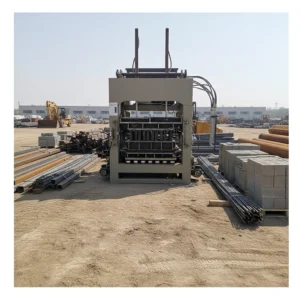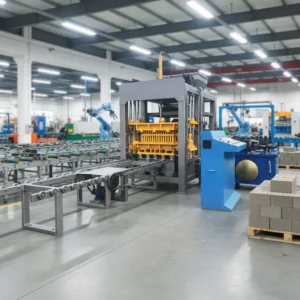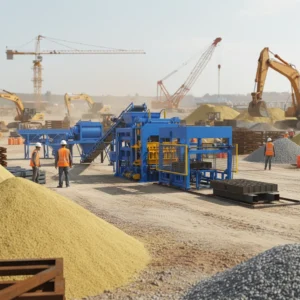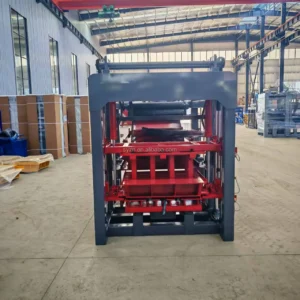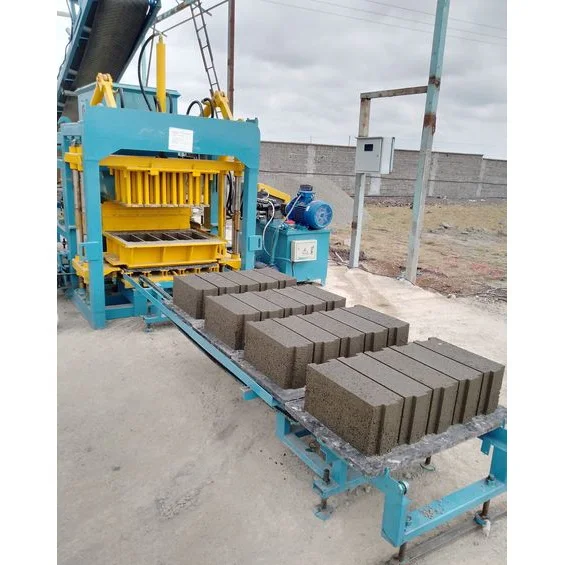
Complete Line Integration — the QT4-15 block production line is configured so the press, mixer, pallet feeding, and stacking stations share matched cycle times, eliminating the idle gaps that cut actual output when stations are sourced separately.
Technical Specifications
| Parameter | Value |
|---|---|
| Model | QT4-15A |
| Product Type | Automatic Concrete Block Making Machine |
| Overall Dimensions (L×W×H) | 7100×1600×2610 mm |
| Molding Cycle | 15–25 s |
| Vibration Frequency | 4600 r/min |
| Vibration Force (Exciting Power) | 40–50 kN |
| Rated Power | 18.45 kW |
| Mixer Model | JQ350 |
| Pallet Size | 850×550×25 mm |
| Total Weight | 3 T |
| Applied Products | Paver, solid block, hollow block, curbstone |
| Raw Materials | Crushed stone, sand, cement, dust, fly ash |
| Output – Hollow Block 400×200×200 mm | 4 pcs/mould, 408 pcs/h, 3264 pcs/8hr |
| Output – Hollow Block 400×150×200 mm | 5 pcs/mould, 510 pcs/h, 4080 pcs/8hr |
| Output – Solid Brick 240×115×53 mm | 18 pcs/mould, 2100 pcs/h, 17000 pcs/8hr |
| Hydraulic System | Equipped (high-pressure, stable operation) |
| Automation Level | Semi-automatic or Automatic (configuration to be confirmed) |
| Voltage & Frequency | Basis to be confirmed with buyer’s site |
| Control System / PLC Language | Basis to be confirmed |
Application Suitability
| Application | Material or Output |
|---|---|
| Hollow block production for building walls | Crushed stone, sand, cement, fly ash — 400×200×200 mm or 400×150×200 mm formats |
| Solid brick production for load-bearing structures | Sand, cement, dust — 240×115×53 mm format |
| Paving block production for walkways and yards | Crushed stone, cement — interlocking or rectangular formats |
| Curbstone production for road edges | Coarse aggregate, cement — kerb format via custom mould |
| On-site block production for housing projects | Locally sourced aggregate and cement, semi-automatic configuration for lower investment |
Why Quoted Capacity Rarely Matches Day-One Output on a concrete block making machine production line
Capacity figures only hold when every station in the line keeps pace with the press.
I have watched lines where the press completed a cycle in 20 seconds but the pallet feeder needed 30, so the operator simply waited. Over an eight-hour shift that gap compounds into thousands of missing blocks. When buyers evaluate a concrete block making machine production line, the question is not how fast the press cycles in isolation but whether the mixer discharge, pallet return, and stacking节奏 all land within that same window [NEED_CITE: line synchronization principles in block production].
The QT4-15A line addresses this by specifying the JQ350 mixer, pallet feed rate, and stacking station as one package rather than leaving those stations to separate suppliers who may quote independently.
How Each Station Connects to Keep the Press Running
Raw material enters the JQ350 mixer, where a batch cycle is timed to finish just before the press completes its current mould. The mixed material drops into a hopper above the press, so the press never waits for a fresh charge. This coordination is the defining difference between a stand-alone press and a true concrete block making machine production line.
Pallets travel from the curing rack back to the press on a return conveyor. If the return path is too slow or the curing rack is too far from the press, empty pallets do not arrive in time and the cycle stalls. The 850×550×25 mm pallet size on this line is chosen to balance curing rack capacity with forklift handling speed at the buyer’s site.
Where Line Bottlenecks Typically Hide
Most bottlenecks appear at the hand-off points: mixer discharge gate to press hopper, press output to stacking station, and stacker discharge to curing area. Each hand-off involves a sensor, a mechanical gate, or a conveyor belt whose speed must match the press cycle [NEED_CITE: material handling synchronization standards]. When any one of those elements is undersized, the press sits idle for seconds that add up across a shift.
On this line, the stacking station is specified to lift and index the same pallet count the press delivers per cycle, so finished blocks leave the press table without delay. If the buyer plans to add automatic cubing later, the stacking station footprint already reserves space for that upgrade.
Reading the Specs That Actually Matter on Site
The vibration force of 40–50 kN works together with hydraulic pressure to compact the mix into the mould. Higher vibration alone does not guarantee denser blocks; the hydraulic head must apply enough downward force to keep the material from bouncing away from the mould walls. When these two values are matched to the buyer’s aggregate size and cement ratio, block strength stays consistent across batches.
The 15–25 second moulding cycle covers the range from simple solid bricks to taller hollow blocks that need longer vibration to settle fully. A shorter cycle on a tall hollow block leaves voids; a longer cycle on a thin paver wastes time. The PLC adjusts dwell within this window per mould installed.
At 18.45 kW total rated power, the line draws within the capacity of a standard industrial supply, but voltage and frequency must still be confirmed before the motor windings are wound — a 60 Hz site running a 50 Hz motor will see the mixer and vibration motor turn slower, directly cutting output [NEED_CITE: motor frequency and speed relationship].
What Happens When the Line Is Assembled from Separate Quotes
A buyer who sources the press from one supplier, the mixer from another, and pallets from a third often discovers on commissioning day that the mixer batch size is too large for the press hopper, or that the pallet thickness does not fit the press guide rails. Correcting these mismatches on site means welding, rewiring, and lost production days [NEED_CITE: equipment integration risks in block plants].
Even when each piece of equipment runs correctly on its own, the absence of a shared control reference means sensors cannot talk to one another. The press may finish a cycle and signal for a new pallet, but if the pallet feeder is controlled by a separate panel with no interlock, the signal goes nowhere and the operator must press a manual button — adding seconds to every cycle and defeating the purpose of automatic operation.
Why This Line Is Specified as One Package
Block machinery is the single focus here, which means the press, mould, pallet, and handling equipment are designed as a matched system rather than assembled from catalogue pages. The line layout states which block format each capacity figure assumes, so the buyer knows what to expect before the machine ships.
Configuration is set against the buyer’s actual mix design and local aggregate, not a default recipe. Mould design covers the formats the buyer’s market sells, including custom drawings when the standard catalogue does not match local demand. Automation level is selectable, allowing a buyer to begin with semi-automatic pallet handling and move to full stacking later without replacing the press.
Documentation & Verification
- Line layout drawing with capacity calculation per block format stated
- Machine specification sheet covering hydraulic, electrical, and mechanical systems
- Mould drawing and format list for every block type quoted
- Pallet specification matched to curing area dimensions and forklift capacity
- Hydraulic and electrical schematic for local maintenance teams
- Factory test record showing cycle times on the buyer’s chosen block format
- Voltage and control language confirmation signed before production begins
Installation, Commissioning & Support
- Foundation plan accounts for the 7100×1600 mm footprint and 3 T operating weight
- Dedicated power circuit sized for the 18.45 kW total draw with confirmed voltage
- Machine shipped in dismantled modules for container loading, reassembled on site
- First-run commissioning includes cycle timing verification on the buyer’s block format
- Operator training covers PLC navigation, mould change procedure, and daily maintenance
- Wear parts list with hydraulic seal and vibration motor brush replacement intervals
- Mould inventory and pallet quantity recommendation based on the buyer’s curing rack count
What to Include in Your Inquiry
To size the concrete block making machine production line correctly, share the block formats you plan to produce, the daily output target per format, and the aggregate and cement available locally. Also confirm your site voltage and frequency, the language you need on the PLC display, and the forklift and curing rack dimensions already in place so the pallet system can be matched from day one.
Frequently Asked Questions
Q: How is daily output calculated, and which block format does each capacity figure assume?
A: Each output number is tied to a specific block size. For the QT4-15A, hollow blocks at 400×200×200 mm yield 3264 pieces in an eight-hour shift, while 400×150×200 mm hollow blocks reach 4080 pieces in the same period, and solid bricks at 240×115×53 mm reach 17000. These figures assume continuous operation with matched upstream and downstream stations.
Q: What supporting equipment is included in the line quotation?
A: The quotation covers the press, JQ350 mixer, pallet feeding conveyor, and stacking station as one package. Pallet quantity is recommended based on the buyer’s curing area size. Raw material feeding and automatic cubing can be added when the buyer confirms the full line layout and available floor space.
Q: How is pallet size and quantity determined for my curing area?
A: The standard pallet for this line measures 850×550×25 mm. Quantity depends on how many pallets the curing rack holds and how fast the forklift can rotate them. A typical recommendation is 300 to 500 pallets so the press never waits for an empty pallet to return from the rack.
Q: What voltage, frequency, and PLC language options are confirmed before shipment?
A: Voltage and frequency are confirmed during the quotation stage to match the buyer’s local grid. The PLC display language is selected at the same time. Both items are documented in a signed confirmation sheet before production starts, avoiding commissioning delays when the machine arrives on site.
Q: How do raw material feeding and mixing connect with the press to avoid idle cycles?
A: The JQ350 mixer batch cycle is timed so mixed material is ready in the press hopper before the current mould finishes. A sensor in the hopper signals the mixer to start the next batch. This interlock keeps the press running at its rated 15–25 second cycle without pausing for material.