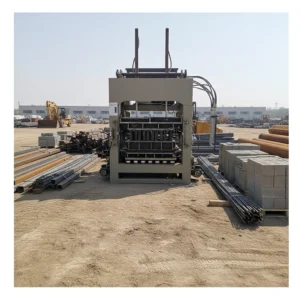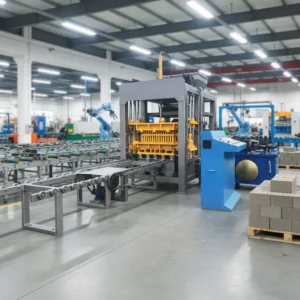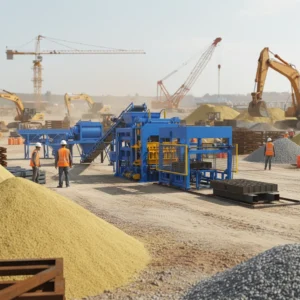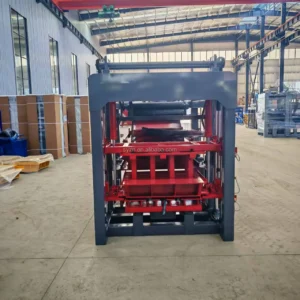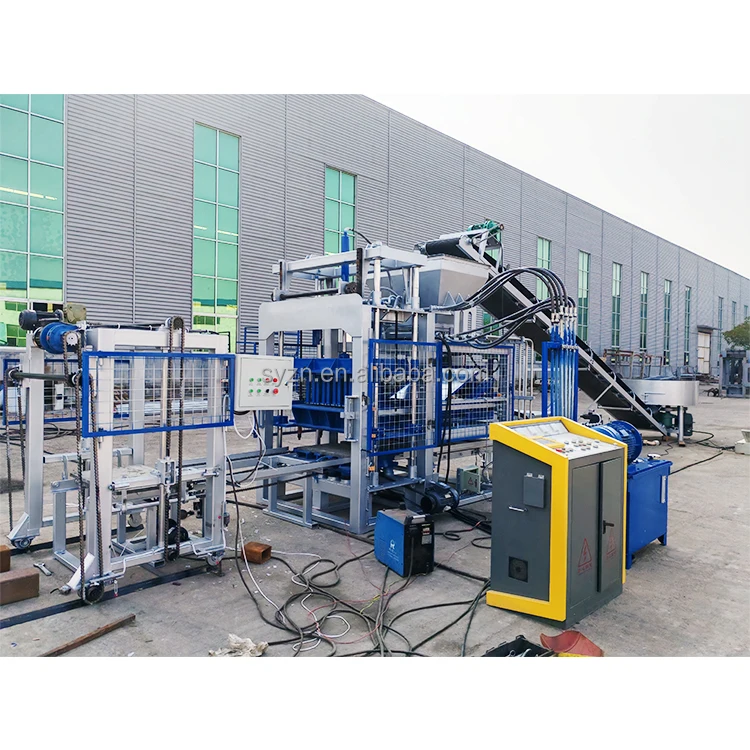
Matched System Sizing — The QT4-15 block press is specified here as the centre station of a coordinated line, with raw material feeding, pallet circulation, stacking and curing rack handling each verified against the 25–30 s molding cycle before any equipment is confirmed for shipment.
Technical Specifications
| Parameter | Value |
|---|---|
| Model | QT4-15 |
| Product Type | Fully Automatic Concrete Block Making Machine |
| Overall Dimension | 4100 × 1600 × 2600 mm |
| Rated Pressure | 16–21 MPa |
| Vibration Form | Platform Vibration |
| Vibration Frequency | 4200 r/min |
| Vibration Force | 55 kN |
| Pallet Size | 880 × 550 mm |
| Molding Cycle | 25–30 s (basis not stated in source — confirm block format, material and thickness) |
| Overall Power | 18.45 kW (source value — verify against manufacturer catalog) |
| Demolding Method | Hydraulic |
| Total Mass | 4 T |
| Factory Area | 300 m² |
| Loading | 1 × 40HQ container (basic equipment) |
| Applied Products | Hollow/solid blocks, pavers, interlocking blocks, curbstone, colored pavers |
| Raw Material | Crushed stone, sand, cement, fly ash, gravel, slag, dust |
Application Suitability
| Application | Material or Output |
|---|---|
| Hollow block production for building walls | Crushed stone, sand, cement, fly ash |
| Solid block production for load-bearing structures | Gravel, sand, cement blend |
| Paving block and colored paver production | Fine aggregate with cement and pigment |
| Interlocking brick and curbstone forming | Slag, dust, sand and cement mixes |
| On-site block production for housing projects | Locally sourced aggregate and cement |
What a Molding Cycle Figure Leaves Out About Line Throughput
A 25–30 second press cycle only translates to real daily output when every upstream and downstream station keeps pace at that same rhythm.
Quoting a QT4-15 block machine production line by its press cycle alone ignores the time a pallet takes to return from the curing rack, the seconds the mixer needs to deliver a fresh batch, and the stacking station’s ability to clear cured blocks before the next pallet arrives. I have seen plants where the press idled for several seconds each cycle simply waiting on a pallet that was still being forklifted back from an undersized curing area [NEED_CITE: typical pallet return time in small block plants]. The turnkey concrete block plant only delivers its calculated capacity when each station is matched to the specific block format and cycle time the buyer will actually run.
Station-by-Station Synchronisation Around the Press
The QT4-15 block machine production line treats the press as one station among several. Raw material feeding and mixing must deliver a consistent batch to the hopper within the 25–30 s window. The pallet feeder must place an empty pallet on the vibration table before the press completes its previous demolding stroke. If any station runs slower, the press waits and the quoted cycle time becomes theoretical rather than actual.
Pallet Circulation and Curing Rack Alignment
The 880 × 550 mm pallet size drives decisions beyond the press itself. The curing rack system must accept that pallet dimension, the site forklift must handle loaded pallets at that width, and the pallet return conveyor must fit within the 300 m² factory area. A turnkey concrete block plant that ignores these interfaces forces the buyer into manual pallet handling — exactly the bottleneck the automatic line was meant to eliminate. Mismatched pallets also lead to block damage during transport from press to curing rack, a problem that only surfaces weeks after commissioning [NEED_CITE: pallet handling losses in block production].
Reading the Specifications Against Actual Production Needs
The rated pressure of 16–21 MPa combined with 55 kN vibration force at 4200 r/min determines the density and compressive strength of the formed block. These values must be evaluated against the buyer’s specific mix design and local aggregate characteristics. Platform vibration ensures force is distributed through the pallet into the material uniformly, but if the mix is too dry or the aggregate grading is outside the tested range, the same pressure and frequency will produce a weaker block. The hydraulic demolding system lifts the mould cleanly after vibration, which matters for interlocking and paver formats where edge integrity affects the finished product. Buyers should request a factory test using their own raw material sample rather than relying on a generic test record. The overall power rating requires confirmation of the buyer’s site voltage and frequency before motor selection is finalised.
The Hidden Cost of Specifying Stations in Isolation
When the QT4-15 block machine production line is quoted as a press alone, with pallet handling and stacking left to the buyer, the result is a semi-manual operation disguised as an automatic plant. Pallets pile up beside the press because the curing rack cannot absorb them fast enough. Workers hand-stack blocks that the quotation implied would be stacked automatically. The turnkey concrete block plant only justifies its investment when every station is documented and verified as part of the line [NEED_CITE: automation gaps in block line quotations].
Why Sourcing the Full Line from One Supplier Matters
- Machine, mould, pallet and handling equipment are specified as one matched system, so the pallet feeder cycle and stacker speed are verified against the QT4-15 press cycle before the line ships.
- Line capacity is calculated per block format the buyer’s market actually sells, not quoted as a single figure that assumes an unstated product.
- Pallet size and material are selected against the buyer’s existing curing rack and forklift, preventing costly on-site adaptation after delivery.
- Voltage, frequency and PLC display language are confirmed against the buyer’s local grid before motor and control panel production begins.
- Installation support covers the full line from mixer to stacker, not just the press, so commissioning addresses station-to-station timing rather than leaving gaps for the buyer to resolve.
Documentation & Verification
- Line layout showing station placement and pallet flow path within the 300 m² area
- Capacity calculation per block format with cycle time assumptions stated
- Hydraulic and electrical schematic confirming voltage and frequency before build
- Factory test record on buyer’s raw material mix at agreed pallet cycle rate
- Pallet specification matched to curing rack dimensions and forklift capacity
Installation, Commissioning & Support
- Foundation plan covering the 4100 × 1600 mm press footprint and pallet return conveyor trench requirements
- Dedicated power circuit sized for the 18.45 kW total load at confirmed site voltage and frequency
- Container loading plan for the 4 T press and ancillary stations within one 40HQ
- PLC parameter set to buyer’s language and block format recipes before first production run
- Operator training covering mould change procedure, pallet feeder adjustment and hydraulic pressure setting
- Wear parts list with mould and hydraulic seal replacement intervals documented at handover
Before You Request a Quote
To size the QT4-15 block machine production line correctly, share your target block formats with dimensions, the daily output you need per format, and your local raw material source. Confirm your site voltage, frequency, available factory area and whether you already operate a curing rack system and forklift so the pallet specification can be matched from the start.
Frequently Asked Questions
Q: How is daily output calculated per block format on the QT4-15 line?
A: The press molding cycle is 25–30 s, but daily output depends on which block format is being run and whether pallet feeding and stacking keep pace at that cycle. A capacity calculation is prepared per format, stating the pallet cycle time and the number of blocks per pallet, so the buyer sees a realistic figure rather than a press-only estimate.
Q: What mixing configuration keeps up with the QT4-15 press cycle?
A: The mixer must deliver a fresh batch within the 25–30 s window so the press hopper never runs empty. Mixer capacity and discharge time are specified against the block format volume per cycle, ensuring the raw material station does not become the line bottleneck during continuous production.
Q: How is the 880 × 550 mm pallet matched to my curing area?
A: Pallet material and dimensions are selected against the buyer’s existing curing rack spacing and forklift fork width. This prevents a situation where pallets do not fit the racks or cannot be moved efficiently from press to curing zone and back.
Q: What electrical confirmation happens before the line ships?
A: Site voltage, frequency and PLC display language are confirmed with the buyer before motor and control panel production. This avoids a situation where the line arrives and cannot start due to a voltage mismatch or an unreadable control interface.
Q: How are the line stations loaded and reassembled on site?
A: The basic QT4-15 equipment loads into one 40HQ container. Ancillary stations are dismantled and packed to fit, with a reassembly sequence documented so the press, pallet return conveyor and stacker are connected and tested in the correct order during on-site commissioning.