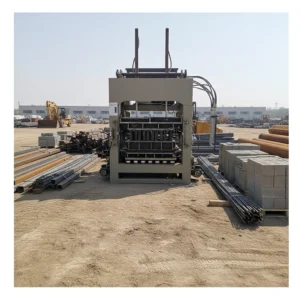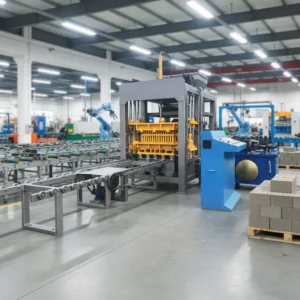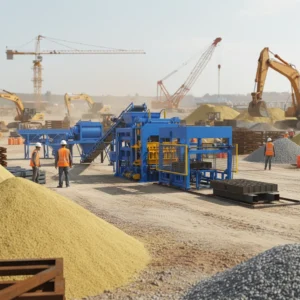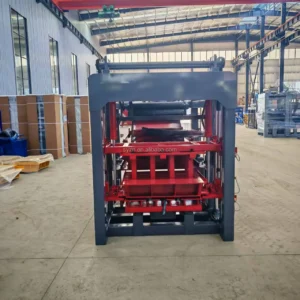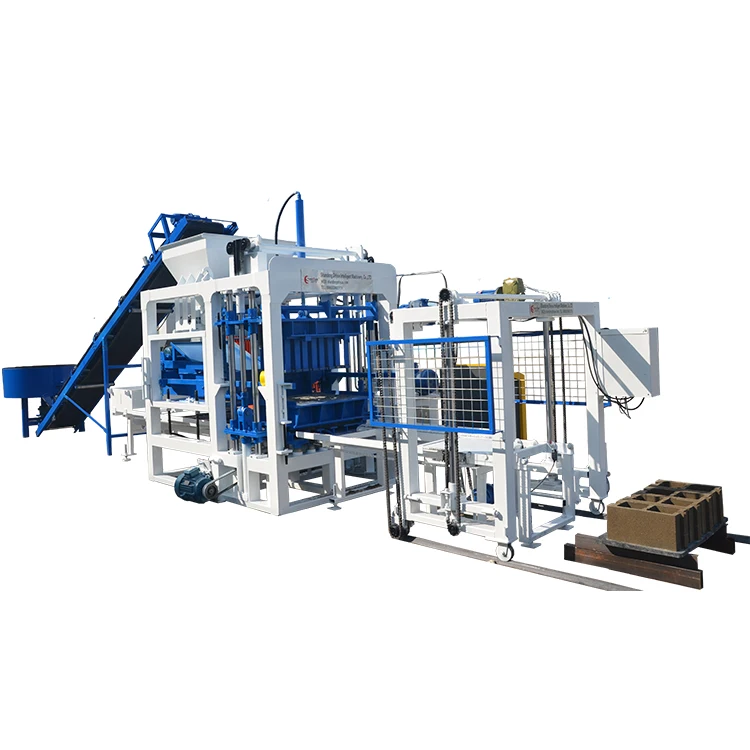
Complete Line Integration — the QT4-15 is positioned as the press at the centre of a matched production line, where raw material feeding, mixing, pallet handling, stacking and curing stations are specified as one system rather than assembled from separate suppliers.
Technical Specifications
| Parameter | Value |
|---|---|
| Model | QT4-15 |
| Product Type | Fully Automatic Concrete Block Making Machine |
| Overall Dimensions (L×W×H) | 4100×1600×2600 mm |
| Rated Pressure | 16-21 MPa |
| Main Vibration Form | Platform Vibration |
| Vibration Frequency | 4200 r/min |
| Vibration Force | 55 KN |
| Pallet Size | 880×550 mm |
| Molding Cycle | 25-30 s (basis not stated in source — confirm block format / material / thickness) |
| Overall Power | 18.45 kW (source value — verify against manufacturer catalog) |
| Total Mass | 4 T |
| Demolding Method | Hydraulic |
| Factory Area | 300 m² |
| Applied Products | Concrete blocks, hollow/solid blocks, pavers, interlocking blocks, curbstone, colored pavers |
| Raw Material | Crushed stone, sand, cement, dust, fly ash, gravel, slag |
| Automation Level | Fully automatic |
| Mould Customization | Available per customer drawings |
| Loading | 1×40HQ container (for basic equipment) |
Application Suitability
| Application | Material or Output |
|---|---|
| Hollow block production | Crushed stone, sand, cement and fly ash |
| Solid block production | Sand, cement, dust and gravel |
| Paving brick production | Sand, cement, slag and colored aggregates |
| Interlocking brick production | Crushed stone, sand and cement |
| Curbstone production | Gravel, sand and cement |
| Colored paver production | Cement, sand and pigment additives |
What a 25-30 Second Cycle Means for Your Line
The automatic block making machine production line only delivers its quoted output when the mixer, pallet feeder and stacking stations are timed to the press.
Quoted cycle times mean nothing if the mixer cannot deliver fresh concrete or the pallet feeder cannot keep up. I have seen plants where the press sat idle waiting for material because the upstream batcher was sized for a smaller machine. The real daily output of this automatic block making machine production line must be calculated per block format before line capacity is committed. [NEED_CITE: production line cycle matching requirements for concrete block plants]
Upstream Stations That Must Match the Press
The automatic block making machine production line starts long before the press. Raw material feeding and mixing stations must deliver a consistent batch within the 25-30 second molding window. If the conveyor is too slow or the mixer capacity is undersized, the press waits — and that idle time compounds across every shift. The QT4-15 needs a mixer and batcher combination that can sustain delivery without bottlenecking the cycle.
Pallet Flow and Curing Area Compatibility
The 880×550 mm pallet size determines what happens downstream. If the buyer’s existing curing racks, forklifts or stacking equipment were designed for a different pallet dimension, the entire handling flow breaks down. Before ordering, confirm that the pallet material, feeding mechanism and return conveyor align with the curing yard layout and available handling equipment within the 300 m² factory area. [NEED_CITE: pallet handling compatibility standards in concrete block production]
Reading the Core Parameters Correctly
Platform vibration at 4200 r/min generates the 55 KN vibration force that compacts the mix, while hydraulic pressure in the 16-21 MPa range shapes and densifies the block. These three values must be balanced against the buyer’s specific mix design and local aggregate — a sand-heavy mix behaves differently from one loaded with fly ash or slag. The 4 T machine mass provides the static weight that keeps vibration energy directed into the mould rather than dissipated into the foundation. Mould customization is available per customer drawings, meaning the QT4-15 can be fitted for any format the buyer’s market actually sells.
The Cost of Mismatched Line Timing
When upstream stations are not sized to the press cycle, the consequences appear quickly. Inconsistent block strength results from batches sitting too long before pressing. Pallet shortages force operators to handle output by hand, eliminating the automation the buyer paid for. A mixer configured for a mix the buyer cannot source locally forces a costly material change after installation. These are not theoretical risks — they are the most common reasons block plants underperform in their first year. [NEED_CITE: common causes of block plant underperformance in first year of operation]
Why Source the Complete Line from One Supplier
Block machinery as a single focus means the QT4-15, moulds, pallets and handling equipment are specified as one matched system. Configuration is set against the buyer’s actual mix design and local aggregate, not a catalogue default. Mould design covers the formats the buyer’s market sells, including custom drawings. Automation level is selectable so a buyer can start semi-automatic and upgrade later. Installation support includes operator training and line timing verification on site.
Documentation & Verification
- Line layout and capacity calculation stating the block format assumed for each cycle time figure
- Machine specification sheet with pallet size and automation level confirmed per buyer requirements
- Mould drawing and format list matching the buyer’s target product range
- Hydraulic and electrical schematic for cabinet placement and cable routing within 300 m²
- Voltage, frequency and PLC display language confirmation recorded before production begins
- Factory test record on the buyer’s specified block format before dispatch
Installation, Commissioning & Support
- 300 m² factory area requires level foundation capable of supporting 4 T machine mass and vibration loads
- 18.45 kW overall power demand needs dedicated circuit with confirmed voltage and frequency before shipment
- Machine dismantled for 1×40HQ container loading with reassembly supervised on site
- Commissioning includes cycle timing verification across all upstream and downstream stations
- Operator training covers mould change procedure and daily maintenance schedule
- Wear parts and mould list provided with recommended replacement intervals
What to Include in Your Inquiry
Provide the specific block formats you intend to produce and your target daily output so capacity can be calculated per format rather than quoted as a generic figure. Confirm your local raw material availability, curing yard dimensions and existing handling equipment so the pallet size and line layout can be matched to your site. State your voltage, frequency and preferred PLC display language to avoid delays after the automatic block making machine production line arrives.
Frequently Asked Questions
Q: How do I verify the 25-30 s cycle time applies to the specific block format I intend to produce?
A: The quoted cycle is a general range and varies by block format, material thickness and mix composition. Request a capacity calculation that states which block format each cycle time figure assumes, so you can compare real daily output against your production targets before committing to the line configuration.
Q: Which upstream stations must match the QT4-15 cycle to prevent the press from idling?
A: The raw material batcher, mixer and conveyor must all deliver a fresh batch within the molding window. If any upstream station is undersized, the press sits idle and daily output drops. Confirm batcher capacity, mixer volume and conveyor speed are all specified against the press cycle, not against a generic plant rating.
Q: Is the 880×550 mm pallet size compatible with my existing curing racks and handling equipment?
A: Compatibility depends on your curing yard layout, rack dimensions and forklift specifications. Before ordering, share your existing pallet handling setup so the pallet feeding mechanism, material choice and return conveyor can be configured to match what you already have on site.
Q: What voltage, frequency and PLC language options need to be confirmed before the line is built?
A: These must be locked in before production starts. Voltage and frequency vary by export market, and the PLC display language must match your operators. Confirming these after the automatic block making machine production line arrives delays commissioning and may require rewiring.
Q: How is raw material feeding, mixing and pallet feeding arranged within the 300 m² factory area?
A: The layout depends on your site shape, raw material storage position and curing yard location. A line layout drawing shows where each station fits, how material flows from batcher to mixer to press, and how pallets circulate — all within the available footprint and ceiling height.