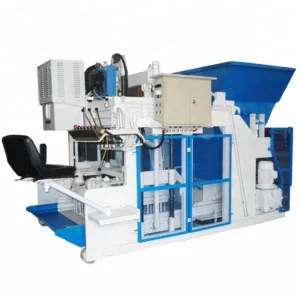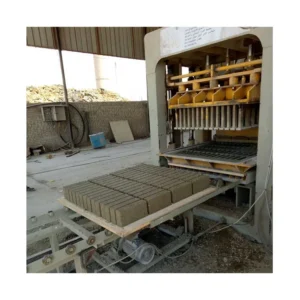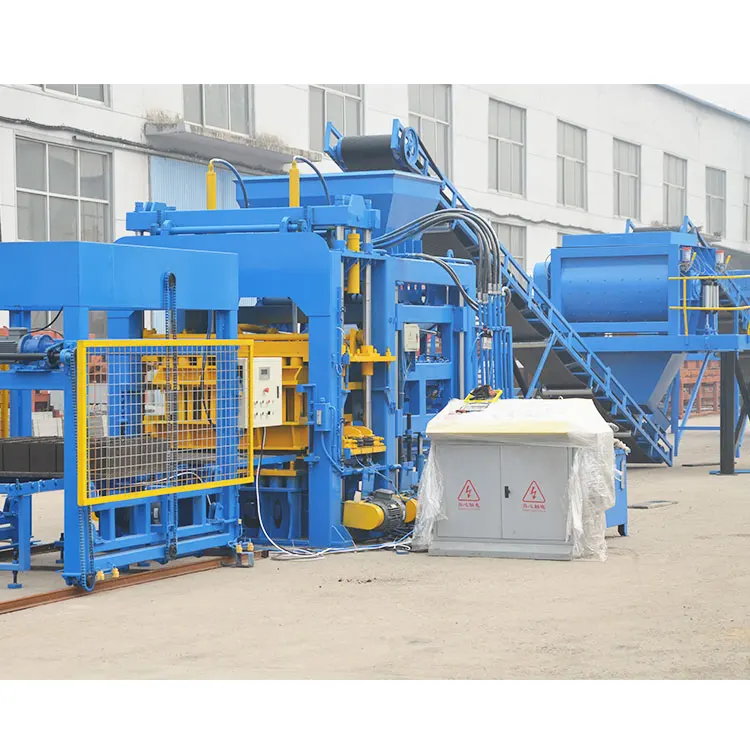
Line-Synchronized Stations — Every station from the PL1200 batcher through the stacker is timed to the QT12-15’s 15-25 s molding cycle so the press never idles waiting for material or pallets.
Technical Specifications
| Parameter | Value |
|---|---|
| Model | QT12-15 |
| Product Type | Automatic Hydraulic Concrete Block Making Machine |
| Overall Dimensions (L×W×H) | 9350 x 2520 x 2950 mm |
| Total Weight | 12000 kgs |
| Rated Hydraulic Pressure | 21 MPa |
| Main Vibration Form | Platform Vibration |
| Vibration Frequency | 2800-4500 r/min |
| Vibration Acceleration | 15-20 g |
| Exciting Force | 120 kN |
| Block Height Range | 50-200 mm |
| Pallet Size | 1350 x 850 mm |
| Molding Cycle | 15-25 s |
| Storage Hopper Volume | 0.4 m³ |
| Feeding Device Volume | 0.31 m³ |
| Total Power | 50.7 kW |
| Control System | PLC controlled (mechanical-hydraulic synthesis) |
| Frame Structure | Gantry frame type, super steel, shock resistant |
| Material Feeding | Net wave swing type feeding device, driving type material storage with independent foundation |
| Mould Type | Cartridge type welding mould, manganese steel (carburizing and quenching) |
| Output — Hollow Block (390×190×190 mm, 12 pcs/mould) | 1720-2160 pcs/h, 13700-17200 pcs per 8h day |
| Output — Porous Block (240×115×90 mm, 35 pcs/mould) | 5040-6300 pcs/h, 40300-50400 pcs per 8h day |
| Output — Standard Block (240×115×53 mm, 62 pcs/mould) | 13100-14800 pcs/h, 105000-119000 pcs per 8h day |
| Compatible Line Equipment | PL1200 batching machine, JS500 or JS750 mixer, 8m conveyor belt, stacker |
| Voltage & Frequency | Confirm with supplier |
| PLC Display Language | Confirm with supplier |
| Automation Level | Automatic (PLC controlled, with stacker in line configuration) |
| Stacking Method | Stacker (line-based) |
Application Suitability
| Application | Material or Output |
|---|---|
| Hollow concrete block production | Crushed stone, sand, cement, fly ash blends for 390×190×190 mm cavity blocks |
| Solid standard brick production | Fine aggregate and cement mixes for 240×115×53 mm masonry units |
| Porous block production | Lightweight aggregate and cement for 240×115×90 mm perforated units |
| Interlock brick production | Graded aggregate blends for dry-stack interlocking formats |
| Cement paving block production | High-strength face mix and base mix for pedestrian and vehicular pavers |
| Fly ash block production | Fly ash, sand, lime, and cement blends for masonry blocks |
Why a Fast Press Still Delivers Slow Output on a Misconfigured Line
The press cycle is only the floor — every upstream and downstream station must match it, or the automatic block machine production line loses thousands of blocks per shift to idle time.
I spent years on sites across the Middle East watching high-capacity presses sit idle for forty seconds between cycles because the mixer could not discharge fast enough or the conveyor dropped material too slowly. A 15-second molding cycle means nothing when the batching station delivers every 55 seconds. The bottleneck simply moves, and daily output falls far below what the quotation promised [NEED_CITE: line synchronization and bottleneck theory in block production].
How Each Station Feeds the Next Without Gaps
The QT12-15 automatic block machine production line pairs the PL1200 batching machine with a JS500 or JS750 mixer, connected by an 8-meter conveyor belt. The mixer must discharge a full batch into the storage hopper within the window the press leaves between fill cycles. When the JS750 is selected, its larger drum handles higher water-content aggregates common in Gulf-region wadi sand without extending the mix time beyond the press rhythm.
Where the Stacker Earns Its Place
Manual pallet handling after the press is where most lines lose their second shift of capacity. The stacker in this turnkey concrete block making plant collects wet blocks on pallets and places them onto curing racks at a rate matched to the press output. Without it, two workers per side can only clear pallets fast enough for roughly half the machine’s cycle speed, and the operator begins skipping cycles to let them catch up [NEED_CITE: manual vs automatic pallet handling throughput in block plants].
Reading the Specs That Actually Shape Your Output
The 21 MPa rated hydraulic pressure works together with the 120 kN exciting force to compact the mix into dense, uniform blocks. Higher vibration frequency (2800-4500 r/min) suits finer mixes like standard brick, while the lower end gives heavier aggregate time to settle in hollow block cavities. The net wave swing feeding device delivers material across the full 1350 x 850 mm pallet in one pass, which matters when the mix includes lightweight aggregate that segregates under gravity feed. Pallet size was chosen to fit standard curing rack dimensions and common 3-ton forklifts, so buyers do not discover after arrival that their existing racks cannot accept the new format.
The Hidden Cost of Stations That Almost Match
A mixer that finishes its cycle three seconds slower than the press expects sounds negligible, but over an eight-hour shift those seconds accumulate into hundreds of lost cycles. I once saw a line where the conveyor belt was too short to reach the storage hopper at the correct angle, causing spillage that required a worker to shovel material back in between every fifth cycle. These are not machine failures — they are specification mismatches that surface only after installation [NEED_CITE: common block line installation mismatches in field reports].
Why This Line Stands Apart
Block machinery is our single focus, so the QT12-15 press, moulds, pallets, and handling equipment are specified as one matched system rather than assembled from separate suppliers. The configuration is set against the buyer’s actual mix design, local aggregate, and target block format instead of a catalogue default. Mould design covers the formats the buyer’s market actually sells, with custom drawings available for non-standard dimensions. Automation level is selectable — a buyer can start with the press and manual pallet handling, then add the stacker when volume justifies it. Installation includes on-site commissioning and operator training so the line runs at rated cycle time from the first production day.
Documentation & Verification
- Line layout drawing showing station connections and capacity per block format
- Machine specification sheet with hydraulic and electrical schematics
- Mould drawing and format list with cycle time per format
- Pallet specification matched to curing area and forklift capacity
- Voltage, frequency, and PLC display language confirmation before production
- Factory test record on buyer’s target block format before dispatch
Installation, Commissioning & Support
- Foundation plan accounts for the 12000 kg total weight and platform vibration load
- Electrical panel requires dedicated circuit matching the 50.7 kW total power draw
- Gantry frame ships assembled; mixer and conveyor dismantle for container loading
- Commissioning includes cycle time verification across all target block formats
- Operator training covers PLC navigation, mould change, and daily maintenance routines
- Wear parts list with first-replacement timeline for moulds and hydraulic seals
What to Include in Your Inquiry
To size the turnkey concrete block making plant correctly, share the block formats your market buys most, the daily volume you need per format, and the local aggregate available — including moisture content and maximum particle size. Confirm your site voltage, frequency, and preferred PLC display language. Let us know the dimensions of your existing curing area and what forklift capacity you have on hand so pallet size can be matched before production begins.
Frequently Asked Questions
Q: How is daily output calculated for each block format?
A: Each capacity figure assumes a specific block dimension and pieces-per-mould count. Hollow block output of 13,700-17,200 pieces per 8-hour day is based on 390×190×190 mm units at 12 per mould. Porous and standard brick figures use their own format assumptions. Real daily output depends on shift length, mould change frequency, and line uptime.
Q: What does the complete line include beyond the press?
A: The automatic block machine production line includes a PL1200 batching machine, JS500 or JS750 mixer, 8-meter conveyor belt, the QT12-15 press, and a stacker. Each station is timed to the 15-25 second molding cycle so material delivery and pallet handling do not create idle gaps at the press.
Q: How is pallet size chosen relative to my curing setup?
A: The 1350 x 850 mm pallet is selected to match standard curing rack spacing and common forklift tine widths. If your existing racks or forklift differ, pallet dimensions can be adjusted during configuration so the new line integrates with your curing area without rack replacement.
Q: Can I add automation stages later?
A: Yes. The QT12-15 can start with semi-automatic pallet handling and add the stacker when production volume grows. The PLC control system supports this upgrade path without requiring a press replacement, keeping initial investment aligned with actual demand.
Q: What voltage and language options should I confirm before shipment?
A: Voltage, frequency, and PLC display language must be confirmed in writing before production begins. The control system supports multiple language options, and electrical components are sourced to match the destination site’s power supply so commissioning proceeds without rewiring or panel swaps.