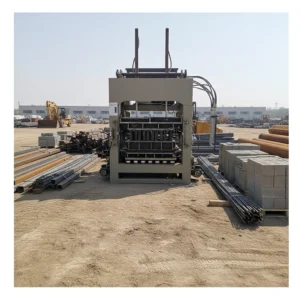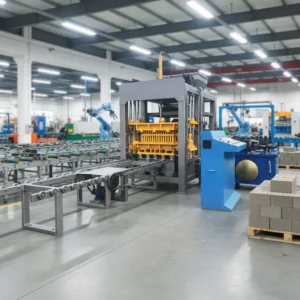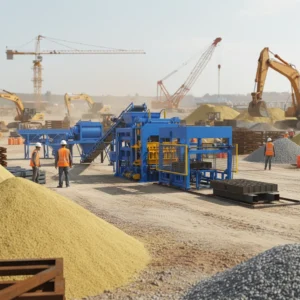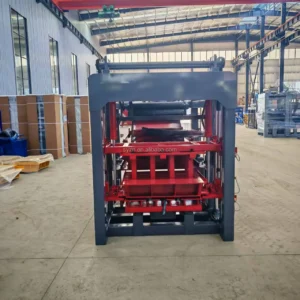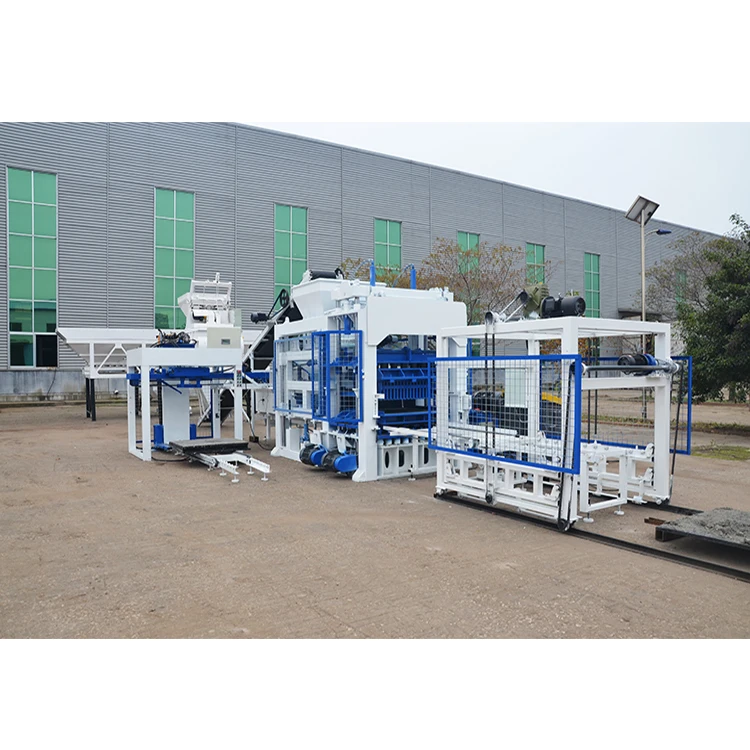
Matched System Engineering — every station from raw material mixing to pallet stacking is coordinated around the QT10-15 press cycle, so no upstream or downstream bottleneck stalls the line during continuous production.
Technical Specifications
| Parameter | Value |
|---|---|
| Model | QT10-15 |
| Product Type | Concrete Block Making Machine |
| Moulding Cycle (Hollow/Solid Bricks) | 15–20 seconds |
| Moulding Cycle (Paving Blocks) | 20–25 seconds |
| Output Capacity (Hollow Block 400×200×200mm) | 1,800–2,400 pcs/hour; 14,400–19,200 pcs/8hr |
| Output Capacity (Hollow Block 400×150×200mm) | 2,160–2,880 pcs/hour; 17,280–23,040 pcs/8hr |
| Output Capacity (Solid Brick 240×115×53mm) | 8,928–11,160 pcs/hour; 71,424–89,280 pcs/8hr |
| Output Capacity (Paving Block 200×100×60mm) | 5,184–6,480 pcs/hour; 41,472–51,840 pcs/8hr |
| Output Capacity (Paving Block 225×112.5×60mm) | 4,032–5,040 pcs/hour; 32,256–40,320 pcs/8hr |
| Vibration Mode | Vertical station mode resonance with automatic FM-AM |
| Hydraulic System | Independent integrated hydraulic station |
| Control System | PLC control cabinet |
| Machine Configuration | Pallet feed machine, block making machine, storage hopper, conveyor, hydraulic unit, PLC control cabinet |
| Mould Change | Quick replacement system for multi-format production |
| Assembly State | Factory assembled; requires on-site installation and commissioning |
| Warranty | 1 year (excluding spare parts) |
| Key Features | Quick mould change, PLC-controlled line coordination, automatic FM-AM vibration, independent hydraulic station |
Application Suitability
| Application | Material or Output |
|---|---|
| Hollow block production | Crushed stone, cement, sand, and water mix for load-bearing and partition blocks |
| Multicellular brick production | Fine aggregate blends for lightweight structural masonry units |
| Paving block production | High-strength concrete mixes for interlocking and pedestrian-grade pavers |
| Standard solid brick production | Dense aggregate and cement blends for facing and common bricks |
| On-site project production | Locally sourced raw materials for housing and infrastructure contractors |
What "1,800 Pieces per Hour" Actually Means on Your Floor
The output figure only holds when the entire concrete block making machine production line is scoped and timed as one system, not as a standalone press.
I have walked onto sites where the press was rated for high throughput but the mixer discharged batches slower than the hopper consumed them, or the pallet return loop could not keep pace. The QT10-15 cycle runs 15 to 20 seconds for hollow and solid formats, and every station around it — feeder, mixer, pallet handler, stacker — must match that tempo. When one upstream or downstream link falls behind, the press sits idle and real daily output drops well below the quoted number [NEED_CITE: line balance and cycle time coordination in block production]. A capacity calculation that does not name the block format and the supporting station speeds is incomplete.
Matching Every Station to the Press Cycle
The pallet feed machine, storage hopper, and conveyor feeding the QT10-15 are each sized against the 15–20 second moulding cycle so that the press never waits for the next pallet or the next batch of mixed material. When you plan a concrete block making machine production line, the bottleneck is rarely the press itself — it is usually the station that was specified without reference to the cycle time of the others. Coordinating these stations on paper before fabrication avoids costly retrofits after commissioning.
Independent Hydraulic Station for Shift-Long Reliability
The hydraulic station on the QT10-15 is physically separated from the host vibration and dust zone. In my field experience, hydraulic valves and seals degrade fastest when vibration and fine cement dust reach them continuously over multiple shifts [NEED_CITE: hydraulic contamination and vibration fatigue in block machine service]. Isolating the station preserves pressure consistency cycle after cycle, which directly affects block density and strength uniformity across the production run.
Reading the Specs That Matter Beyond the Press
The vertical station mode resonance with automatic FM-AM vibration adjusts frequency and amplitude during each cycle, which means the concrete block making machine production line can switch between a dense paving block and a lighter hollow block without manual retuning. The independent hydraulic pressure works together with this vibration to compact the mix uniformly — higher pressure alone without matched vibration leaves density variations across the mould face. The quick mould change system is specified so that a format swap takes minutes rather than hours, preserving the flexibility that a multi-product plant depends on. Pallet size, which is often overlooked in quotations, must align with the curing rack spacing and the forklift capacity the buyer already operates.
The Cost of Overlooking Line-Level Configuration
Quoting a press without the pallet feed, stacking, and curing rack handling leaves the buyer to stack output by hand or source mismatched downstream equipment separately. Pallets specified without regard to the curing area force the buyer to rebuild rack systems or buy a different forklift. Voltage and frequency confirmed too late — after the machine leaves the factory — can strand a line for weeks waiting for a step-down transformer, as I witnessed on a Southeast Asian site where a 380V machine met a 440V/60Hz grid [NEED_CITE: industrial voltage and frequency standards by export market]. These are not minor details; they determine whether the line runs on day one.
Why Buyers Source the Full Line Here
The QT10-15 and its supporting stations are specified as one matched system rather than assembled from separate suppliers, so cycle times, pallet dimensions, and hydraulic ratings are cross-checked before the quotation is issued. Configuration is set against the buyer’s actual mix design and local aggregate, not a catalogue default, which prevents costly material substitutions after arrival. Moulds are designed for the formats the buyer’s market actually sells, with custom drawing support where standard formats do not fit. Voltage, frequency, and PLC display language are confirmed and documented before production begins. Installation support with operator training ensures the line is commissioned correctly on the first attempt.
Documentation & Verification
- Line layout and capacity calculation stating the block format assumed for each output figure
- Machine specification sheet covering press, pallet feeder, mixer, and stacker ratings
- Mould drawing and format list matching the buyer’s product range
- Pallet specification aligned with curing rack dimensions and forklift capacity
- Hydraulic and electrical schematic with confirmed voltage and frequency
- Factory test record on the buyer’s target block format before dispatch
Installation, Commissioning & Support
- Foundation plan sized to the QT10-15 footprint and vibration load requirements
- Dedicated power circuit matching confirmed voltage, frequency, and PLC cabinet draw
- Factory-assembled press dismantled for container loading and reassembled on site
- First-run commissioning with cycle time verification across all line stations
- Operator training covering PLC navigation, mould change, and daily maintenance
- Wear parts and mould list supplied with recommended reorder intervals
Start Your Line Specification
Share your target block formats, the daily output you need, your local raw material source, and your site’s voltage and frequency so we can size each station of the concrete block making machine production line around the QT10-15. Include your existing curing area dimensions and forklift capacity so pallet specifications align from day one.
Frequently Asked Questions
Q: How is line capacity calculated and which block format does each figure assume?
A: Each output figure on the QT10-15 is tied to a specific block dimension and moulding cycle. For example, the 1,800–2,400 pieces per hour rate applies to 400×200×200mm hollow blocks at a 15–20 second cycle. Capacity for other formats is calculated separately and stated alongside the corresponding dimensions.
Q: How do upstream mixing and downstream stacking cycle times match the press?
A: The mixer discharge rate, conveyor speed, pallet feed interval, and stacker cycle are each set against the QT10-15 press cycle of 15–25 seconds depending on format. This coordination is documented in the line layout so no station creates idle time for another.
Q: What pallet size and material are specified, and how do they align with existing equipment?
A: Pallet dimensions are chosen to match both the QT10-15 mould area and the buyer’s existing curing rack spacing and forklift tine width. Material — typically bamboo, PVC, or steel — is selected based on local climate and expected service life.
Q: Is the full line from raw material feeding to cubing included in the quotation?
A: Yes. The quotation scope covers the storage hopper, conveyor, mixer, pallet feed machine, QT10-15 press, hydraulic unit, PLC control cabinet, and downstream stacking equipment. Every station is listed so there are no unquoted gaps in the concrete block making machine production line.
Q: What voltage, frequency, and PLC language options are confirmed before shipment?
A: The buyer’s site voltage, frequency, and preferred PLC display language are confirmed in writing before production starts. This prevents the kind of grid mismatch that can idle a line for weeks while a transformer is sourced locally.