
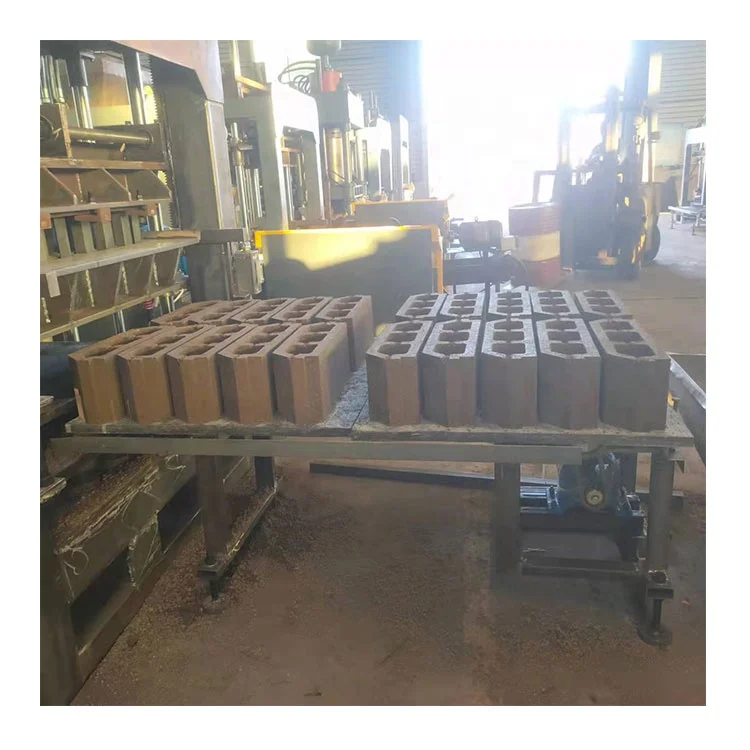
Matched Line Stations — every feeder, conveyor and pallet handler is timed to the QT10-15 press cycle so throughput is not bottlenecked by a missing link around the press.
Technical Specifications
| Parameter | Value |
|---|---|
| Model | QT10-15 |
| Product Type | Automatic Hydraulic Block Making Machine |
| Control System | PLC control cabinet |
| Hydraulic System | Independent integrated hydraulic station |
| Vibration Mode | Vertical station mode resonance, automatic FM-AM |
| Mould Change | Simple replacement (multi-function with one machine) |
| Component Line | Pallet feed machine, block making machine, storage hopper, conveyor, hydraulic unit, PLC control cabinet |
| Output Capacity (400×200×200mm hollow block) | 1800–2400 pcs/hour (15–20s cycle, 10 pcs/mould) |
| Output Capacity (400×150×200mm hollow block) | 2160–2880 pcs/hour (15–20s cycle, 12 pcs/mould) |
| Output Capacity (240×115×53mm solid brick) | 8928–11160 pcs/hour (15–20s cycle, 62 pcs/mould) |
| Output Capacity (200×100×60mm paving block) | 5184–6480 pcs/hour (20–25s cycle, 27 pcs/mould) |
| Output Capacity (225×112.5×60mm interlocking brick) | 4032–5040 pcs/hour (20–25s cycle, 24 pcs/mould) |
| Cycle Time | 15–25s (basis: varies by block format as stated above) |
| Automation Level | Automatic (pallet feeding, material feeding, PLC-controlled) |
| Warranty | 1 year for the whole machine (excluding spare parts) |
| Rated Power | (basis not stated in source — confirm kW rating) |
| Voltage & Frequency | (basis not stated in source — confirm voltage and frequency for target market) |
| Pallet Size | (basis not stated in source — confirm dimensions and material) |
| Mould Change Time | (basis not stated in source — confirm minutes per change) |
Application Suitability
| Application | Material or Output |
|---|---|
| Hollow block production for building walls | Crushed stone, sand, cement and fly ash blends for load-bearing and partition walls |
| Solid brick production for masonry | Dense aggregate mixes for structural and boundary wall masonry |
| Paving block production for roads and walkways | High-strength face mix with base course aggregate for vehicular and pedestrian paving |
| Interlocking brick production for landscaping | Colored or natural aggregate mixes for retaining walls and landscape features |
| Multi-cellular brick production | Lightweight aggregate or aerated concrete mixes for insulation block formats |
Why the Press Keeps Waiting — and How a Synchronized Block Production Line Equipment Layout Fixes It
A press rated for thousands of blocks per hour will deliver only a fraction of that if upstream feeders and downstream pallet handlers are not timed to its cycle.
In my early years on the assembly floor, I watched a QT10-15 class machine sit idle because the pallet feeder ran out of boards while the mixer was still discharging. The operator stood there, the PLC flagged a pallet fault, and the cycle counter stopped. That is how a line rated at 2400 hollow blocks per hour ends up producing fewer than 1500 over a shift. The bottleneck is never the press itself; it is the station that was left out of the quotation or undersized against the press cycle [NEED_CITE: block line station synchronization and cycle time matching].
When buyers ask why their daily tally falls short, the answer almost always traces back to a conveyor that feeds too slowly, a storage hopper that empties between batches, or a pallet stack that cannot keep pace with the automatic feed mechanism. Each of those gaps steals seconds from every cycle, and those seconds compound across a ten-hour shift.
How Station Timing Defines Real Throughput
The QT10-15 completes a moulding cycle in 15 to 25 seconds depending on the block format. Within that window, the storage hopper must discharge a measured charge into the mould box, the hydraulic station must reach full pressure, the vibration table must run its programmed FM-AM sequence, and the pallet feeder must advance the next board into position. If any one of those events finishes late, the PLC holds the press at the start of the next cycle. A turnkey block making system must therefore specify every station’s response time, not just the press cycle.
What Gets Left Out When Only the Press Is Quoted
Many quotations list the block making machine and nothing else. The pallet feed machine, conveyor, hydraulic unit and PLC cabinet are treated as optional extras. Yet the QT10-15 component line is designed as a set: the pallet feeder board dimensions match the mould footprint, the conveyor speed matches the demoulding rate, and the hydraulic station sits independently to avoid vibration transfer. When those elements are sourced separately, the buyer becomes the system integrator, and integration errors show up as lost cycles [NEED_CITE: risks of sourcing block line components from separate suppliers].
Reading the Specs That Matter for Line Balance
The independent integrated hydraulic station isolates the oil circuit from the vibration table, keeping valve response consistent across long shifts and reducing the chance of a slow-acting solenoid delaying the next press stroke. The vertical station mode resonance with automatic FM-AM vibration adjusts amplitude and frequency per mould format, so the same machine can move from a dense paving block to a lighter hollow block without a manual retune. The PLC control cabinet sequences pallet feed, material charge, press cycle and conveyor discharge as one timed loop, meaning the operator monitors rather than triggers each station. Pallet size must be confirmed against the buyer’s existing curing racks and forklift tine width before production starts, because a mismatch there will slow the curing end of the line even if the press runs at full pace.
The Hidden Cost of an Undersized Feeder Station
A storage hopper that holds only one batch forces the mixer to discharge more often than the press can consume, leading to material segregation in the hopper and inconsistent block density from first to last brick in the batch. A conveyor belt narrower than the hopper gate causes spillage that builds up under the frame, requiring mid-shift cleanup stops. These are not press failures; they are line design failures, and they account for a noticeable share of lost output on sites where the block production line equipment was specified station by station instead of as a matched set [NEED_CITE: material segregation effects on block density consistency].
Why Buyers Source the Full Line from One Supplier
The QT10-15 line is specified so that the pallet feeder, storage hopper, conveyor and hydraulic unit are matched to the press cycle at the quotation stage, not assembled on site from separate purchase orders. Configuration is set against the buyer’s actual mix design and local aggregate, meaning the hopper gate opening and conveyor speed are calculated for that specific material flow. Mould design covers the formats the buyer’s market sells, and the PLC program is written with those formats pre-loaded so cycle time and vibration profile switch automatically. Automation level is selectable, allowing a buyer to start with semi-automatic pallet handling and add stacking later. Installation support includes operator training on the full line, not just the press, so the team understands how each station’s timing affects the next [NEED_CITE: block machinery manufacturer matching line stations to buyer mix design].
Documentation & Verification
- Line layout drawing showing every station from raw material hopper to curing rack exit
- Capacity calculation sheet stating the block format and cycle time assumed for each output figure
- Pallet specification matched to buyer’s curing area dimensions and forklift capacity
- Voltage and PLC display language confirmation signed off before production begins
- Hydraulic and electrical schematic for the buyer’s site electrician to prepare conduits and breaker panels
- Factory test record running the buyer’s selected block format through the full station sequence
Installation, Commissioning & Support
- Foundation drawing issued before shipment so concrete pads cure to full strength before the QT10-15 arrives
- Independent hydraulic station placed away from the vibration table to maintain oil circuit stability
- PLC cabinet wired to the buyer’s confirmed voltage and frequency with display language set before dispatch
- First production run supervised on site with cycle time verified at each station against the layout drawing
- Operator training covers mould change procedure, hopper refill timing and pallet feeder board loading
- Wear parts list provided with part numbers for hydraulic seals, vibration springs and mould liners
What to Include in Your Inquiry
To size the block production line equipment correctly, share the block formats you sell most, your target daily output per format, and the raw materials available locally including aggregate gradation. Confirm your site voltage, frequency and preferred PLC display language. If you already have curing racks and forklifts, send their dimensions so pallet size can be matched before the line is built.
Frequently Asked Questions
Q: How are cycle times matched across stations so the press is never left waiting for pallets or material?
A: Each station’s response time — pallet advance, hopper gate open-close, conveyor travel — is calculated against the QT10-15 press cycle of 15 to 25 seconds. The PLC sequences all events in one timed loop, and the factory test runs the full sequence on the buyer’s selected format before dispatch.
Q: Which stations are included in the quotation and which are optional add-ons?
A: The standard QT10-15 component line includes the pallet feed machine, block making machine, storage hopper, conveyor, hydraulic unit and PLC cabinet. Stacking and cubing systems are configurable additions, allowing buyers to start semi-automatic and expand later.
Q: How does pallet size selection affect curing rack capacity and forklift compatibility on site?
A: Pallet dimensions determine how many boards fit on each curing rack tier and whether the buyer’s existing forklift tines can lift a loaded rack. We confirm pallet size against the buyer’s rack spacing and forklift capacity before the pallet feeder is built.
Q: What raw material feed configuration is needed to keep up with the press at maximum cycle rate?
A: The storage hopper volume and conveyor speed are calculated from the buyer’s mix density and the press cycle time for the target format. A heavier mix like paving block requires a wider hopper gate and faster conveyor than a lighter hollow block blend.
Q: Can the line start semi-automatic and add full stacking and cubing later?
A: Yes. The PLC program is written with upgrade paths, and the conveyor discharge end is designed to accept an automatic stacker when the buyer is ready. The pallet feeder and press stations remain unchanged during the upgrade.



