
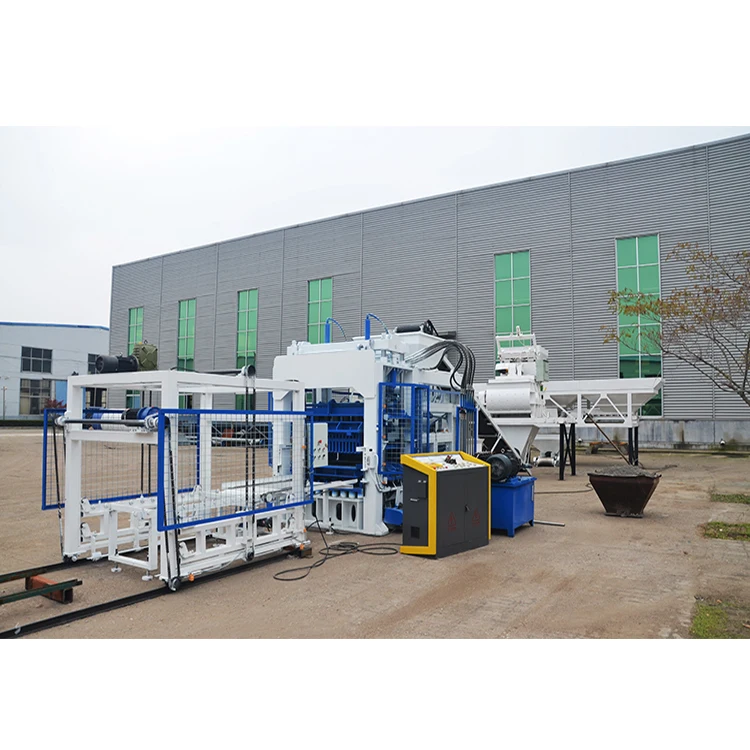
Line-matched supporting equipment — every station from raw material feeding through curing rack handling is sized against the QT10-15 press cycle so the automatic block making machine production line never idles waiting for pallets or mix.
Technical Specifications
| Parameter | Value |
|---|---|
| Product Type | Automatic Concrete Block Making Machine |
| Model | QT10-15 |
| Moulding Cycle | 15–20s (hollow/solid bricks), 20–25s (paving blocks) |
| Output Capacity (Hollow Block) | 1,800–2,400 pcs/h (basis: 400×200×200mm, 10 pcs/mould) |
| Output Capacity (Hollow Block) | 2,160–2,880 pcs/h (basis: 400×150×200mm, 12 pcs/mould) |
| Output Capacity (Solid Brick) | 8,928–11,160 pcs/h (basis: 240×115×53mm, 62 pcs/mould) |
| Output Capacity (Paving Block) | 5,184–6,480 pcs/h (basis: 200×100×60mm, 27 pcs/mould) |
| Output Capacity (Interlocking Block) | 4,032–5,040 pcs/h (basis: 225×112.5×60mm, 24 pcs/mould) |
| Control System | PLC control cabinet |
| Hydraulic System | Independent integrated hydraulic station (isolated from host vibration and dust) |
| Vibration System | Vertical station mode resonance with automatic FM-AM |
| Line Components | Pallet feed machine, block making machine, storage hopper, conveyor, hydraulic unit, PLC control cabinet |
| Mould Change | Quick mould replacement for multi-format production |
| Automation Level | Automatic |
| Warranty | 1 year (excluding spare parts) |
| Hydraulic Pressure | (basis to be confirmed) |
| Vibration Force | (basis to be confirmed) |
| Pallet Size | (basis to be confirmed) |
| Overall Dimensions | (basis to be confirmed) |
| Net Weight | (basis to be confirmed) |
| Rated Power | (basis to be confirmed) |
| Voltage & Frequency | (basis to be confirmed) |
Application Suitability
| Application | Material or Output |
|---|---|
| Hollow Block Production | Crushed stone, cement, sand, fly ash aggregates |
| Solid and Multicellular Brick Production | Concrete mix, quarry dust, gravel blends |
| Paving Block Production | High-density concrete mixes for interlocking and rectangular pavers |
| Interlocking Block Production | Standard concrete mixes with local aggregate variations |
| Block and Paver Production Plants | High-volume daily output across multiple formats |
| Construction Contractors Producing On-site | Local aggregate and cement adapted to project specifications |
| Housing Project Contractors Producing Locally | Consistent supply of structural and partition blocks on-site |
What "Pieces per Hour" Hides About the Rest of the automatic block making machine production line
The press cycle only sets the upper limit; the supporting stations decide whether you ever reach it.
I have seen QT10-15 class presses installed with mixers that could not deliver fresh batch in time, leaving the host waiting empty for minutes at a stretch. The rated cycle means nothing when the pallet feeder is slower than the press, or when the stacking station forces the operator to clear blocks by hand [NEED_CITE: line balance engineering for block plants]. Quotations that list only the press capacity often leave the buyer discovering on day one that pallet handling, stacking, and curing rack transfer were never part of the deal.
How Each Station Must Match the QT10-15 Press Cycle
The pallet feed machine, storage hopper, and conveyor must deliver materials within the 15–25 second moulding cycle window. If the mixer batch cycle is longer than the press consumption rate, the automatic block making machine production line stalls. PLC coordination across all stations keeps the pallet inventory circulating without the operator manually intervening between cycles.
Where the Line Loses Output Without Visible Downtime
Small mismatches accumulate silently. A conveyor that delivers mix three seconds late per cycle adds up to hundreds of missed cycles across a shift. Pallets returning from the curing area slower than the press ejects finished blocks create a queue that the PLC cannot resolve without a buffer station. Line-level capacity planning must account for every transfer point, not just the press [NEED_CITE: pallet circulation and buffer design in block lines].
Reading the Specifications That Actually Matter
The independent integrated hydraulic station sits away from the press vibration and dust, which protects valve life across continuous shift operation. Vertical station mode resonance with automatic FM-AM adjustment means the vibration adapts as mix consistency drifts through the day — critical for maintaining block density when local aggregate moisture varies. Quick mould replacement allows format changeover within a single shift, so switching from 400×200×200mm hollow blocks to 200×100×60mm paving blocks does not cancel an entire production run. The PLC control cabinet coordinates pallet feeding, block forming, conveyor transfer, and stacking as one sequence.
The Cost of Skipping Line-Level Planning
Buyers who source the press alone and add supporting equipment later often discover that the pallet size specified for the QT10-15 does not match the curing racks already on site. Forklifts cannot handle the loaded pallets, and manual restacking doubles the labour requirement [NEED_CITE: pallet and curing area mismatch in block plants]. Voltage and PLC display language left unconfirmed before production can delay commissioning for weeks after the line arrives.
Why Sourcing the Full Line Here Reduces Integration Risk
Block machinery is our single focus, so the press, moulds, pallets, and handling equipment are specified as one matched system rather than assembled from separate suppliers. Configuration is set against the buyer’s actual mix design, local aggregate, and target block format — not a catalogue default. Mould design covers the formats the buyer’s market actually sells, including custom drawings. The automation level is selectable so a buyer can start semi-automatic and add stacking or cubing later. Installation support includes operator training at the buyer’s site.
Documentation & Verification
- Line layout drawing with capacity calculation stated per block format assumed
- Cycle time matching document across every station in the production loop
- Pallet specification aligned to buyer’s curing area dimensions and forklift rating
- Mould drawing and format list covering all planned block types
- Voltage, frequency, and PLC display language written confirmation before production
- Factory test record on buyer’s specified block format before dispatch
Installation, Commissioning & Support
- Foundation plan provided based on QT10-15 overall dimensions and net weight
- Power supply specification covering rated power, voltage, and dedicated circuit requirements
- Machine dismantling for container loading with reassembly sequence documented
- First-run commissioning with PLC parameter tuning to buyer’s mix design
- Operator training covering mould change, daily maintenance, and fault response
- Wear parts list with hydraulic seal and vibration motor replacement intervals
What to Include in Your Inquiry
To size the full line accurately, provide your target block formats with daily output targets, the local raw materials and aggregate you plan to use, and the curing area dimensions you have available. Confirm your site voltage, frequency, and preferred PLC display language. Let us know which supporting stations — mixer, pallet feeder, automatic stacking, curing rack handling — you need included and which you already have on site.
Frequently Asked Questions
Q: How is the daily output of the full line verified per block format?
A: We provide a line layout with capacity calculations stated for each specific block format — for example, 1,800–2,400 pieces per hour based on 400×200×200mm hollow blocks at ten per mould. The calculation accounts for the mixer batch cycle, pallet feed rate, and stacking speed so no station becomes a bottleneck.
Q: Which supporting stations must be matched to the press cycle time?
A: The mixer, pallet feed machine, conveyor, and stacking station must all deliver within the 15–25 second moulding cycle. The PLC coordinates these stations, but each one must be physically capable of matching the QT10-15 throughput. A slower mixer or pallet return conveyor will reduce the actual output below the press rating.
Q: What pallet size does the line require and how does it relate to the curing area?
A: Pallet size is selected to match both the QT10-15 press table and the buyer’s existing curing racks and forklift capacity. We confirm pallet dimensions and material during the configuration stage so that loaded pallets move from press to curing area and back without manual restacking or equipment incompatibility.
Q: How are voltage, frequency, and PLC language confirmed before shipment?
A: These are confirmed in writing during the quotation stage before production begins. The PLC control cabinet is built to the buyer’s specified voltage and frequency, and the display language is set to the operator’s preference. This prevents commissioning delays after the line arrives on site.
Q: What is the lead time for a complete line order including supporting equipment?
A: Lead time depends on the configuration scope — a press-only order ships faster than a full line with custom moulds, pallet inventory, and automatic stacking. We quote the dispatch lead time upfront once all stations are confirmed, and provide container loading plans so the buyer can plan arrival and foundation work.



