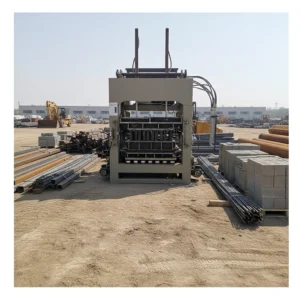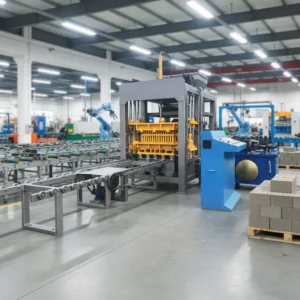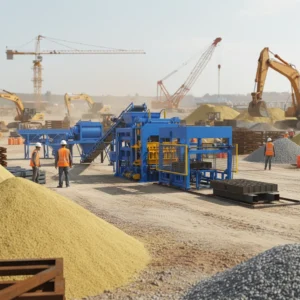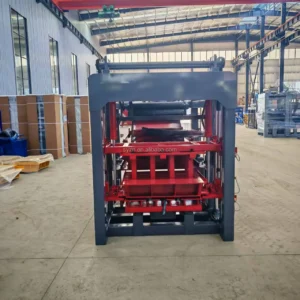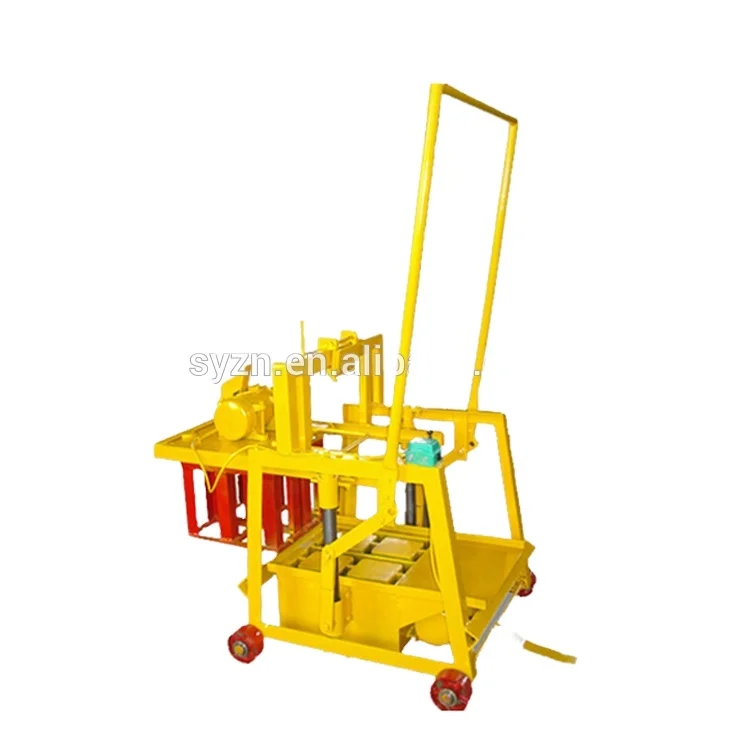
Single-Focus Line Design — every station from mixer to curing rack is sized against the QMJ2-45 cycle time so the press never waits for upstream feed or downstream pallet removal.
Technical Specifications
| Parameter | Value |
|---|---|
| Model | QMJ2-45 |
| Product Type | Manual Hollow Block Making Machine |
| Machine Power | 1.5 kW |
| Exciting Power | 2 vibrators per mould |
| Molding Cycle | 45 seconds |
| Theoretical Output (400×200×200 mm hollow block) | 2 pcs/mould, approx. 150 pcs/h, 1 200 pcs per 8-hour shift |
| Theoretical Output (400×150×200 mm hollow block) | 3 pcs/mould, approx. 220 pcs/h, 1 760 pcs per 8-hour shift |
| Voltage | Configurable to local supply |
| Machine Weight | 400 kg |
| Overall Dimensions | 1 300 × 1 300 × 1 150 mm |
| Automation Level | Semi-automatic |
| Key Features | Top die push-pull, automatic scraper, bed mould vertical vibration, upper mould compression vibration |
Application Suitability
| Application | Material or Output |
|---|---|
| Small-scale hollow block production | Crushed stone, sand, cement, water |
| On-site masonry block manufacturing | Fly ash, lime, gypsum blends |
| Contractor self-supply for housing projects | Locally sourced aggregate and cement |
| Start-up block plant with phased expansion | Concrete mixes with standard grading |
Why the Mixer Capacity Question Beats the Press Price
A 45-second cycle means nothing if the mixer delivers one batch every three minutes.
I spent years on the assembly floor before moving into line configuration, and the most common call I get is from buyers whose press sits idle half the shift. The QMJ2-45 completes a mould every 45 seconds, so it needs a fresh batch roughly every two minutes when running 400×200×200 mm hollow blocks. If the upstream pan mixer is undersized, the press operator simply stands there watching an empty hopper. That idle time is never reflected in the brochure output figure [NEED_CITE: common causes of block line throughput shortfalls]. Matching block production line equipment to a mixer that can deliver on that cadence is the first calculation I do before anything else.
Upstream Feed and Mixer Synchronization
The QMJ2-45 draws from a concrete mix that must arrive consistently graded and moist enough to hold shape under vibration yet dry enough to strip cleanly. A pan mixer rated for one batch every 90 to 120 seconds keeps the hopper charged without flooding it. When I lay out a block production line equipment plan around this press, the mixer drum capacity and discharge height are checked against the press feed opening so no manual shoveling bridges the gap.
Downstream Pallet Flow and Curing Handoff
Every 45 seconds a loaded pallet exits the press. If a worker is carrying pallets by hand to the curing yard, fatigue sets in within the first hour and the rhythm breaks. Even at this entry level, specifying a simple roller conveyor or a pallet return loop means the operator focuses on mould changes rather than lifting. The curing rack spacing must accept the QMJ2-45 pallet footprint so no re-stacking happens before the blocks gain initial set [NEED_CITE: pallet handling best practices for small block plants].
Vibration and Pressure Balance for Block Density
This press pairs vertical bed vibration with upper mould compression vibration. The two forces must be tuned to the specific mix. A high-fly-ash blend needs longer vibration to consolidate, while a coarse crushed-stone mix reaches density faster. Getting that balance wrong shows up as crumbling corners or hollow cores that fail the drop test. I always ask buyers for their local aggregate source and a sample mix before we lock in the vibration timer settings.
Reading the Spec Sheet Beyond the Headline Numbers
The 1.5 kW main drive and twin vibrator motors are modest by industrial standards, which suits a small plant running on a limited grid connection. The 400 kg machine weight means the QMJ2-45 can be bolted to a standard concrete pad without a reinforced foundation pit. Pallet size is dictated by the mould frame; specifying pallets that match the buyer’s existing curing racks and forklift tine spacing avoids a second capital outlay on handling gear. Voltage is wound to the buyer’s local supply before dispatch, so the control panel powers up on arrival rather than waiting for a transformer [NEED_CITE: voltage and frequency standards by export market].
The Cost of Skipping Line Integration
Buyers who order the press alone and source the mixer, conveyor, and pallets separately often discover mismatched cycle times on the first production day. The mixer runs too slow, the conveyor is too narrow for the pallet, or the curing racks are five centimetres short. Each mismatch chips away at the theoretical daily output until the shift ends with a fraction of the promised count. Those hidden losses far outweigh the line-discount a single-supplier quotation might carry [NEED_CITE: total cost of ownership in block production].
Why Source the Whole Line from One Supplier
Block machinery is our single focus, which means the QMJ2-45 is never sold as a standalone island. We configure the mixer discharge, pallet feeder, and stacking station around the 45-second cycle so each hand-off is timed. Mould design covers the hollow, solid, and paving formats the buyer’s market actually sells, including custom drawings when a local specification calls for a non-standard web thickness. Automation level is selectable: a buyer can start with manual pallet handling and bolt on an automatic stacker later without replacing the press. Installation support includes operator training on vibration tuning, mould change procedure, and daily greasing points. Factory test records document output on the buyer’s chosen block format before the crate is sealed.
Documentation & Verification
- Line layout drawing showing QMJ2-45 station positions and cycle-time hand-offs
- Capacity calculation sheet naming the exact block format behind every output figure
- Voltage and PLC language confirmation signed off before winding begins
- Factory test record with block count, dimension check, and density sample
- Hydraulic and electrical schematic matching the as-built press
- Packing photographs documenting pallet and mould condition at crate closure
Installation, Commissioning & Support
- 1 300 × 1 300 mm footprint requires a level concrete pad with anchor bolts, no special pit
- 1.5 kW drive plus twin vibrators need a dedicated 3-phase breaker sized to local code
- Press ships partially assembled; mould and hopper bolt on within one shift
- First-run commissioning verifies 45-second cycle with the buyer’s actual mix
- Operator training covers vibration timer adjustment, scraper clearance, and mould swap
- Wear parts list identifies vibrator mounts and scraper blades for initial spares order
What to Share Before Requesting a Quotation
Send the block format you sell most, the daily piece count you need to hit, and the aggregate available within hauling distance of your yard. Include your site voltage and frequency, plus any mixer or pallet system already in place so the block production line equipment we propose plugs straight in.
Frequently Asked Questions
Q: How does the 45-second cycle translate to daily output when the mixer and stacking are factored in?
A: The 45-second mould cycle assumes the mixer delivers a fresh batch every 90 to 120 seconds and a worker or conveyor removes the loaded pallet before the next press stroke. If either station lags, real output drops. We calculate daily capacity on the specific block format and confirm it in the factory test record before shipment.
Q: What pallet size does the QMJ2-45 use, and will it fit my curing racks?
A: Pallet dimensions are set by the mould frame. We confirm pallet length, width, and thickness against your existing curing rack slots and forklift tine spacing before production starts. Mismatched pallets are one of the most common reasons new plants lose output in the first week.
Q: Can I start with manual pallet handling and add automatic stacking later?
A: Yes. The QMJ2-45 is designed so an automatic pallet feeder and stacker can be bolted on when volume justifies the investment. The press frame and control panel remain unchanged; only the downstream conveyor and stacking module are added, keeping the original capital working.
Q: Which block formats can this press produce within its vibration and mould limits?
A: Hollow blocks in 400×200×200 mm and 400×150×200 mm are standard. Solid blocks and thinner paving formats are possible if the mould is engineered within the press’s vibration force and platen area. We review the target format and mix before confirming feasibility.
Q: What supporting equipment must be on site before the press arrives?
A: A pan mixer with batch capacity matched to the 45-second cycle, a level concrete pad with anchor bolts, a dedicated 3-phase power circuit at the confirmed voltage, and pallets cut to the specified size. We provide a pre-arrival checklist covering each item so commissioning starts on day one.