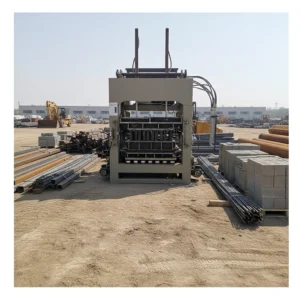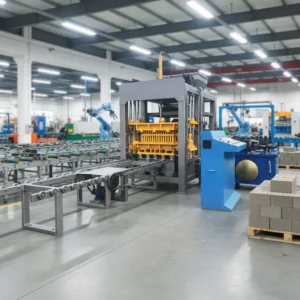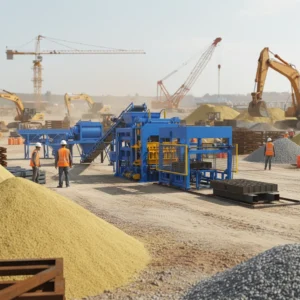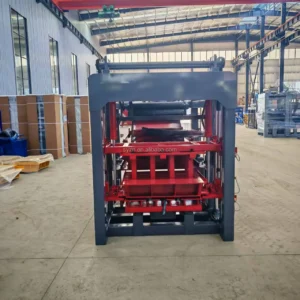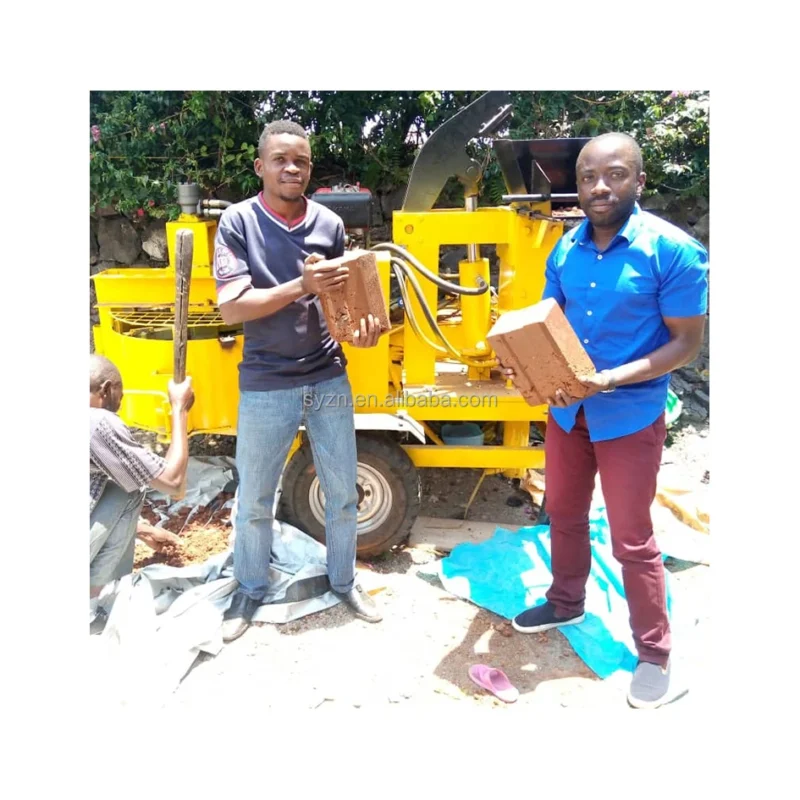
Matched Line Design — Raw material feeding, mixing, moulding, pallet handling and curing stations specified as one coordinated system around the M7MI so the press is never left waiting.
Technical Specifications
| Parameter | Value |
|---|---|
| Model | M7MI |
| Product Type | Hydraulic Interlocking Clay Block Making Machine |
| Engine | Diesel Engine |
| Rated Power | 7.5 kW |
| Hydraulic Pressure | 16 MPa |
| Molding Cycle | 15–20 s |
| Output Capacity | 2200 pcs/day (8 hours) (basis not stated in source — confirm block format / material / thickness) |
| Productivity Detail | 300×150×100 mm block, 20 s cycle, 1 pc/mould, 200 pcs/h, 1600 pcs/8 hr (source value — verify against manufacturer catalog) |
| Raw Material | Clay, soil, or concrete |
| Mould Format | Interlocking block (multiple formats by changing moulds) |
| Automation Level | Mobile / manual operation |
| Power Source | Diesel (suitable for sites without electricity) |
| Overall Dimensions (L×W×H) | 3200 × 1100 × 1500 mm |
| Net Weight | 1100 kg |
| Key Features | Mobile chassis, diesel power unit, manual pallet handling, hydraulic press with vibration |
Application Suitability
| Application | Material or Output |
|---|---|
| On-site interlocking block production | Clay and soil mixes for housing walls |
| Rural or off-grid building projects | Diesel-powered operation without stable grid electricity |
| Small-scale local material supply | Concrete or clay interlocking bricks for sale to contractors |
| Development project wall construction | Soil-based interlocking bricks matching local aggregate availability |
Why the Voltage Question Should Come Before the Price on an Interlocking Clay Block Making Machine Production Line
Confirming your power source and control specifications before the quotation avoids weeks of idle equipment on site.
I have seen hydraulic interlocking clay block making machine production line units arrive at remote project sites only to discover the local three-phase supply does not match the motor rating on the nameplate. When a diesel-powered mobile unit is specified, the voltage question shifts to supporting equipment — mixers, conveyors, and curing rack fans still need grid or generator power matched to local frequency standards [NEED_CITE: voltage and frequency standards by export market]. A machine sitting uncommissioned while electricians rewire a control panel burns through a project schedule faster than any production delay.
Matching Upstream Mixing to the M7MI Cycle Time
The interlocking clay block making machine production line must keep material flowing into the M7MI hopper at a rate that matches the 15–20 second moulding cycle. If the pan mixer batches are too small or the discharge is too slow, the press idles between cycles and daily output drops noticeably. We calculate mixer batch volume and discharge timing against the mould cavity count and cycle duration so that fresh mix is always available when the operator initiates the next press stroke.
Downstream Pallet Handling and Curing Layout
Manual pallet handling on a mobile unit means operators carry loaded pallets to the curing area by hand. The interlocking clay block making machine production line layout must position curing racks close enough to minimise walking distance while leaving room for the machine to reposition along the work face. Pallet dimensions, rack spacing, and curing area capacity should be confirmed before the line is installed, not improvised after the first production run [NEED_CITE: curing conditions for clay-soil interlocking blocks].
Hydraulic Pressure, Vibration, and Block Density
The 16 MPa hydraulic pressure on the M7MI works together with the vibration system to compact the clay-soil or concrete mix inside the mould cavity. Higher pressure forces particles closer together, reducing voids and increasing green strength so blocks can be demoulded without cracking. The vibration frequency must suit the aggregate gradation in the buyer’s local soil — a fine clay mix responds differently than a sandy soil with larger particle sizes, and the pressure setting may need adjustment to achieve consistent density across every block.
Diesel power removes the dependency on grid electricity, which matters for housing projects in areas where three-phase supply is unavailable or unreliable. The 7.5 kW rated output covers the hydraulic pump and vibration motor simultaneously, but supporting equipment such as the mixer and any pallet return conveyor must be powered separately — either from a generator set or from local mains if available.
What Happens When Line Stations Are Mismatched
If the mixer output exceeds what the M7MI can press, wet material sits in the hopper losing workability and eventually clogs the feed. If the curing area is too small, fresh blocks pile up on the ground before the previous batch has gained enough strength to stack. These mismatches are not visible in a catalogue specification sheet — they only appear once production starts and bottlenecks force operators to slow the entire interlocking clay block making machine production line down [NEED_CITE: production line bottleneck analysis in concrete block plants].
Why Buyers Source the Full Line Here
Shiyue configures the M7MI as part of a matched system rather than selling the press as a standalone unit. The mixer capacity, pallet size, curing rack layout, and handling equipment are all specified together against the buyer’s actual site conditions and target block format. Mould design covers the interlocking profiles the buyer’s local market demands, including custom drawings when standard formats do not match. Automation level is selectable — a buyer can begin with manual pallet handling and add semi-automatic stacking later as production volume grows. Factory testing runs the complete line with the buyer’s specified mix before dispatch, so commissioning on site is limited to connection and calibration rather than troubleshooting.
Documentation & Verification
- Line layout drawing showing station spacing and pallet flow path for your site dimensions
- Capacity calculation sheet stating the block format and cycle time assumed for output figures
- Mould drawing with interlocking profile dimensions and cavity count per format
- Diesel engine specification sheet with fuel consumption and maintenance intervals
- Hydraulic and electrical schematic for on-site troubleshooting and spare parts ordering
- Factory test record on your specified clay-soil mix before machine dispatch
Installation, Commissioning & Support
- Level ground area of approximately 3.2 m length plus curing space for mobile positioning
- Diesel fuel supply and separate power circuit for mixer and any conveyor motors
- Machine arrives assembled on chassis; wheels and tow bar fitted for site repositioning
- First-run parameter setting for hydraulic pressure and vibration matched to your mix design
- Operator training covering mould change procedure, cycle timing, and daily maintenance checks
- Wear parts and mould inventory list provided with first replacement availability confirmed
What We Need to Configure Your Line
Tell us the interlocking block format your local market sells and the daily volume you need to sustain your project schedule. Share your local clay or soil characteristics and whether you have grid electricity available for supporting equipment. We also need your existing curing area dimensions and any forklift or pallet handling equipment already on site so the line layout fits your actual conditions.
Frequently Asked Questions
Q: How is the 2200 pcs/day capacity calculated and which block format does it assume?
A: The 2200 pcs/day figure is quoted without a stated block format or material basis in the source data. Actual output depends on the interlocking profile size, moulding cycle achieved with your specific mix, and whether upstream mixing keeps pace. We provide a capacity calculation for your exact block format during the proposal stage.
Q: What supporting equipment is needed to keep the M7MI running without idle time?
A: A pan mixer sized to match the mould volume and cycle time, pallets in the correct dimensions for your curing racks, and a curing area with enough capacity for daily output. Optional pallet return conveyors reduce manual carrying distance on larger production runs.
Q: Can the M7MI line be upgraded from manual pallet handling to semi-automatic stacking later?
A: Yes. The M7MI can start with manual pallet handling and be upgraded with an automatic pallet feeder and stacking station as production volume grows. The upgrade path is planned during initial line layout so foundation and spacing accommodate future additions.
Q: How do clay-soil mix design and local aggregate affect hydraulic pressure and block strength?
A: Fine clay retains more moisture and compacts differently than sandy soil with larger particles. The 16 MPa hydraulic pressure must be matched to your mix so that blocks achieve target density without cracking during demoulding. We test your actual material during factory trials to set the correct pressure.