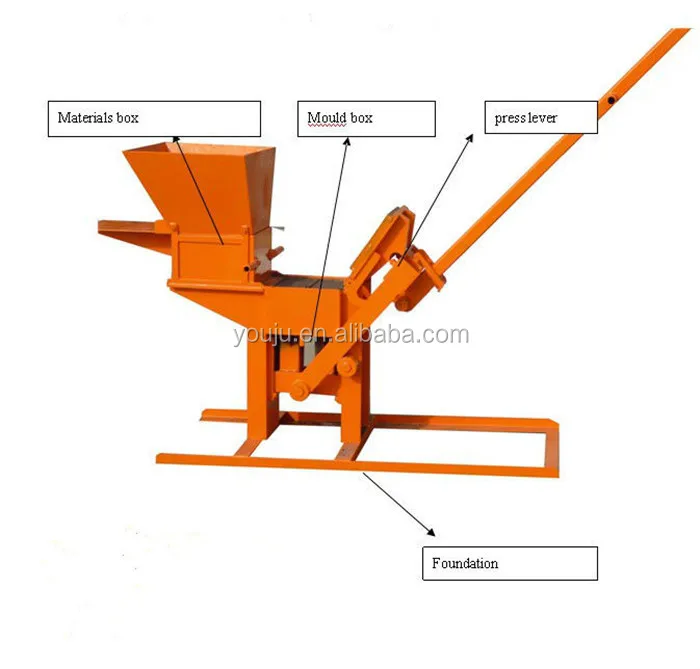
Line Cycle Synchronization — the LY2-40 manual clay brick press is specified alongside its mixer and curing stations so the forming cycle is never starved of material or left waiting for pallets.
Technical Specifications
| Parameter | Value |
|---|---|
| Model | LY2-40 |
| Product Type | Manual Clay Interlocking Brick Making Machine |
| Operation Type | Completely Manual (No Power Required) |
| Lifting System | Manual |
| Mobility | Steel wheel mobile device |
| Mould System | Changeable for various block formats |
| Overall Dimensions (L×W×H) | 1600 × 700 × 1200 mm |
| Total Mass | 200–240 kg |
| Molding Cycle | 30–40 s |
| Output Capacity | 400–1000 pcs/day (basis not stated in source — confirm block format and material) |
| Basic Equipment (Optional Mixer) | JFA-1 Mixer or JQ350 Mixer |
| Warranty | 1 Year |
Application Suitability
| Application | Material or Output |
|---|---|
| Off-grid rural brick production | Soil-cement mix with local clay and aggregate |
| On-site housing project brick forming | Interlocking profiles using site-excavated soil blended with cement |
| Small-volume artisan brick plants | Clay interlocking bricks for local distribution and self-build markets |
| Remote construction camp supply | Soil-cement interlocking units where grid electricity is absent |
Why "400 to 1000 Pieces per Day" Needs a Format Attached
Daily output means nothing until the block profile, wall thickness, and mix consistency are defined.
I once laid out a line for a South Asian contractor where the manual clay interlocking brick making machine production line ran perfectly in isolation, yet the upstream JQ350 mixer could not keep pace with two presses working in rotation. The gap was small — only a few batches per hour — but it compounded into hundreds of missing bricks by shift end [NEED_CITE: production line bottleneck analysis methodology for small-scale brick plants]. Quoted capacity figures that omit the assumed format and upstream feed rate leave buyers discovering the shortfall only after commissioning. The LY2-40 forms one brick every 30 to 40 seconds, which sets a hard ceiling on what the rest of the line must deliver to avoid idle time.
Matching the Mixer Output to the Press Cycle
A manual clay interlocking brick making machine production line starts with material preparation, and the mixer is where most scheduling errors originate. The LY2-40 completes a molding cycle in 30 to 40 seconds, meaning the chosen mixer — whether the JFA-1 or the larger JQ350 — must discharge a fresh batch within that window or the operator stands waiting. I calculate mixer discharge time against press cycle time before finalizing any line layout, because a mismatch here is invisible during a standalone factory test but painfully obvious once the line runs continuously on a real site.
Connecting Forming to Curing Without Losing Rhythm
The forming station is only one link in a manual clay interlocking brick making machine production line. Once a brick leaves the mould, it must be transferred to a curing rack or flat bed without disrupting the next cycle. Steel wheel mobility on the LY2-40 lets the press be repositioned along the curing area as racks fill, reducing the distance an operator carries each wet brick. The curing layout must account for the daily volume the press can realistically produce, the ambient drying conditions at the buyer’s location, and the spacing required between fresh units to prevent surface damage [NEED_CITE: soil-cement brick curing practices in tropical and arid climates].
Reading the Specifications for Line Planning Purposes
The LY2-40 weighs between 200 and 240 kg, which means it can be relocated by two operators without lifting equipment — a practical advantage when the production layout needs to shift as a project moves through phases. Its overall footprint of 1600 × 700 × 1200 mm defines the minimum aisle width between the mixing station and the curing area. The changeable mould system means cycle time may vary between interlocking profiles; a deeper or thicker format typically requires a longer compression hold, stretching the 30–40 second baseline. The completely manual operation eliminates electrical dependency, but it also means every cycle depends on operator rhythm, so fatigue over a long shift will affect throughput consistency in ways a powered press would not.
The Cost of Ignoring Line-Wide Timing
When a buyer treats the press as a standalone purchase, the hidden friction appears downstream. I have seen wet bricks stacked directly on the ground because no curing rack specification was included in the order, leading to cracked edges and rejected units that quietly erode the quoted daily output [NEED_CITE: common causes of breakage in unfired soil-cement bricks]. Pallet sizes that do not match the buyer’s existing wheelbarrows or hand carts create an extra transfer step the operator repeats hundreds of times per day. These gaps do not show up in a machine brochure, but they define whether a line runs smoothly or constantly stalls.
Why This Line Configuration Approach Matters
Block machinery is our single focus, so the LY2-40 is never quoted without confirming the mixer, pallet, and curing station specifications as one matched system. Configuration is set against the buyer’s actual soil-cement mix and local aggregate rather than a catalogue default. Mould formats are selected for the interlocking profiles the buyer’s market actually demands, and custom mould design is available to buyer drawings. Automation level is selectable — a buyer can start fully manual and add powered mixing later without replacing the press. Factory test records document the specific block format and cycle time achieved before the machine leaves Linyi.
Documentation & Verification
- Line layout drawing showing mixer, LY2-40 press, and curing rack positions with aisle dimensions
- Capacity calculation sheet stating the exact interlocking brick format assumed for daily output
- Mould format list with changeover procedure for each profile in the buyer’s order
- Soil-cement mix compatibility note based on the buyer’s submitted local aggregate sample
- Factory test record documenting cycle time achieved on the buyer’s chosen block format
- Packing photographs showing dismantling state and container loading arrangement
Installation, Commissioning & Support
- Ground preparation for the 1600 × 700 mm footprint requiring a level, compacted surface
- No electrical connection needed for the LY2-40; optional mixer requires voltage and frequency confirmation
- Steel wheel assembly checked on arrival before the press is positioned in the line layout
- First-day production run supervised to verify mixer-to-press cycle synchronization
- Mould changeover training covering each interlocking profile in the buyer’s format list
- Wear part list provided with recommended reorder intervals based on soil abrasiveness
Before You Send an Inquiry
To configure the manual clay interlocking brick making machine production line accurately, share your target interlocking brick profile and dimensions, the daily volume you need to sustain, and a sample description of your local clay or soil type. Let us know whether grid power is available for a mixer or if the entire line must run without electricity. If you already have curing racks, pallets, or material handling equipment on site, send the dimensions so the line layout connects to what you have rather than requiring a separate purchase.
Frequently Asked Questions
Q: How is the 400–1000 pcs/day capacity calculated and which block format does it assume?
A: That range is published without a stated block format, material thickness, or mix type. Before quotation, we calculate realistic daily output based on your specific interlocking profile, soil-cement ratio, and operator cycle rhythm, then document the assumed format in the capacity sheet so there is no ambiguity after delivery.
Q: What mixer capacity is needed upstream so the manual press is not starved of material?
A: The LY2-40 completes a cycle every 30 to 40 seconds, so the JFA-1 or JQ350 mixer must discharge a batch within that interval. We calculate batch size and mixing time against your chosen press count and specify the mixer model that keeps pace without forcing operators to wait between cycles.
Q: How are pallets and curing racks specified to match the buyer’s existing handling equipment?
A: We ask for the dimensions of your current wheelbarrows, hand carts, and curing area before finalizing the line layout. Pallet size and rack spacing are then matched so that wet bricks move from the LY2-40 to curing without an extra manual transfer step that slows the cycle.
Q: What soil-cement mix design and local aggregate testing is done before line configuration?
A: Buyers submit a description or sample of local soil and aggregate. We review compatibility with soil-cement interlocking brick production and note any adjustments to cement ratio or moisture content needed before the LY2-40 mould and cycle settings are finalized for factory testing.
Q: How does the manual forming station connect to downstream stacking and curing in the line layout?
A: The LY2-40 is positioned relative to the curing area using a scaled line drawing that accounts for steel wheel repositioning as racks fill. Aisle width, rack spacing, and operator walking distance are calculated so the 30–40 second forming cycle is not disrupted by downstream congestion.