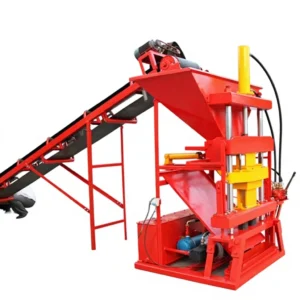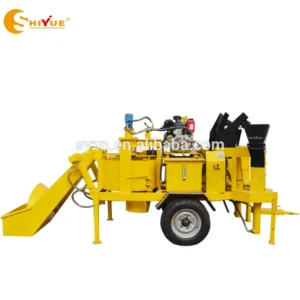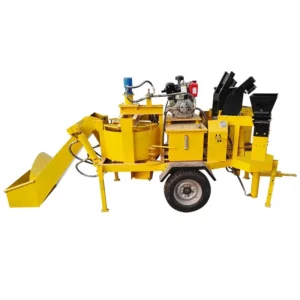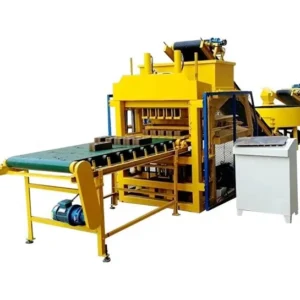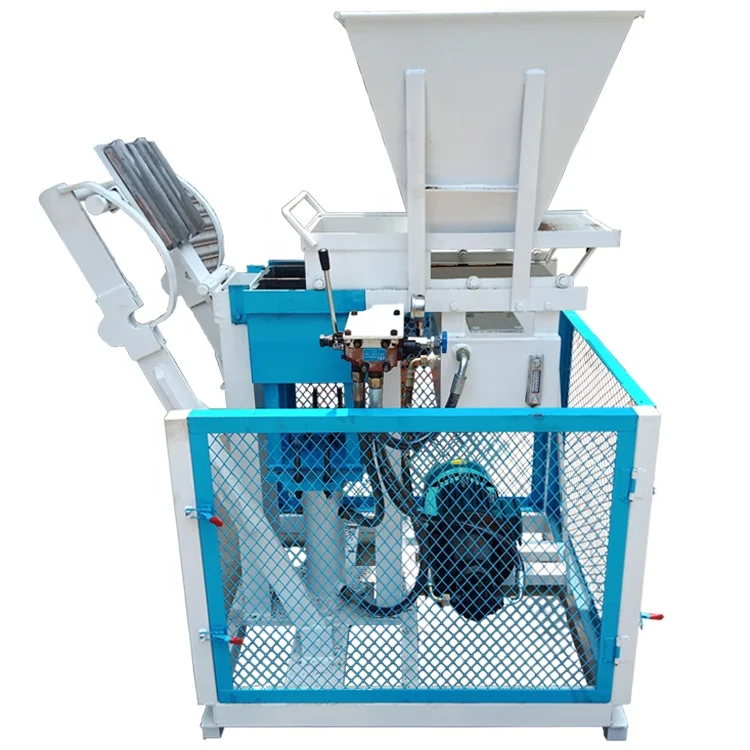
Matched System Engineering — the ECO BRB is specified alongside upstream mixing and downstream curing so the 15-20 s cycle never stalls waiting for material or space.
Technical Specifications
| Parameter | Value |
|---|---|
| Model | ECO BRB |
| Product Type | Compressed Earth Block Machine |
| Overall Dimensions (L×W×H) | 1490 × 980 × 1970 mm |
| Pressure Type | Hydraulic |
| Pallet Requirement | No pallets required |
| Molding Cycle | 15–20 s |
| Overall Power | 4.5 kW |
| Total Mass | 850 kg |
| Daily Capacity | about 3800 pcs/shift (basis not stated in source — confirm block format, material, thickness) |
| Raw Material | Cement or clay |
| Mould Format | Interlocking brick |
| Warranty | 1 year (excluding spare parts) |
Application Suitability
| Application | Material or Output |
|---|---|
| On-site interlocking block production for housing projects | Local clay mixed with stabilizer, pallet-free stacking |
| Small-plant clay brick manufacturing | Clay or cement-based mix, interlocking format |
| Paving brick and solid brick runs | Cement or clay mix with format-specific moulds |
| First block plant for entrepreneurs | Low-footprint line with minimal auxiliary equipment |
What the Quoted Daily Output Actually Means for Your Line
A capacity figure without a block format is a number without a context.
I once watched a contractor receive a full mixing-to-stacking line rated at a certain shift output. The problem was that the local clay had a moisture content well above what the standard recipe assumed, so the mixer discharge rhythm fell out of sync with the press cycle. Interlocking bricks were coming out with inconsistent density, and the line sat idle while parameters were adjusted. The 3800 pcs/shift figure for the ECO BRB compressed earth block machine production line must be validated against the specific interlocking brick dimensions, wall thickness, and clay-cement ratio you intend to run. Without that confirmation, upstream feeders may deliver too fast or too slow, and the press spends more time waiting than pressing. [NEED_CITE: clay moisture variability and its effect on compressed earth block cycle consistency]
Upstream Feeding and Mixing Synchronization
The ECO BRB completes a molding cycle every 15–20 seconds, which means the raw material batch must arrive at the hopper within that same window. For clay-based interlocking bricks, this requires a mixer that can handle high-moisture earth without clogging, paired with a feeder that meters material in portions matching one cycle. A compressed earth block machine production line that mismatches these intervals will see the press idling or the mixer overflowing. We size the mixer volume and feeder speed against the actual cycle time of the interlocking format you plan to produce, not against a generic average.
Pallet-Free Workflow and Curing Area Layout
Because this machine requires no pallets, the downstream handling changes fundamentally. Interlocking bricks exit the mould and are stacked directly, which removes pallet circulation, pallet washing, and curing rack loading from the line. However, this also means the curing area must be planned differently — flat floor space with adequate cover, organized so that freshly pressed bricks are not moved until initial set is achieved. The layout of a compressed earth block machine production line without pallets trades rack infrastructure for floor area, and that trade must be calculated before the equipment ships. [NEED_CITE: curing requirements for pallet-free interlocking earth blocks]
Reading the Core Parameters for Production Impact
Hydraulic pressure is the forming method here, and it directly governs how densely the clay or cement mix is compacted inside the mould. Higher pressure yields stronger blocks but demands a mix with the right moisture and particle gradation — too wet and the brick deforms on ejection, too dry and it crumbles. The 4.5 kW power rating indicates a compact drive system suited to a small workshop rather than a high-volume plant, meaning electrical supply requirements remain modest. The 1490 × 980 × 1970 mm footprint allows the press to fit into constrained spaces, but you still need clearance on the ejection side for brick removal and stacking. Mould format is currently listed as interlocking brick; if your market also demands paving or solid formats, the mould change procedure and its time cost must be understood before committing to a production schedule.
The Hidden Cost of Skipping the Line Integration Step
When buyers focus only on the press and treat feeding, mixing, and curing as afterthoughts, the result is a bottleneck that no amount of operator effort can fix. A mixer too small for the cycle rate forces the press to pause between strokes. A curing area too cramped for pallet-free stacking means bricks are handled before they gain enough strength, cracking the interlocking lips. These failures are not machine defects — they are line design failures. I have seen entire shipments blamed on the press when the real issue was a mixer discharge gate that could not keep pace. [NEED_CITE: common causes of compressed earth block line downtime related to auxiliary equipment mismatch]
Why Source This Line Here
Block machinery is our single focus, which means the ECO BRB is never treated as a standalone unit disconnected from its supporting stations. Every line proposal starts with your raw material — send us a sample of your local clay, and we run it through the mixer and press to confirm moisture tolerance before finalizing the configuration. Mould design covers the interlocking format your market actually sells, including custom profiles from your drawings. Automation level is selectable, so you can begin with manual brick handling and add semi-automatic feeding later. Installation includes operator training on the specific clay mix and cycle parameters your line was tested against. Wear parts and mould spares are listed and available when the first replacement cycle arrives, not after a production halt.
Documentation & Verification
- Line layout diagram showing each station sized to the 15–20 s interlocking brick cycle
- Machine specification sheet with hydraulic pressure and power confirmed against your local voltage
- Mould drawing and format list covering interlocking profile dimensions and tolerances
- Factory test record run on your submitted clay sample before dispatch
- Operation and maintenance manual covering press, feeder, and mixer as one system
Installation, Commissioning & Support
- Foundation pad sized to the 1490 × 980 mm base with leveling anchors for the 850 kg mass
- 4.5 kW power connection verified against local voltage and frequency before wiring
- Machine arrives assembled; mould and hopper fitted on-site during commissioning
- First production run supervised with cycle timing adjusted to your clay moisture level
- Operator training covers mould change procedure and hydraulic pressure adjustment
- Wear parts list provided with recommended reorder intervals for the first year
What to Share When You Request a Proposal
To build an accurate line layout around the ECO BRB, we need to know the specific interlocking brick profile you intend to produce, the source and moisture range of your local clay, and the daily output target in finished bricks. Please also confirm your workshop floor dimensions, available voltage and frequency, and whether you have existing mixing or handling equipment that the line must integrate with. If you can ship a raw material sample, we will test it before finalizing any station specifications.
Frequently Asked Questions
Q: How is the 3800 pcs/shift figure calculated and which block format does it assume?
A: That figure appears in source documentation without a stated block format, material mix, or brick thickness. Before we quote a line, we calculate capacity based on your specific interlocking brick dimensions and the confirmed cycle time achieved during material testing. The actual output may differ depending on wall thickness and stabilizer ratio.
Q: What mixing equipment is needed so the press is not left waiting between cycles?
A: The ECO BRB cycles every 15–20 seconds, so the mixer must discharge a batch within that window. We specify mixer volume and feeder type based on your clay moisture and batch recipe, ensuring continuous material flow to the hopper without surges or gaps that interrupt pressing.
Q: How does pallet-free operation change the curing area layout?
A: Without pallets, bricks are stacked directly on the floor, so you need flat, covered curing space rather than rack systems. We calculate the required floor area based on your daily output and the curing duration your clay mix needs before blocks can be moved or shipped.
Q: What electrical details must be confirmed before the line ships?
A: Voltage, frequency, and control language must match your site supply and operator requirements. The ECO BRB runs on 4.5 kW, but the exact voltage and phase configuration vary by market. We confirm these details during the proposal stage so no rewiring is needed on arrival.
Q: Which spare parts should be ordered with the initial line?
A: We provide a wear parts list covering hydraulic seals, mould wear surfaces, and mixer components most likely to need replacement in the first year. Ordering these with the line avoids production stops while waiting for international shipments of small but critical items.