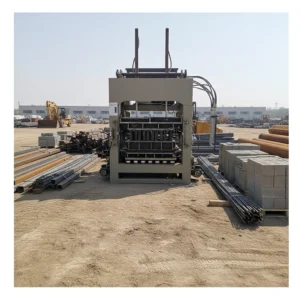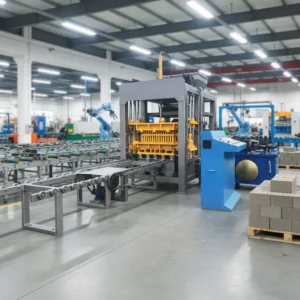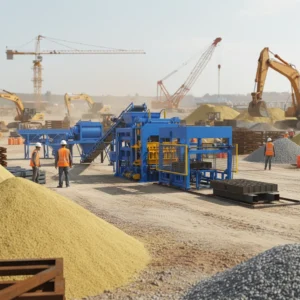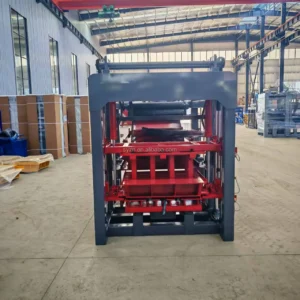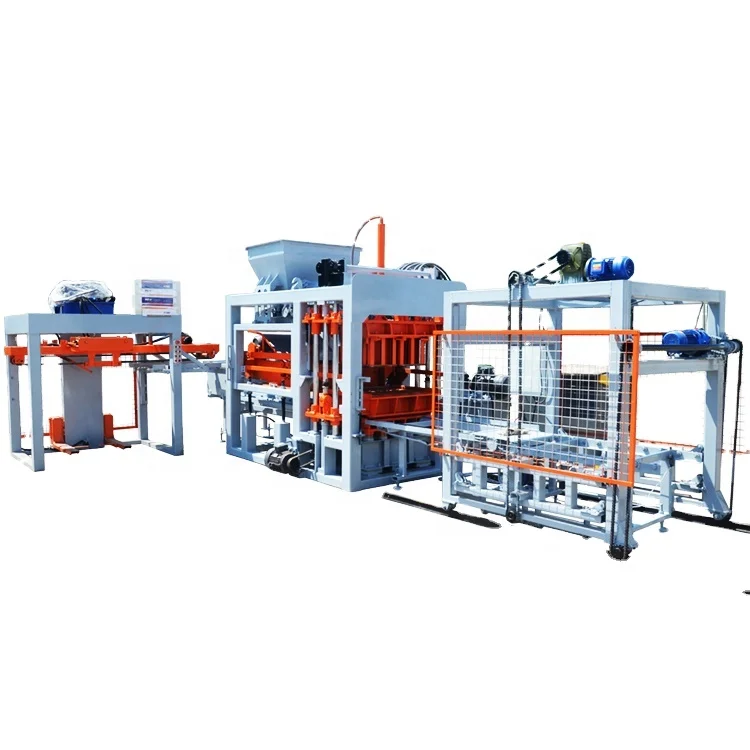
Integrated Line Configuration — every station around the QT6-15 block making machine production line is specified as one matched system so the press is never left waiting for upstream feeding or downstream pallet handling.
Technical Specifications
| Parameter | Value |
|---|---|
| Model | QT6-15 |
| Product Type | Interlocking Block Making Machine |
| Overall Dimensions | 8200×1700×2950 mm |
| Total Mass | 7 T |
| Overall Power | 37 kW |
| Vibration Form | Platform Vibration |
| Vibration Frequency | 0-60 Hz |
| Vibration Force | 45 kN |
| Pallet Size | 880×850 mm |
| Molding Cycle | 15-20 s |
| Moulding Mode | Load automatically, vibration moulding |
| Demolding Method | Hydraulic |
| Hydraulic System | Independent integrated type hydraulic station |
| Control System | PLC (Programmable Controller) with touch screen |
| Fault Diagnosis | Built-in fault diagnosis with safe logic circuit interlock |
| Factory Area | 1200 m² |
| Output (Hollow block 400×200×200 mm) | 1080-1440 pcs/hour, 8640-11520 pcs/8hr |
| Output (Hollow block 400×150×200 mm) | 1440-1920 pcs/hour, 11520-15360 pcs/8hr |
| Output (Solid brick 240×115×53 mm) | 5760-7680 pcs/hour, 46080-61440 pcs/8hr |
| Output (Rectangular brick 200×100×60 mm) | 2160-2880 pcs/hour at 20-25s cycle, 17280-23040 pcs/8hr |
| Output (Zigzag brick 225×112.5×60 mm) | 2160-2880 pcs/hour at 20-25s cycle, 17280-23040 pcs/8hr |
| Block Compressive Strength | More than 15 MPa |
| Raw Material Adaptability | Waste ash, slag, and various aggregates; adjustable cement dosage |
| Standards | CE |
Application Suitability
| Application | Material or Output |
|---|---|
| Hollow block production | Crushed stone, cement, and local aggregates in 400×200×200 mm and 400×150×200 mm formats |
| Solid brick production | Cement, sand, and waste ash for 240×115×53 mm bricks |
| Rectangular paving brick production | Aggregates and cement for 200×100×60 mm interlocking pavers |
| Zigzag interlocking brick production | Local aggregates and slag for 225×112.5×60 mm interlocking bricks |
| Waste material utilization | Fly ash, slag, and construction waste blended with adjustable cement dosage |
Why the Pallet Handling Station Decides Your Real Daily Output
A block making machine production line that quotes press capacity without specifying pallet circulation, stacking, and curing rack handling is quoting a number you will never reach on the floor.
The press can cycle every 15-20 seconds, but if the downstream stacker cannot keep pace or the pallet return loop is undersized, wet blocks sit on pallets waiting for a forklift. The press then idles. I have seen turnkey block plant equipment installations where the owner paid for a high-tier press but ended up stacking by hand because the quotation stopped at the machine frame. [NEED_CITE: common causes of output shortfall in concrete block plants]
How Stations Connect Around the QT6-15 Press
The raw material feeding system, mixer, and press must share a common cycle logic so material arrives at the hopper exactly when the mould is ready. The QT6-15 block making machine production line uses a PLC touch screen interface with built-in fault diagnosis to coordinate these stations. When one station signals a delay, the logic interlock holds the upstream feed rather than flooding the mixer.
Downstream, the 880×850 mm pallet exits the press carrying freshly moulded blocks. The pallet feeder and stacking system must accept that pallet within the same 15-20 second window. If the stacker cycle is slower, pallets queue on the floor, and the 1200 m² factory area fills with uncured product blocking forklift routes.
Matching Pallet Size to Your Curing Area and Forklift
The 880×850 mm pallet dimension is not arbitrary. It determines how many pallets fit on a standard curing rack, how many racks fit in your curing zone, and whether your existing forklift can carry a loaded rack in one trip. When I plan a turnkey block plant equipment layout, I start from the curing area footprint and work backwards to confirm pallet size, rack spacing, and forklift capacity all align. [NEED_CITE: pallet handling and curing rack design for concrete block plants]
If your curing area uses a different rack spacing or your forklift has a lower load rating, the pallet specification must change before the press order is placed, not after arrival.
Reading the Specs That Actually Affect Line Balance
The 45 kN vibration force combined with the independent hydraulic station determines block density and compressive strength above 15 MPa. The hydraulic station sits apart from the main frame, isolated from platform vibration and dust. This separation keeps pressure stable across consecutive cycles, which matters when the press runs eight-hour shifts producing interlocking zigzag bricks at 20-25 second cycles.
The 37 kW overall power draw covers the press, vibration motor, and hydraulic pump but not the mixer, conveyor, or stacker. When sizing the electrical supply for the full block making machine production line, those upstream and downstream motors must be added separately. The PLC fault diagnosis system monitors the press station; line-wide monitoring requires additional sensors on the mixer and pallet return loop.
Platform vibration at 0-60 Hz is adjustable. Lower frequencies suit larger hollow blocks where the mix needs time to settle into deep mould cavities, while higher frequencies compact finer aggregates for solid bricks. Matching frequency to the block format and local aggregate is part of line configuration, not a setting the operator guesses on day one.
What Happens When the Line Is Not Balanced
If the pallet return conveyor is too slow, pallets run out at the press infeed and the machine stops. The rated output of 8640-11520 hollow blocks per eight-hour shift assumes continuous pallet supply. When pallets queue on the floor instead of cycling back, real output drops and the shift ends with wet blocks scattered across the factory rather than racked for curing. [NEED_CITE: pallet shortage and line stoppage in block production]
Voltage and frequency mismatches cause a different problem. The PLC, hydraulic pump, and vibration motor all require confirmed voltage before production starts. If the control language on the touch screen does not match the operator’s language, commissioning stretches from days into weeks. These are line-level issues, not press-level issues, and they surface only when every station is specified together.
Why Buyers Source the Full Line from One Supplier
The machine, mould, pallet, and handling equipment are specified as one matched system rather than assembled from separate vendors, so cycle times connect station to station without gaps.
Configuration is set against the buyer’s actual mix design, local aggregate, and target block format, not pulled from a catalogue default, which keeps the 45 kN vibration force aligned with the material you can actually source.
Mould design covers the formats the local market sells, including custom drawings, so the 15-20 second cycle applies to the block you plan to produce, not only to the standard test format.
Automation level is selectable, allowing a buyer to start with semi-automatic pallet handling and add the stacker and cubing system later without replacing the press.
Installation support includes operator training on the PLC touch screen and fault diagnosis system, so the crew understands the logic interlocks before the first production run.
Documentation & Verification
- Line layout and capacity calculation stating the block format assumed for each output tier
- Machine specification sheet covering the 8200×1700×2950 mm press and all connected stations
- Mould drawing and format list for hollow, solid, paving, and interlocking brick types
- Pallet specification matched to the 880×850 mm size and your curing rack system
- Hydraulic and electrical schematics for the independent integrated station and PLC wiring
- Factory test record on your target block format before dispatch
- Voltage, frequency, and PLC display language confirmation signed before production
Installation, Commissioning & Support
- Foundation must accommodate the 8200×1700 mm footprint plus pallet return conveyor length within the 1200 m² factory area
- Electrical supply must deliver 37 kW to the press plus additional load for mixer, feeder, and stacker motors
- Independent hydraulic station arrives pre-filled; lines are flushed and pressure-set to match your block density target during commissioning
- PLC touch screen language and fault diagnosis parameters are loaded before shipment to shorten on-site setup
- Operator training covers mould change procedure, vibration frequency adjustment across the 0-60 Hz range, and safe logic interlock response
- Wear parts list and mould maintenance schedule provided for the specific formats in your production plan
Planning Your Line Starts with Three Questions
To size the complete block making machine production line around the QT6-15, tell us the exact block formats your market buys and the daily volume you need for each format. Share your local aggregate type and the cement dosage you plan to run, so we can match vibration force and frequency to your mix. Finally, provide your site voltage, frequency, and preferred PLC display language so the electrical and control systems arrive ready to run.
Frequently Asked Questions
Q: How do I verify the QT6-15 output capacity against my target block format and cycle time?
A: Each output figure in the specification assumes a specific block dimension and molding cycle. For example, 1080-1440 hollow blocks per hour assumes the 400×200×200 mm format at a 15-20 second cycle. Share your target format and we provide a capacity calculation based on that exact size, including the mold cavity count and realistic cycle time for your mix design.
Q: Which supporting equipment is included so the line runs without bottlenecks?
A: The quotation can include raw material feeding, mixing, pallet feeding, automatic stacking, curing rack handling, and cubing. Each station is matched to the QT6-15 press cycle so material arrives and pallets circulate without the press idling. We confirm which stations you already have and specify only the gaps.
Q: How are pallet size and material matched to my curing area and existing forklift?
A: The standard 880×850 mm pallet is checked against your curing rack spacing and forklift load rating before the order is placed. If your racks use different dimensions or your forklift has a lower capacity, we adjust the pallet specification and pallet feeder tooling so the full curing loop works from day one.
Q: What raw material feed configuration keeps the press supplied without interruption?
A: We calculate the mixer batch size and conveyor speed based on your daily output target and block format. The feeding system is sized so a fresh batch reaches the press hopper before the current batch empties, preventing press idle time. Your local aggregate type and cement ratio determine the hopper and feeder configuration.
Q: How do I confirm voltage, frequency, and PLC language before shipment to avoid delays on arrival?
A: We request your site voltage, frequency, and preferred PLC display language during the proposal stage and write them into the production order. The electrical panel and touch screen are configured and tested at the factory before dispatch, so commissioning starts with power-on rather than rewiring.