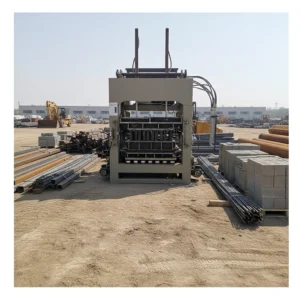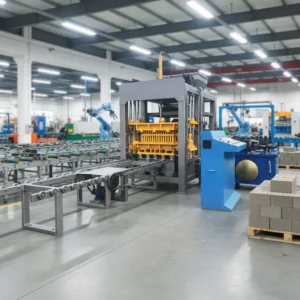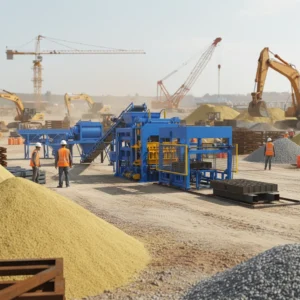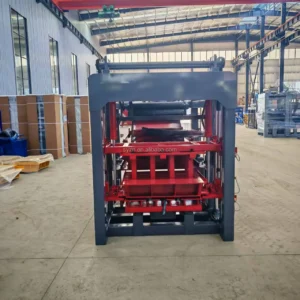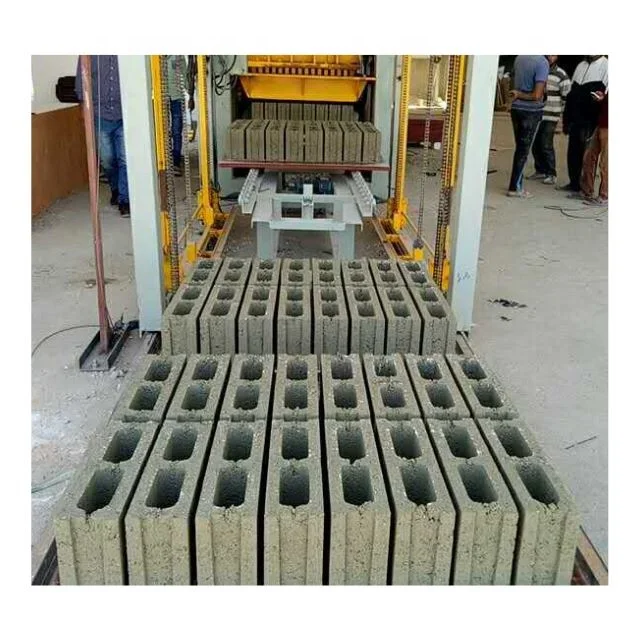
Matched System Sizing — every supporting station around the QT5-15 is selected against your actual mix, pallet inventory and curing yard, so the press never waits on upstream feeding or downstream handling.
Technical Specifications
| Parameter | Value |
|---|---|
| Model | QT5-15 |
| Product Type | Fully Automatic Hydraulic Block Making Machine |
| Overall Dimensions | 7400 × 1950 × 2800 mm |
| Total Mass | 5000 kg |
| Overall Power | 32 kW |
| Vibration Force | 80 kN |
| Vibration Frequency | 0–60 Hz |
| Vibration Form | Platform Vibration |
| Moulding Mode | Automatic loading with vibration moulding |
| Demolding Method | Hydraulic |
| Hydraulic System | Independent integrated hydraulic station |
| Pallet Size | 1100 × 550 mm |
| Molding Cycle | 15–20 s (basis not stated in source — confirm block format) |
| Control System | PLC with touch screen interface |
| Voltage & Frequency | Configurable (confirm before order) |
| Block Compressive Strength | ≥ 15 MPa |
| Automation Level | Fully automatic (pallet feeding, material feeding, vibrating, demoulding) |
| Mould Change System | Quick mould replacement for multi-format production |
| Recommended Factory Area | 1000 m² |
| Warranty | 1 year (excluding spare parts) |
| Standards | CE declaration referenced |
Application Suitability
| Application | Material or Output |
|---|---|
| Hollow block production for commercial building | Crushed stone, sand and cement; 400×200×200 mm or 400×150×200 mm formats |
| Solid brick manufacturing for load-bearing walls | Sand, fly ash (up to 70%) and cement; 240×115×53 mm format |
| Paving brick for municipal and residential projects | Crushed stone aggregate; 200×100×60 mm rectangular or 225×112.5×60 mm zigzag format |
| Fly ash brick production using industrial residue | Fly ash, slag, gangue with cement binder |
| On-site block plant for housing developments | Local aggregate and cement with mobile raw material feed |
Why the Line Layout Matters More Than the Press Alone
A block production line equipment package that quotes only the press cycle leaves you discovering the real bottleneck on commissioning day. The press is only as fast as the slowest station feeding or clearing it.
I have watched fully automatic lines stall because the mixer discharge could not keep pace with the moulding cycle, or because manual pallet return created a gap every third cycle. The QT5-15 moulds at 15–20 seconds per cycle, which means raw material feeding, mixing, pallet return and stacking must each complete within that window — not averaged over a shift, but on every single stroke. When we lay out a turnkey block making line, the cycle budget for each station is calculated against the target block format, not the fastest format in the catalogue [NEED_CITE: line cycle matching principles for concrete block production].
How Upstream Feeding Meets the Press Cycle
Raw material proportioning and mixing sit upstream of the QT5-15, and any inconsistency in aggregate moisture or cement dosing shows up immediately as density variation in the finished block. The independent integrated hydraulic station is mounted away from the main frame to keep vibration and dust out of the valve block, which matters when the line runs three shifts with fly ash in the mix. Batching accuracy and feed timing are set during factory commissioning so that each mould charge arrives at the correct slump and volume.
Downstream Handling That Keeps the Press Running
Once the QT5-15 completes a vibration and demoulding cycle, the wet block on its pallet must move to the curing rack before the next pallet enters. If stacking or rack handling is slower than the press, the machine idles. The pallet size of 1100 × 550 mm is confirmed against your curing area dimensions and forklift capacity before production begins — a mismatch here means pallets pile up on the factory floor [NEED_CITE: pallet logistics in block curing yards]. Automatic stacking and cubing can be added or left for later, but the space and conveyor interface are planned from the start so an upgrade does not require a line rebuild.
Reading the Numbers That Actually Matter
The vibration force of 80 kN combined with hydraulic pressure determines how densely the mix is compacted into the mould, and that density directly sets compressive strength at ≥ 15 MPa. Platform vibration at 0–60 Hz is adjustable across the range, which lets the operator tune frequency to match a specific aggregate gradation — coarser crushed stone needs higher amplitude while fine fly ash mixes respond to higher frequency. The 32 kW total power covers the press, hydraulic pump and vibration motors; the mixer, conveyor and stacker draw additional power that must be accounted for in your transformer sizing. Quick mould replacement allows format changes within a shift, but the actual changeover time depends on mould weight and whether a handling crane is positioned at the press.
The Cost of Skipping the Line Audit
Buyers who select the press first and add supporting equipment later often discover that the mixer volume is too small to fill two consecutive mould charges, or that the pallet return conveyor runs at a fixed speed that does not match a 20-second cycle for pavers. The result is a line that achieves its nameplate capacity for hollow blocks but drops noticeably when switching to denser formats. Correcting these mismatches after installation means replacing conveyors, rewiring control panels and losing production weeks during the retrofit [NEED_CITE: block plant retrofit downtime case studies].
Why Buyers Source the Full Line Here
Block machinery as a single focus means the QT5-15 is never quoted without its pallet, mixer, feeder and stacker being sized in the same document. Configuration is set against your local aggregate sieve analysis and target block format, not a catalogue default. Mould design covers the formats your market actually buys, including custom drawings when standard formats do not fit. Automation level is selectable, so you can commission semi-automatic and add stacking later without replacing the PLC. Installation includes on-site commissioning with operator training covering mould change, fault diagnosis on the touch screen and daily maintenance routines.
Documentation & Verification
- Line layout and capacity calculation stating which block format each output figure assumes
- Pallet specification confirmed against your curing area and forklift before production
- Voltage, frequency and PLC display language confirmed in writing before dispatch
- Factory test record showing the QT5-15 running with your target mould installed
- Hydraulic and electrical schematic for your site electrician before arrival
- Wear parts and mould list with part numbers for reordering
Installation, Commissioning & Support
- Foundation plan sized to the 7400 × 1950 mm footprint and 5000 kg mass with vibration isolation
- Dedicated power circuit for 32 kW press load plus mixer and conveyor draw confirmed before wiring
- Factory assembled and container loaded; dismantling sequence documented for site reassembly
- First run with your target mould and local aggregate to set vibration frequency and cycle timing
- PLC touch screen training covering fault codes, mould change sequence and parameter adjustment
- Hydraulic station filter and seal replacement schedule aligned to your shift pattern
What We Need to Size Your Line
To configure the supporting equipment around the QT5-15, share your target block formats with daily output targets, the local aggregate type and moisture range, and the dimensions of your available curing yard. Confirm the site voltage and frequency, the PLC display language your operators need, and whether you plan to stack manually at first or require automatic cubing from day one.
Frequently Asked Questions
Q: How do I verify the daily output figure for my block format?
A: Every output figure we quote names the block format, mould cavity count and cycle time it assumes. For the QT5-15, a 400×200×200 mm hollow block at a 15–20 second cycle yields 900–1200 pieces per hour. If your target format differs, we recalculate and show the new cycle and shift output before you commit.
Q: Which supporting stations are included in the quotation?
A: The quotation lists each station — raw material feeder, mixer, pallet feeder, press, stacker and curing rack handler — with its own cycle time. Nothing is assumed or left for the buyer to source separately unless you specifically request a press-only scope.
Q: How do upstream and downstream cycle times stay matched to the press?
A: During line design we build a cycle budget showing the maximum allowable time for each station based on the slowest block format you plan to run. Conveyor speeds, mixer discharge volume and stacker index time are all set to stay within that budget so the QT5-15 never idles waiting for material or pallet clearance.
Q: Can the pallet size and automation level fit my existing curing yard?
A: The standard 1100 × 550 mm pallet is a starting point. We confirm your curing rack spacing and forklift tine width before production, and adjust pallet dimensions if needed. Automation level is selectable from manual pallet return through to full automatic stacking, with upgrade paths that do not require PLC replacement.
Q: What voltage, frequency and PLC language are confirmed before shipment?
A: We confirm your site voltage, frequency and the PLC display language in writing during the order stage. The QT5-15 electrical panel is then wired and labelled accordingly, and the factory test is run at that voltage so there are no commissioning surprises when the container arrives.