Single Focus — block machinery as our only product line, so every mixer, pallet system, and curing station is selected to match the manual press cycle rather than sourced from separate catalogs.
Technical Specifications
| Parameter | Value |
|---|---|
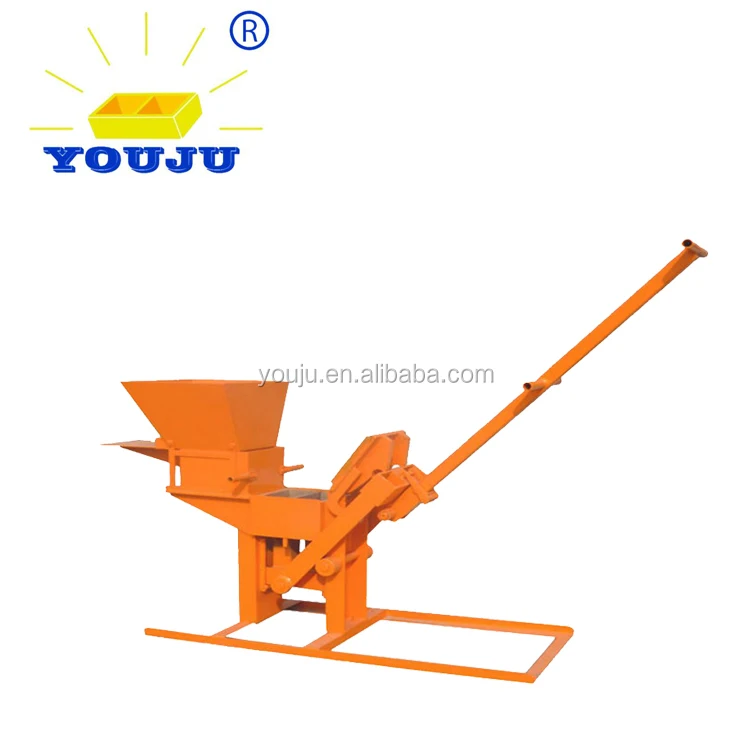
| Product Type | Manual Clay Interlocking Brick Making Machine |
| Model | LY2-40 |
| Rated Power | No Power, Completely Manual Operation |
| Control System | Manual Operation |
| Overall Dimensions | 1600 x 700 x 1200 mm |
| Net Weight | 200-240 kgs |
| Output Capacity | 400-1000 pcs/day (basis not stated in source — confirm block format / material / thickness) |
| Molding Cycle | 30-40s |
| Assembly State | Mobile devices using steel wheels |
| Compatible Mixers | JFA-1 Mixer or JQ350 Mixer |
| Warranty | 1 Year |
Application Suitability
| Application | Material or Output |
|---|---|
| Interlocking clay brick production in areas without electrical power supply | Local soil mixed with cement |
| Small-scale brick manufacturing for rural construction | Earth-based mixes requiring manual compaction |
| On-site brick production for remote housing projects | Soil-cement blends prepared by JFA-1 or JQ350 mixer |
When the Press Cycles but the Line Stalls
A manual interlocking clay brick making machine production line only runs as fast as its slowest station upstream and downstream of the press.
I have seen buyers invest in a press that completes a cycle in 30-40 seconds, only to discover the mixer delivers batch output too slowly to keep the operator fed, or the curing racks are too few so fresh bricks pile up on the floor [NEED_CITE: block production line bottlenecks at mixing and curing stations]. The daily capacity of 400-1000 pieces is entirely dependent on which interlocking format is being produced, the local soil-cement ratio, and how many workers are assigned to material preparation and pallet handling. A line that looks productive on paper often loses hours to workflow gaps that were never calculated before shipment.
Sizing the Mixer to the Press Cycle
The LY2-40 completes one interlocking brick every 30-40 seconds, which means the operator needs a steady supply of mixed material throughout the working day. The JFA-1 mixer serves low-volume setups where a single worker feeds the press, while the JQ350 mixer supports higher daily volumes where two or more operators rotate between mixing and pressing. Selecting between these two options depends on the target output format, the local soil type, and how much cement the buyer’s mix design calls for. A manual interlocking clay brick making machine production line fails when the mixer batch size is either too small to sustain continuous pressing or too large to handle before the mix begins to set.
Coordinating Curing Space with Daily Output
Every brick that leaves the press needs a flat surface to rest on during the initial curing period, and that surface must stay occupied for days. If the production target assumes 1000 pieces per day but the curing area only holds 600, the press must stop regardless of how fast the operator can cycle it [NEED_CITE: curing rack capacity planning for block production]. The mobile steel wheel assembly on the LY2-40 allows the press to be repositioned within the production area so that freshly pressed bricks move directly to adjacent curing zones, reducing the distance workers carry each piece and the chance of damage during transfer.
Reading the Specs That Matter
The 30-40 second molding cycle is the heartbeat of the entire line. This cycle time, combined with the number of working hours and the format being produced, determines what daily output is realistic. The net weight of 200-240 kgs makes the unit stable during manual compaction but still movable when the production layout needs adjustment. Zero electrical power requirement means the line can operate anywhere, but it also means every station depends on human labor, so the buyer must plan shift rotations, material staging, and rest periods into the daily schedule. The overall dimensions of 1600 x 700 x 1200 mm define the minimum workspace footprint around the press for one operator to load material, pull the lever, and extract the finished brick without obstruction.
The Cost of Skipping Line-Level Planning
Buyers who purchase the press without specifying the downstream workflow often discover that pallet handling, stacking, and curing were never included in the scope. Workers end up stacking output by hand on whatever flat surface is available, bricks crack during the first curing day, and the actual daily yield falls far below the quoted range [NEED_CITE: manual block production losses from inadequate curing setup]. The manual interlocking clay brick making machine production line only delivers its full capacity when every station — from mixer discharge to final stacking — has been matched to the press cycle in advance.
Why Source the Full Line from One Supplier
Block machinery is our single focus, so the LY2-40 press, the compatible mixer, the pallet specification, and the curing rack layout are all discussed as one system before any quotation is issued. We configure the line against the buyer’s actual local soil type, cement availability, and target brick format rather than a catalog default. Mould options are reviewed for the interlocking profiles the buyer’s market actually sells. The automation level is selectable, so a buyer starting with fully manual operation can plan an upgrade path as production grows. Installation support includes workflow planning so that each station connects without leaving the press idle.
Documentation & Verification
- Machine specification sheet confirming LY2-40 dimensions, weight, and manual lever system details
- Line layout and capacity calculation stating the interlocking brick format assumed for daily output
- Mixer specification sheet matched to the buyer’s local soil-cement mix characteristics
- Operation and maintenance manual covering mould change procedures and daily lubrication points
- Factory test record on the buyer’s selected interlocking format before dispatch
Installation, Commissioning & Support
- Flat concrete or compacted earth surface required for stable LY2-40 operation across the 1600 x 700 mm base footprint
- No electrical connection needed for the press; mixer power supply must match local voltage and frequency
- Steel wheel assembly allows on-site repositioning during initial layout and commissioning
- First-day production run supervised to confirm mixer batch timing aligns with the 30-40s press cycle
- Operator training covers soil-cement mixing ratios, mould loading technique, and lever operation rhythm
- Wear parts list provided with recommended reorder intervals based on local aggregate abrasiveness
What to Include in Your Inquiry
To size a complete manual interlocking clay brick making machine production line accurately, we need the interlocking brick format you intend to produce, your local soil type and available cement grade, and the dimensions of your production and curing area. Share your target daily volume and the number of workers you plan to assign to the line. If you already own a mixer or have existing pallets, provide their specifications so the line can be built around them.
Frequently Asked Questions
Q: How should I interpret the 400-1000 pcs/day capacity figure for the LY2-40?
A: That range depends entirely on which interlocking brick format you produce, the soil-cement ratio in your mix, and how your line is staffed. We calculate realistic daily output per format once you share your target brick profile and local material conditions, so the number in your quotation reflects your actual production scenario rather than a catalog generalization.
Q: How do I coordinate the mixer batch cycle with the 30-40 second press cycle?
A: Each mixer batch must deliver enough mixed material to sustain continuous pressing until the next batch is ready. We match the JFA-1 or JQ350 mixer to your daily target and local mix characteristics so that batch size and mixing duration align with the press rhythm, preventing the operator from waiting idle between batches.
Q: What downstream equipment must I plan for beyond the press and mixer?
A: You will need pallets or flat curing surfaces, a covered curing area with enough capacity for multiple days of output, and staging space for finished bricks. We specify these requirements in the line layout based on your target daily volume so that nothing is left to source after the press arrives.
Q: Can I change the interlocking brick format on the LY2-40, and how long does it take?
A: The press accepts different mould inserts for various interlocking profiles. Mould changeover is manual and typically completed within a short production pause. We recommend confirming your primary and secondary format needs during inquiry so that the correct moulds ship with the machine and you avoid downtime waiting for replacements.